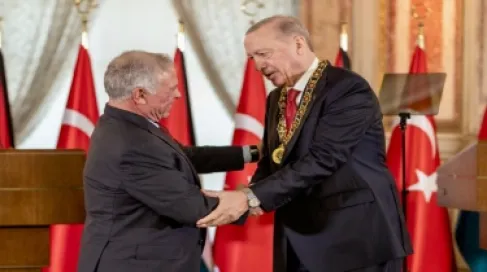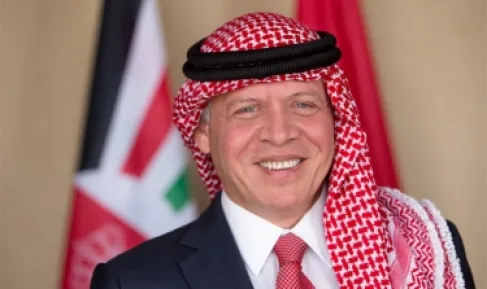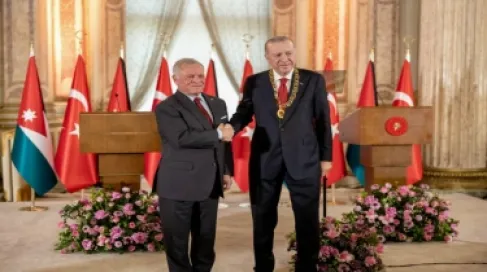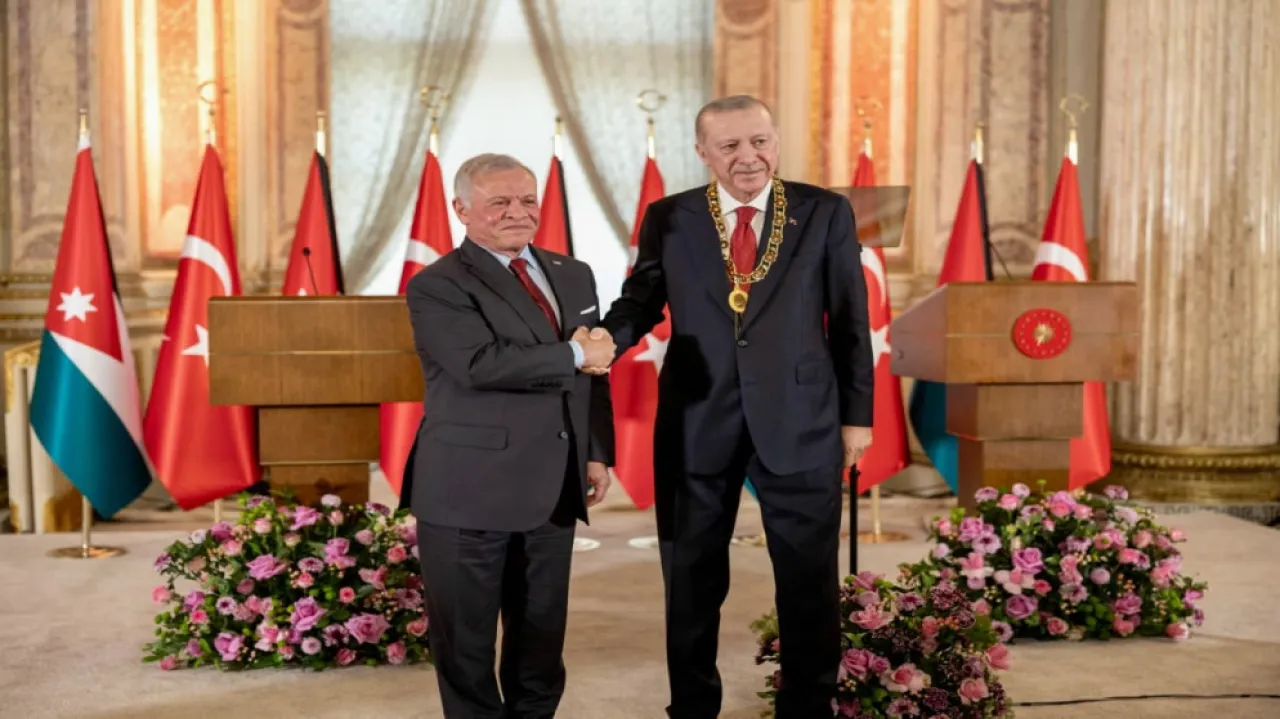
Khaberni - Jordan and Turkey issued a joint statement at the conclusion of the talks between the King and Erdogan.
The leaders affirmed their commitment to continue enhancing bilateral relations.
The statement: Emphasizing the importance of enhancing economic, commercial, and investment cooperation and continuing to explore ways for private sector cooperation between the two countries.
The leaders expressed their deep concern about the humanitarian disaster in Gaza and emphasized the need to deliver aid.
The statement: Israeli annexation policies, displacement, and settler violence undermine any hope of achieving peace and joint prosperity.
The leaders emphasized the necessity of preserving the territorial integrity, sovereignty, and national unity of all states for peace and stability in the region.
Jordan and Turkey expressed their categorical rejection of any attempts to change the legal and historical status in Jerusalem and its holy sites.
The leaders expressed their determination to continue working on transportation cooperation between Turkey, Jordan, and Syria.
The statement: The King extended an invitation to the Turkish president to visit Jordan.
The Hashemite Kingdom of Jordan and the Republic of Turkey, on Saturday, issued a joint statement at the conclusion of the talks between His Majesty King Abdullah II and President Recep Tayyip Erdogan held in Istanbul, as follows:
"His Majesty King Abdullah II ibn Al Hussein, King of the Hashemite Kingdom of Jordan, visited the Republic of Turkey on February 7, 2026, and was received by His Excellency President Recep Tayyip Erdogan in Istanbul. This visit provided an opportunity for the leaders to exchange views on bilateral relations and regional issues.
The meeting, held out of a desire to enhance cooperation, reflected the depth of historical ties and the exceptional relations and mutual understanding between the two countries, as well as their common goal of enhancing partnership in various fields. The leaders reaffirmed their commitment to continue enhancing bilateral relations at all levels, which will culminate in 2027, marking eighty years since the establishment of diplomatic relations between Jordan and Turkey.
Both sides emphasized the importance of enhancing economic, commercial, and investment cooperation and called on the private sectors in both countries to continue exploring new ways of cooperation, expanding partnerships, and increasing the exchange of expertise and visits.
The leaders welcomed the results of the first meeting of the Joint Economic Committee, which took place in Amman on October 27-28, 2025, and stressed the importance of effectively implementing the committee's decisions.
The leaders reviewed the current frameworks of cooperation and expressed their determination to ensure effective use of existing agreements, including arrangements related to trade and investment, and to promote economic and industrial cooperation.
The leaders reaffirmed the importance of continuing coordination and cooperation in the fields of defense industries and security, noting the mutual interest of both countries in maintaining regional security and stability.
The meeting discussed regional developments, with a particular focus on the situation in Palestine. The leaders expressed their deep concern about the humanitarian disaster in Gaza, and emphasized the urgent need to deliver humanitarian aid unimpeded, and to initiate early recovery and reconstruction efforts in Gaza.
The leaders emphasized the need for a just and lasting peace based on the two-state solution, which would lead to the establishment of an independent, sovereign Palestinian state, geographically contiguous on the June 4, 1967 lines, with East Jerusalem as its capital. They also focused on the urgent need to restore calm in the West Bank, where Israeli annexation policies, the displacement of thousands of Palestinians, and settler violence undermine any hope of achieving peace and joint prosperity.
The leaders expressed their support for peace efforts made by U.S. President Donald Trump and United Nations Security Council Resolution 2803 (2025), affirming that these efforts should end the war and provide a tangible political path leading to the implementation of the two-state solution in accordance with relevant United Nations resolutions.
The leaders strongly rejected the occupation, military aggression, and annexation, reaffirming the necessity of preserving the territorial integrity, sovereignty, and national unity of all states for peace and stability in the region. In this respect, the leaders expressed their support for the establishment of collective mechanisms in accordance with international law to ensure security and prosperity in the region.
The leaders furthermore expressed their categorical rejection of any attempts to change the legal and historical status in Jerusalem and its holy sites, and reasserted their rejection of all violations of the sanctity of the Haram al-Sharif.
The Republic of Turkey confirmed its full respect for the Hashemite guardianship of the Islamic and Christian holy sites in Jerusalem, and the special role played by Jordan in their care.
The leaders highlighted the importance of the United Nations Relief and Works Agency for Palestine Refugees (UNRWA), affirming its indispensability in providing essential services to the Palestinian people, and expressed their deep concern about the systematic Israeli measures against UNRWA, stressing that these measures exacerbate the already dire humanitarian situation. The leaders called on all partners to continue supporting UNRWA.
The leaders reaffirmed their steadfast commitment to the sovereignty, territorial integrity, and unity of Syria, and looked forward to a successful outcome of a comprehensive political process. In this context, the leaders called for the full implementation of the agreements announced on January 18 and 30, 2026, and emphasized the importance of combating terrorism in all its forms and manifestations to ensure stability in the country. The leaders expressed their determination to continue working on transportation cooperation between Turkey, Jordan, and Syria. They also emphasized the importance of maintaining calm in southern Syria, calling for an end to Israeli violations and full compliance with the 1974 Disengagement Agreement, and reaffirmed the importance of implementing the Sweida Roadmap announced in September 2025.
At the conclusion of the visit, His Majesty King Abdullah II ibn Al Hussein expressed his appreciation to His Excellency President Recep Tayyip Erdogan and to the government and people of the Republic of Turkey for their warm hospitality extended to him and the accompanying delegation.
His Majesty King Abdullah II ibn Al Hussein also extended an invitation to His Excellency President Recep Tayyip Erdogan to visit Jordan.