Khaberni - Amid ambiguity and secrecy, the investigations conducted by the Office of the Attorney General into the murder of Saif al-Islam Gaddafi progress, on the evening of last Tuesday. In a statement, the head of the Presidential Council, Mohammad Menfi, on Tuesday called "all political forces to await the official investigation results", emphasizing the Attorney General's announcement about commencing the investigation into the incident. Menfi reminded, in the first statement issued by a Libyan entity, that the investigations being conducted by the Attorney General aim to "uncover the circumstances and reasons behind the incident" and confirmed that the Presidential Council would follow them "meticulously to ensure that no one escapes punishment and we understand the sources of concern", welcoming "the use of necessary technical support and expertise within legal frameworks to enhance the transparency of investigations and expedite their outcomes, thereby bolstering public trust". Menfi offered condolences to the family of Saif al-Islam and his tribe and called at the same time "political, media, and social forces to control public discourse and reject investigation, to foil the assassination's objective", considering it as "aimed at undermining national reconciliation efforts and the conduct of free and fair elections in which the people choose their leadership". Conversely, as of yesterday afternoon, Wednesday, no statements were issued by the leadership of Khalifa Haftar, or the Gaddafi family and tribe, while the Attorney General's office issued a statement confirming the killing of Saif al-Islam Gaddafi from gunshot wounds that led to his death, noting that "investigations are still ongoing".
Mystery surrounds the assassination of Saif al-Islam Gaddafi
The municipal council of Zintan, where Saif al-Islam Gaddafi lived and was killed, and the city's hospital, where his body lies, refrained from making any statements to "Al-Arabi Al-Jadid", under the pretext of an investigative authorities' warning against making any statements. After the political advisor of Saif al-Islam Gaddafi, Abdullah Othman, confirmed to "Al-Arabi Al-Jadid" the assassination news on Tuesday evening, he explained that the killing of Saif al-Islam Gaddafi resulted from a "premeditated assassination operation" during which his residence was raided. Saif al-Islam Gaddafi's political team issued a statement mourning him, revealing that "four masked individuals" stormed the house "and proceeded to deactivate the cameras" before engaging him in a clash that ended with his death.
Akila Dalhoum, head of Saif al-Islam's media team, did not add anything in his statement to "Al-Arabi Al-Jadid" beyond confirming the waiting for the investigation results being conducted by the prosecution, and that the team reserved the announcement of the incident details, preserving the investigation's confidentiality and wishing to avoid causing confusion. Despite the Attorney General's office promptly investigating the death incident of Saif al-Islam Gaddafi and releasing some initial details, the almost total silence from other official bodies has led most analyses to adopt the narrative presented by Gaddafi's team, which claims that "four masked individuals" stormed his house, deactivated the cameras before the Gaddafi "engaged in a direct clash" which ended with his death. These narrations raised several questions about the accuracy of identifying the number of attackers and their appearance at a time when the cameras were turned off, and also his killing amid clashes at noon, without any monitoring by the residents of the city known for its narrow neighborhoods and interconnecting streets, in addition to questioning the size of the security accompanying Saif al-Islam Gaddafi at his home and during his movements, especially since the timing of the attack came after a desert trip he used to do, opening assumptions about the possibility of exploiting the moment of changing or reducing security elements upon his arrival home.
After the incident, activists circulated a statement issued by 17 notables of Zintan dated January 14th, declaring "an end to any commitment" towards Gaddafi inside the city, urging him to "leave the city immediately", accusing his supporters of "exploiting tolerance and seeking to rule the country through incitement and spreading discord". They confirmed that Saif al-Islam Gaddafi did not respect the tribal sanctuary offered to him by the city. Salem Al-Sharif, a member of the Social Council of Libyan Tribes, confirmed the statement's legitimacy, noting that it resulted from verbal confrontations between Saif al-Islam Gaddafi's supporters and tribal leaders during the last reconciliation meetings over "Saif's supporters chanting slogans of his father's revolution". However, he emphasized denying any connection between the demands of the statement and the killing of Saif al-Islam Gaddafi.
Reflecting on the security and political scene, Al-Sharif clarified that Zintan, despite its history in the revolution against Colonel Muammar Gaddafi
and its harboring of his son Saif al-Islam after 2011 under tribal norms preserving "the right of sanctuary", has witnessed internal divisions due to the tugs between supporters of the National Unity government in Tripoli, represented by Interior Minister Imad Al-Tarabulsi, and the faction loyal to retired Libyan General Khalifa Haftar in the east, represented by General Osama Juwaili, commander of the Military Council in the city, which weakened the city's ability to protect Saif al-Islam Gaddafi as in previous years. Al-Sharif pointed out that the government in Tripoli "is known that most of its figures were part of Saif al-Islam Gaddafi's reform project before the regime's fall, and indeed, the government released Saadi and sought to free Hannibal in Lebanon", Saadi and Hannibal being Saif al-Islam's brothers.
Since the announcement of his death, claims have circulated on social media platforms that the incident occurred during a clash between his guards and a force belonging to Brigade 444 of the National Unity government, but Brigade 444 denied any involvement in the incident or the presence of its forces in Zintan. Regarding Haftar's camp, arrests of Saif al-Islam Gaddafi's supporters in the south and Sirte have been carried out over the past years, but Al-Sharif confirmed in his talk to "Al-Arabi Al-Jadid" that Haftar "is not interested in escalating the situation in the south, as it represents a fundamental base for his supporters". Al-Sharif did not rule out the involvement of Saif al-Islam Gaddafi's killing incident with the lack of international desire for his continued presence in the political scene, noting that hindering the 2021 elections was one of the reasons due to Saif al-Islam Gaddafi's candidacy, and arrangements have been underway for some time to gather the conflicting Libyan parties to form a unified authority "excluding Saif al-Islam Gaddafi and supporters of the former regime from being a key party in the conflict or negotiations about it".
Saif al-Islam Gaddafi emerged in his father's governance system since 1999 by establishing "Gaddafi International Foundation for Development", launching his reform project under the name "Libya Tomorrow", gradually progressing quietly until he became one of the significant unofficial political actors within his father's regime, and a link between what was known as "the old guard" in the governance system and "the new guard" of elements adopting a reformist discourse aiming to grant the regime a new internal and external legitimacy after years of international isolation, particularly in light of the heavy files that burdened his father, like the nuclear program file, and the Lockerbie case.
In several problematic files, Saif al-Islam Gaddafi managed to dismantle them, including internal files such as reconciliations with some Islamic currents, and external ones like compensating Lockerbie victims and dismantling the nuclear program after opening dialogue channels internationally, in an attempt to rebuild the regime's image and moderate its ideological harshness without touching the core of the power, calling for constitutional frameworks, free media, and discussing corruption. However, with the outbreak of February 2011 protests, Saif al-Islam Gaddafi's reformist discourse transformed into complete alignment with his father's regime, appearing in a confrontational televised speech threatening to suppress the revolution by force, and calling tribes and his father's supporters to assemble for armed confrontations with the revolutionaries whom he described as "foreign agents". Conversely, the International Criminal Court issued arrest warrants for him and his father during the revolution for their participation in suppressing it with arms.
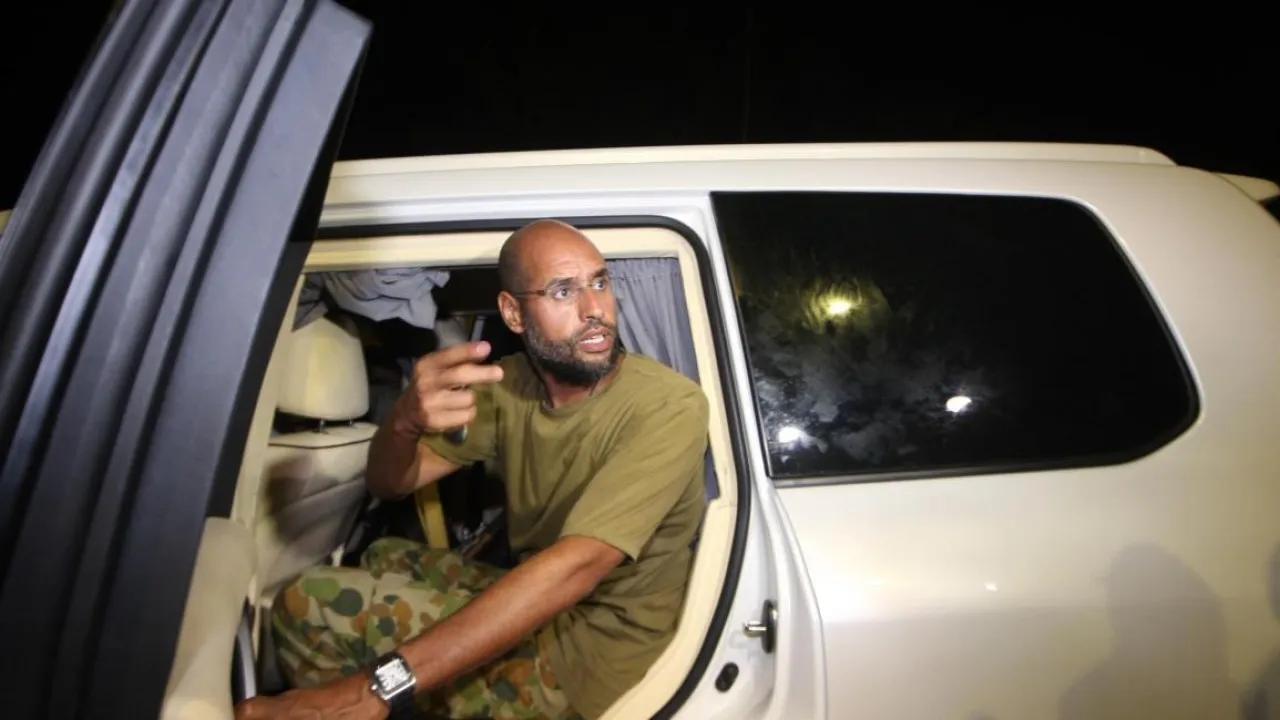
After his father's regime fell in 2011, Saif al-Islam Gaddafi was arrested in November 2011 in the desert while trying to escape to a neighboring country, by "Zintan rebels" who transported him to their city, particularly the Abu Bakr Al-Siddiq battalion which captured him and provided protection, refusing to hand him over to the Criminal Court in Tripoli which sentenced him to death in 2015. In 2017, the battalion announced his release in accordance with the general amnesty law issued by the House of Representatives, and although it disbanded simultaneously, it continued to provide protection, allowing him to cautiously reposition himself. He appeared limitedly to present himself as a leader for his father's regime supporters, capitalizing on the disappointment Libyans lived through after the revolution, reaching his presence peak by announcing his candidacy for the presidential elections in 2021, which powerfully brought his name back to the forefront despite the stunted electoral process.
Complex relationships and complicated circumstances
In this context, Professor of Political Science, Hassan Abdel Moula, in a conversation with "Al-Arabi Al-Jadid", considered that Saif al-Islam Gaddafi's presence in the latter period of Muammar Gaddafi's rule was merely in alignment with the internal and international changes necessary to rescue the governance situation, capitalizing on his relationships built abroad to present himself "as a reformer of his father's image". However, he faced difficulties, according to Abdel Moula, as his relationships "were marred by caution, as there was confidence on one hand that he could provide a different image, and on the other hand, fear that he might succeed in transferring power to his hands, and at the same time competing with his brothers". Abdel Moula pointed out that Saif al-Islam Gaddafi "possessed soft tools and a relatively modern discourse, but he lacked an independent political base and the will to break with the deep structure of power, thus remaining suspended between a postponed modernization project and a personal regime not ready to give up its essence".
Abdel Moula explained that after the revolution, Saif al-Islam Gaddafi shifted from an actor "to a political symbol possessing no effective tools, only mentally and psychologically representing a segment clinging to any pretext, as they had not forgotten that his project involved most of the revolution's icons and current leaders, therefore, he could not manage to develop any clear political program or effective organizational presence". Abdel Moula concluded by saying that the announcement of Saif al-Islam Gaddafi's killing "will have implications that extend beyond his person, primarily closing the symbol reminiscing of the past, the fall of betting on him, and distributing the loyalties of his supporters among competing local forces. True, his absence reduces the polarization state, but it will enter the country into a challenge of how to integrate his supporters into any upcoming scene".