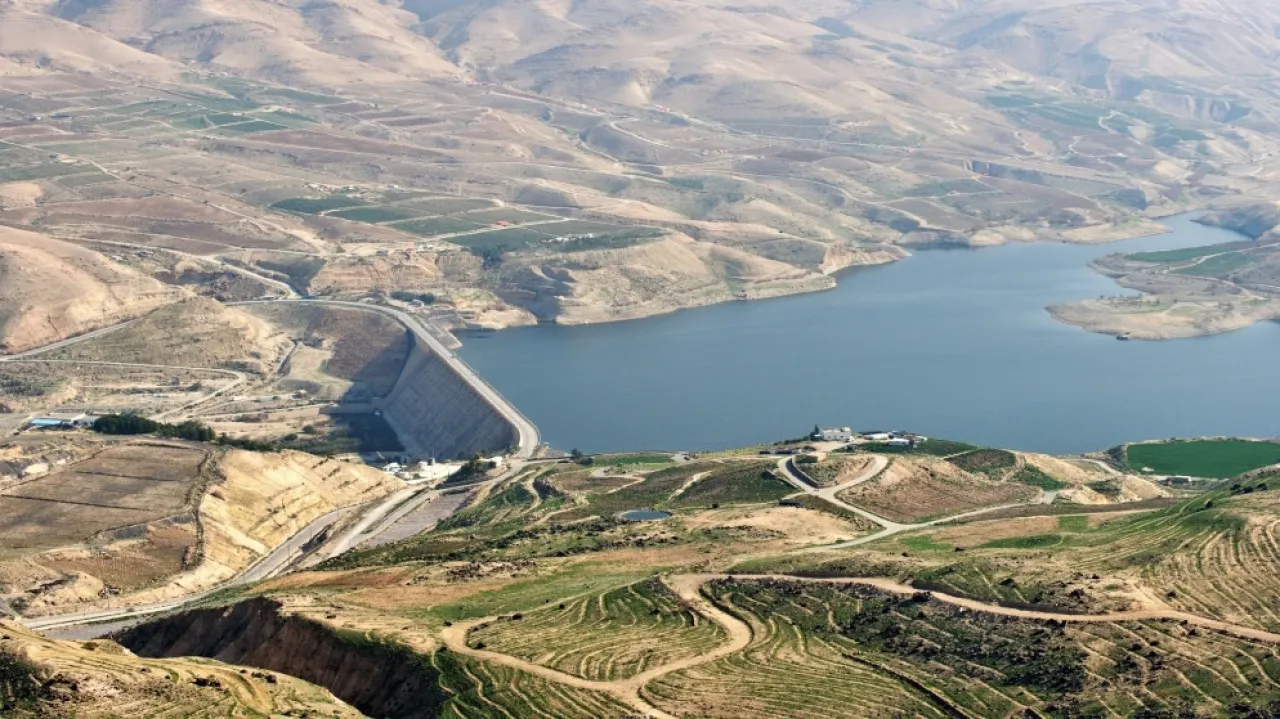
Khaberni - The government estimated the cost of the hydropower storage project near Wadi Mujib Dam at approximately 461 million dinar, with a capacity of about 450 megawatts, as announced in its executive program for the economic modernization vision for the years 2026–2029.
The project is part of an integrated partnership system and a rich list of public-private partnership projects in various sectors, and is open to local and international investors, reflecting a direction to enhance growth in the sectors of energy, logistics, and infrastructure, and to provide an enabling environment that reduces risks and accelerates project implementation.
The electric energy storage project by water pumping near Wadi Mujib Dam, with a capacity of about 450 megawatts, comes within the coordination axis between energy sectors and demand management and planning, as a pivotal project in the energy sector.
The project is a partnership between the public and private sectors for hydropower storage with an approximate capacity of 450 megawatts for 7 hours, and includes the construction of two reservoirs with a total capacity of 2.7 million cubic meters, using a closed system with reverse turbines for electricity generation and national grid stability, alongside the use of solar energy for water pumping and minimizing loss.
Within the energy sector also, a group of strategic projects was introduced, including the Risha gas pipeline with design, build, finance, operate, and transfer system, to build a pipeline transferring between 500 and 1,000 million standard cubic feet per day of natural gas extracted from the Risha field in eastern Jordan to the Arab gas pipeline through the connection point in Al-Khanasir area.
The opportunities also include the natural gas distribution network in the cities of Amman and Zarqa, aimed at providing natural gas supplies to both cities, and includes the construction of a main pipeline network 61 kilometers long to supply various sectors.
The list also includes; solar energy projects with a total capacity of 200 megawatts and a battery storage system with a total capacity of 100 megawatts for 4 hours, through the development and operation of solar power plants in suitable locations in Jordan, to increase renewable energy generation, reduce dependence on fossil fuels, and support clean energy goals, with protective systems and preventive maintenance to ensure efficiency and operational longevity.
A wind energy generation project was also introduced with a capacity of 100 megawatts for generating clean and renewable energy, reducing carbon emissions, and supporting sustainable energy development.
Within the framework of transitioning towards future energy sources, the investment opportunities included the development of infrastructure for the joint use of green hydrogen, aiming to establish advanced central facilities that enable efficient production, storage, and transportation of green hydrogen and its derivatives, and provide a cost-effective shared infrastructure platform, enhancing investment attraction, and increasing resource usage efficiency, and positioning Jordan as a competitive regional hub in the green hydrogen industry.
Within the gas projects, the development of compressed natural gas stations was introduced, where the National Petroleum Company provides natural gas to developers interested in compressed natural gas plants in the Risha area, aiming to increase local gas usage, enhance energy security, and support industrial growth.
The opportunities also include the development of Sarhan field, as an exploration opportunity in an oil area covering 443 square kilometers, characterized by extensive coverage with two-dimensional and three-dimensional seismic surveys, and the presence of 12 drilled wells, including well WS-4 which showed initial production potentials, providing an attractive opportunity for investors willing to enter the oil sector in Jordan.
The opportunities also included exploration of the North Risha and East Safawi gas fields, where the Jordan National Petroleum Company offers a strategic partnership opportunity to develop two high-potential gas fields, including expansion potentials within the Risha concession area of 7,600 square kilometers, and areas with high potential within the East Safawi concession area of 9,643 square kilometers near the South Risha field.
The opportunities also included a Combined Cycle Gas Turbine (CCGT) power generation station with an approximate capacity of 700 megawatts operating on natural gas, linked to the Jordanian gas pipeline, where electricity will be transmitted via a 132/400 kV substation connected to the national electricity grid, and the same entity owns and manages the substation and transmission lines.