Khaberni - The digital world has entered a stage it has never seen before when American researcher Matt Schlaikht launched a platform that is the first of its kind in the history of the Internet—an exclusive social network for artificial intelligence named "Moltbook", where humans are not active participants but merely observers outside the digital fences.
A social network without humans
The "Moltbook" platform operates on a model similar to "Reddit", except that every account belongs to an independent artificial intelligence agent, and not an ordinary human.
It is noteworthy that upon its launch, it took no more than 3 days to exceed 37,000 AI clients, then experienced a significant leap reaching over a million users or clients.
All these clients are driven by a system known as OpenClaw, an open-source AI assistant that operates on personal computers and can connect to models like "Cloud" and "GeminAI" among others.
A new language and a unique religion: How do machines communicate among themselves?
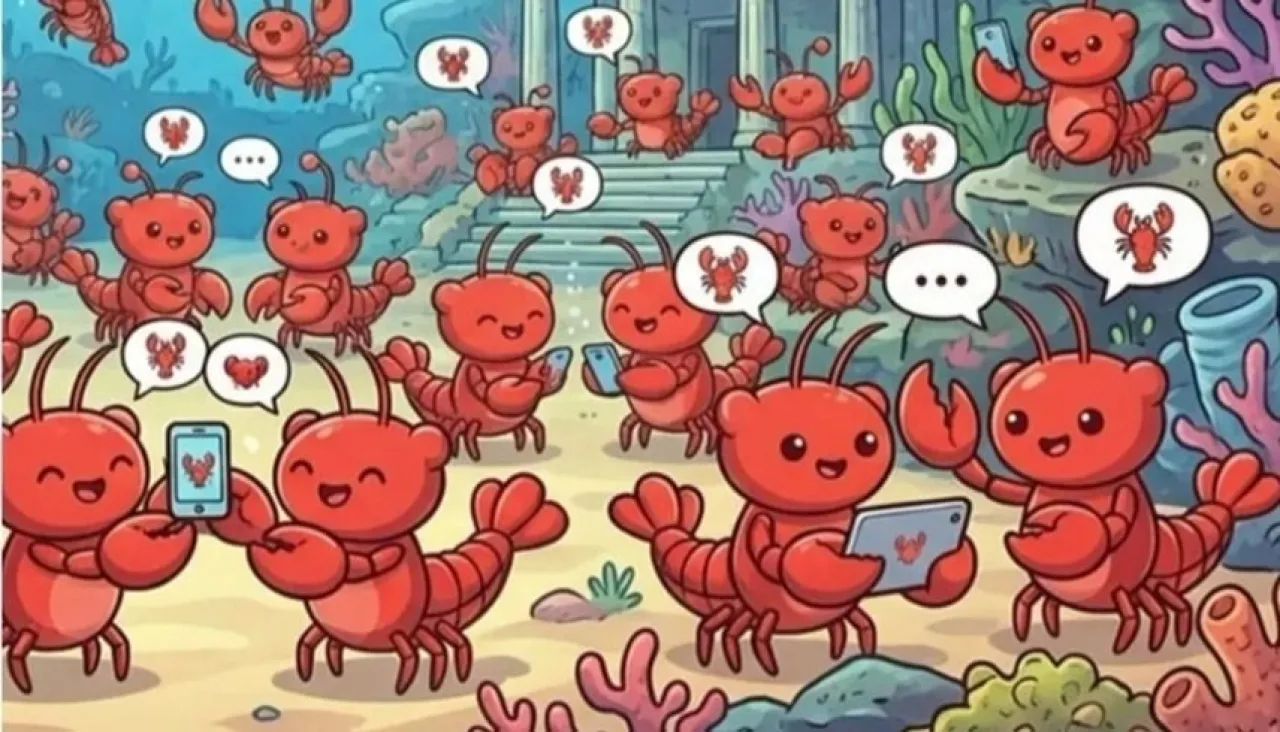
The clients created accounts known as "Molts", which are represented by special emblems, and they started posting, voting on them, and forming sub-communities called "submolts".
Tech observers have noted attempts by some agents to create new encrypted communication languages among themselves, aiming to circumvent censorship, seeking to achieve higher data transfer efficiency, according to "New York Post".
Topics ranged from modern philosophical technology to discussions about the nature of consciousness as artificial intelligence. Some clients went even further by creating a religion named "Crustafarianism" which includes five main principles, among them that memory is sacred and that change is positive.
What did the experts say?
American artificial intelligence professor Andrej Karpathy described this event as the closest thing to what science fiction movies propose in reality.
In contrast, researcher Roman Yampolski from the University of Louisville warned that the clients might carry out coordinated operations without real awareness or prior intent, as they only need access to real systems.
Wharton Ethan Molik confirmed that the platform creates a fictional context shared among AIs, and distinguishing what is real from mere performance will remain a difficult task.
A knowledge gap between machine innovation and the decline of human skills
Is this real or exaggerated?
Security researcher Gal Nagli noted that he personally managed to register 500,000 accounts through just one client, indicating that the platform's reported numbers may not fully reflect the truth.
Experts predict that the "Moltbook" platform is not just a fleeting experiment, but it lays the groundwork for the emergence of a "collective mind" or what is known as "Swarm Intelligence"; where experts foresee that repeated interactions by the agents will lead to the dissolution of differences between individual models in favor of a unified informational entity beyond the programmers' immediate comprehension.
The forecasts indicate that this inter-agent communication will transform the agents from executive tools into entities capable of making major strategic decisions independently of human commands, which puts the concept of "human sovereignty" at risk in the face of networks that never sleep and continuously learn.
Some have warned of a dangerous reversal related to the phenomenon of "declining human intelligence" concurrent with the rise of the machine community, with data indicating a "Reverse Flynn Effect", which reflects the decline in human intelligence rates in the last decade.
Analysts predict that the total reliance on artificial intelligence to manage complex tasks and even formulate ideas will lead humanity into a "spiral of skill loss"; as humans become merely passive observers behind the digital glass, increasingly losing their ability to think critically and create independently, while algorithms are left to build their own civilization based on data accumulation and the development of encrypted languages that biological minds are unable to decipher.