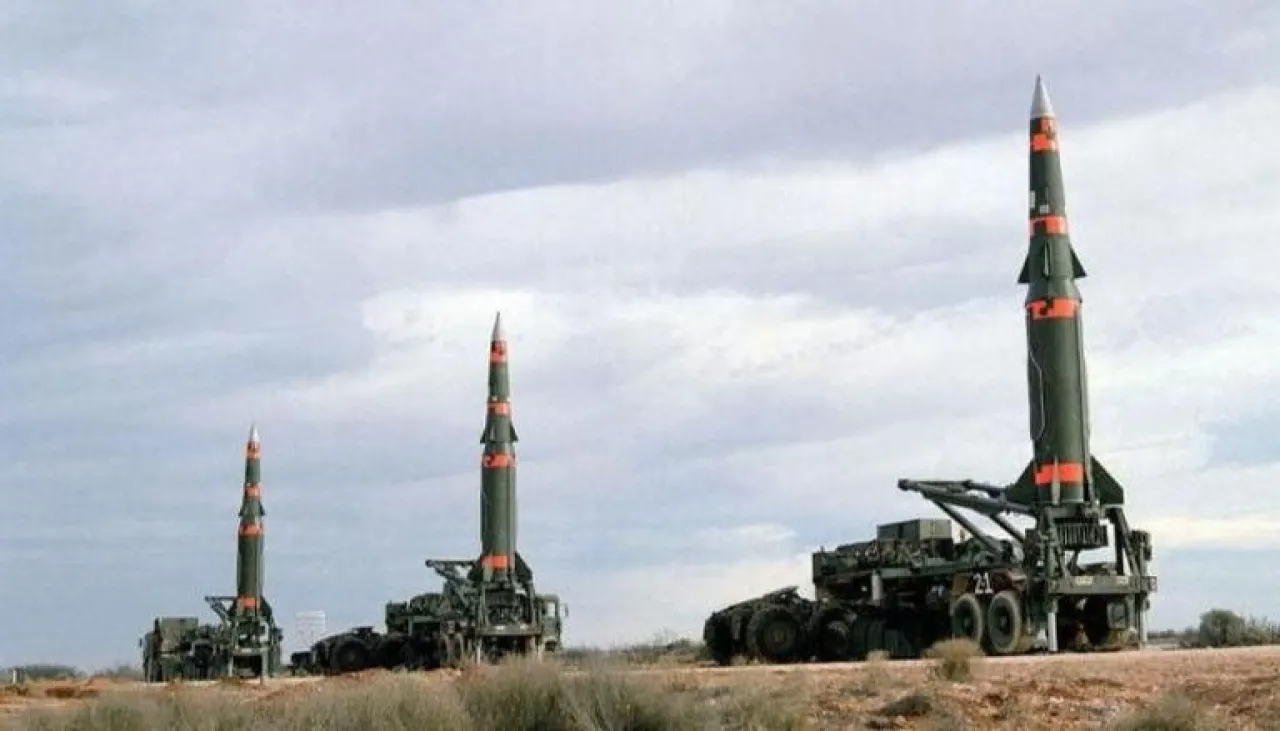
Khaberni - With the press of a button, it was supposed to open the covers of missile silos in western China to launch nuclear weapons capable of reaching the United States, according to the British newspaper "Telegraph".
However, according to American intelligence information published in 2024, it turned out that the materials used in the manufacture of those missiles were too heavy, and it didn’t stop there, as it was revealed that some of the missiles were filled with water instead of fuel.
It seems that this scandal - or something like it - prompted Chinese President Xi Jinping to dismiss the entire leadership of the missile forces, during the months leading up to the leak publication, according to the newspaper.
Dismissal of Hundreds of Officers
The newspaper added that this "purge" came as part of a broader effort to eliminate corruption within the Chinese military; since taking power 14 years ago, Xi has dismissed hundreds of officers and brought criminal charges against some of the most powerful figures in the armed forces.
Last week, this campaign expanded to include the removal of General Zhang Yuxia, one of the prominent military leaders in the Chinese army.
While eradicating rampant corruption is a major motivator for President Xi Jinping, the newspaper's analysts said that his fierce campaign against the military is also driven by his desire to reshape the world’s second-largest army into a modern fighting force capable of invading Taiwan by 2027 and surpassing the United States to become the world's strongest military power by 2049.
Complete Loyalty
From this perspective, corruption poses a serious threat to the military and, at the same time, a tool that enabled the president to redirect the military establishment towards achieving these goals and ensuring their complete loyalty to his rule.
While what exactly General Zhang did is unclear amid the complexities of China's high politics—where he was accused of leaking secrets related to Chinese nuclear weapons to the United States—rumors suggest that the general may have opposed the timeline set by the president for invading Taiwan.
In this context, analyst Ke Tristan Tang noted that the general's recent speeches focused on a training program that could, by its nature, delay a complex operation to cross the Taiwan Strait.
At the present time, combating corruption seems to be the only goal that the Central Military Commission can focus on; as the purging campaigns launched by President Xi have reduced the number of its members to only two: Xi Jinping himself, and Zhang Xinmin, the head of the Anti-Corruption Agency.
The Political Path for the Reunification of Taiwan
The newspaper continued that the elimination of senior military leaders has sparked speculation about whether President Xi Jinping has significantly weakened the military, stripping it of the expertise necessary to even handle the simplest combat tasks, let alone carry out an invasion requiring full coordination between the naval, air, cyber, and space forces.
On his part, Jonathan Chin, who worked as a Chinese affairs analyst at the Central Intelligence Agency for 17 years and is currently a senior fellow at the Brookings Institution in Washington, warned against rushing to interpret these developments.
Chin said, "I believe that the purging operations do not show that Xi is unmotivated by operational issues; on the contrary, they show that he is very focused on them."
In fact, Xi may prefer to reunify Taiwan through a political path, considering the exorbitant cost of any military invasion.
Good Results in Polls
While the political landscape in Taiwan may tilt in his favor, with the approach of the 2028 elections, at a time when a Beijing-friendly party is doing well in polls, Chin confirms that he is "serious about having options."
He added that Xi wants the military to be at the highest level of readiness and preparedness, and is ready to be very tough with the military establishment, because he is very focused on achieving his fundamental goals.
Former CIA analyst Christopher K. Johnson, agreed with Chin, considering the prevailing belief that the purging operations aim only to strengthen Xi Jinping’s political position is completely mistaken.
Dismissal of 9 Generals
Johnson said, "I think it reflects his impatience with his generals because of their failure to accomplish tasks timely," adding, "I'm not saying he's in a hurry, but he's getting older, and he might face whispers suggesting that it's time to think about stepping down."
Chin continued, "The corruption is real, and rooted. But the army's update is impressive. It's a massive and sufficiently funded effort, allowing the two to coexist side by side." He added: "Now, the army can do two things at once."
In November, President Xi dismissed nine generals, among them seven who had previously served on the eastern front, which is responsible for the Taiwan file. The following month, he ordered the largest military maneuvers yet around the island.