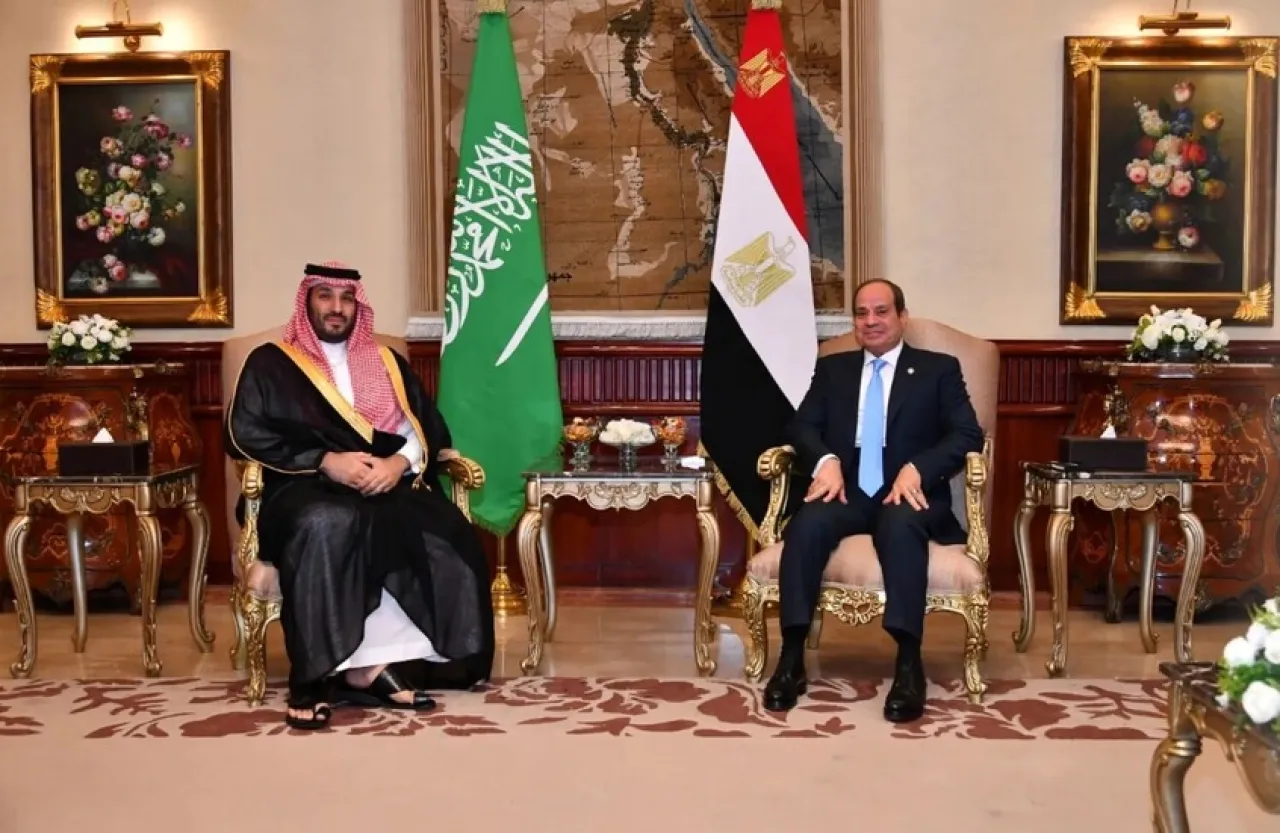
Khaberni - An Israel Hayom newspaper report reveals concerns in Tel Aviv regarding dramatic transformations witnessed by regional alliances in the Middle East, especially between Egypt and Saudi Arabia.
The report referred to the formation of what it described as a "regional axis" that includes Turkey, Egypt, Saudi Arabia, Qatar, and Oman, which — according to the claim — is exerting collective pressure on the United States to avoid launching a military attack on Iran and to engage with it in negotiations instead of supporting popular protests against it.
The report raised questions about whether Saudi Arabia and Egypt "have actually joined the ranks of Iran", considering that a positive answer to this question would represent a "deep strategic shift" in the alliance map.
The report also noted that Shia Iran was until recently considered the main threat to Saudi Arabia and its Sunni allies in the Arabian Peninsula — except for Qatar — who were hoping that Israel would help contain the nuclear, ballistic, and sabotage threat coming from Tehran, which is one of the main reasons for the "Abraham Accords".
Additionally, these countries saw the policies of the Obama and Biden administrations as a "mistaken" attempt to tame the Iranian regime through dialogue, hoping to achieve "stability" regionally through a "balance" between Iran and its enemies.
The report mentioned that in 2017, Saudi Arabia, the UAE, and Bahrain imposed a blockade on Qatar and cut diplomatic and trade relations with it, because of its cooperation with Iran and support for Islamic currents — such as the Muslim Brotherhood — which, according to those countries' view, pose a threat to their regimes. The report considered this also a reason for the tension with Turkey, which supported Islamic movements in the region and did not stand against Iran.
The report added that the alleged weakness of Iran after recent military strikes may have led Saudi Arabia and Egypt to believe that the survival of the regime in Tehran is better than its collapse, which may lead to a security vacuum, as happened after the fall of Saddam Hussein's regime and the rise of ISIS.
It mentioned that the military rise of Israel is seen as an "increasing threat" in some Arab capitals, making the American-Israeli alliance "undesirable" to some. The report also claimed that Egypt refuses to allow Gaza residents to cross its territory not to support the Palestinians, but to ensure that the Gaza threat remains a factor "distracting Israel strategically".
The report concluded by saying that alliances in the Middle East were never static, noting that Israel was an ally of Iran before the Islamic Revolution and an ally of Turkey before Erdogan's era, then relations turned into hostility. It considered that Saudi Arabia is "much less of a reliable ally", warning against "falling into the Saudi trap".
The Israeli platform "jdn" reported that secretive diplomatic efforts are underway between Turkey, Egypt, and Qatar to coordinate a meeting between representatives of the U.S. administration and Iranian officials in Ankara this week.
The platform added that these efforts aim to prevent regional escalation amid ongoing military movements by the U.S. in the Gulf.
"jdn" reported that a high-ranking American source revealed that the Trump administration sent messages through multiple channels expressing its readiness to hold talks with Iran to reach a settlement between the two countries.
It mentioned that the three countries — also involved in mediation to stop fighting in Gaza — are coordinating their contacts with both the American and Iranian sides, and that "negotiations are making progress".
The platform added that the United States confirmed that Trump ordered an increase in the American military presence in the Gulf region in anticipation of a possible military operation, but he has not made a final decision yet and is still considering the diplomatic path.
"jdn" stated that U.S. officials described Trump's recent statements about readiness to negotiate as "serious", despite the unclear stance of the Iranian leadership on entering talks.
The platform reported that the Iranian Foreign Minister said that the regional countries are trying to build trust between the two sides, describing these efforts as "useful".
It mentioned that the possibility of additional talks will remain if the United States moves to prevent the development of nuclear weapons.
"jdn" reported that intensive contacts recently occurred between Iranian officials and their Qatari, Egyptian, and Turkish counterparts to establish a possible negotiation framework, noting that the President of Egypt spoke by phone with his Iranian counterpart and urged him to agree to meet with American representatives, and discussed the matter with his Iranian counterpart.
The platform added that Trump expressed before journalists his hope to reach an agreement that prevents Iran's nuclear progress, while the Supreme Leader of Iran declared in a speech in Tehran that Washington seeks to control his country's resources, warning that an outbreak of war would lead to regional conflict, without mentioning the possibility of entering into negotiations.
"jdn" concluded its report by noting that the Israeli Chief of Staff recently visited Washington to hold talks with senior American military leaders, intending to coordinate joint preparations for various scenarios in case of a confrontation with Iran, confirming that the objective of these meetings is to "build a mutual understanding regarding defense and response plans".