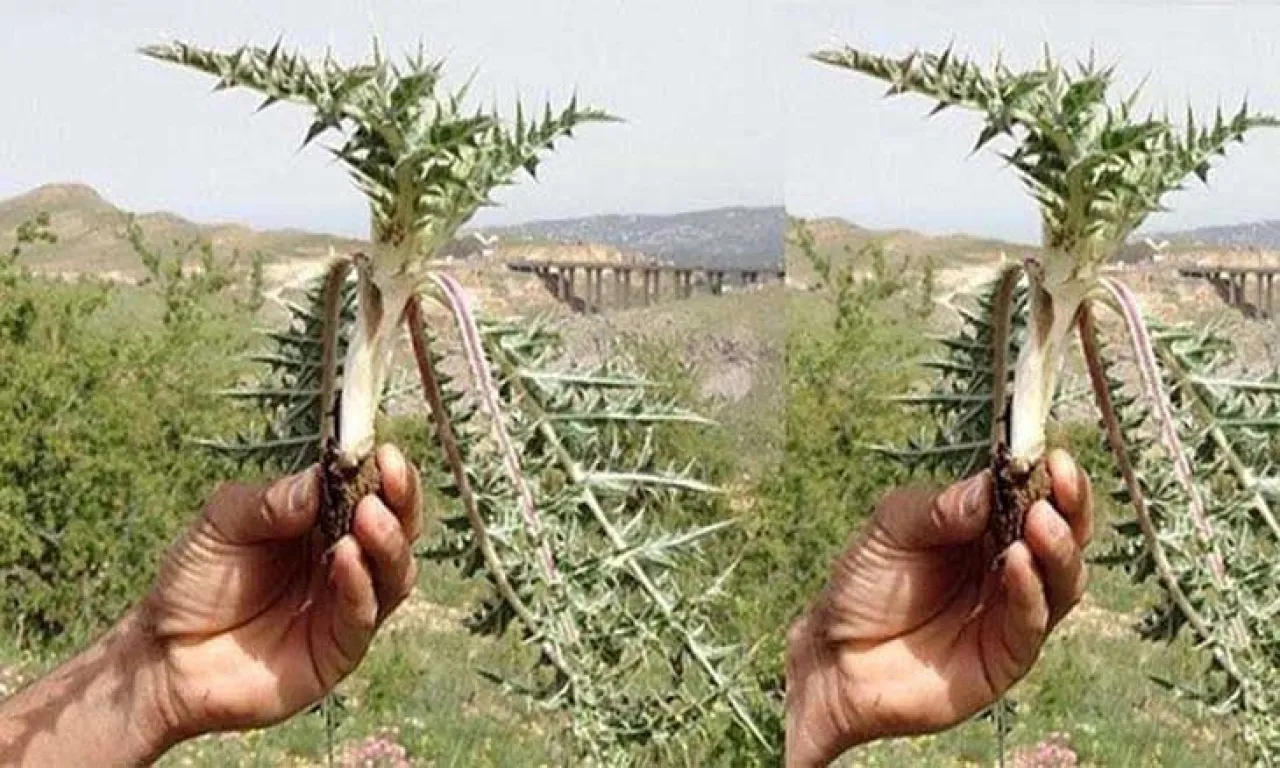
Khaberni - The National Center for Agricultural Research signed a support and funding agreement yesterday, Sunday, with the Abdul Hameed Shoman Foundation to develop the Akoub plant using chemical mutations.
The agreement is part of support agreements for 14 research projects that were selected from among 173 projects submitted by Jordanian universities and research centers, under the leadership thought corner of the applied projects aimed at finding scientific solutions to local and global challenges.
The General Director of the Center, Dr. Ibrahim Al-Rawashdeh, praised this scientific achievement, pointing out that this project marks a successful start for the propagation and development of the Akoub plant, transforming it from a threatened wild plant into a cultivated agricultural crop of added economic value, which contributes to enhancing biodiversity and food security and reduces pressure on the natural environment, as well as easing the burden on citizens in obtaining Akoub by providing it as a cultivated and safe agricultural product.
He added that the selection of the project among the 14 winning projects supported by Shoman Foundation underscores the confidence of national institutions in the research and applied role that the National Center for Agricultural Research undertakes, embodying its commitment to turning scientific research into practical solutions that serve farmers and the community, and align with the vision of economic modernization and sustainable development plans.
He affirmed that the center continues to support innovative projects that employ modern technologies to improve plant genetic resources, as they are a fundamental pillar for enhancing food security and agricultural sustainability.
Akoub is a perennial plant found in the semi-arid mountainous regions of the Eastern Mediterranean and holds a special place in the folkloric dietary heritage as a seasonal meal with high nutritional value. However, reliance on wild harvesting as a primary source poses a threat to its natural sustainability, despite its importance as a seasonal income source for many families.
The project aims to develop Akoub as an economically viable agricultural commodity through the use of chemical mutagenesis treatments to select improved strains characterized by large flower heads and leaves and flower heads that are free of or have limited spines, in addition to preserving and propagating the distinguished plants using tissue culture techniques in preparation for commercial production.
The project's goals align with national priorities in selecting high-yield plant strains adapted to the local environment, while its expected outputs include developing desirable marketing characteristics, propagating improved plants, supporting producers, and working on registering a patent for the improved plants, thereby enhancing the status of the National Center for Agricultural Research as a leading institution in agricultural innovation and applied scientific research.