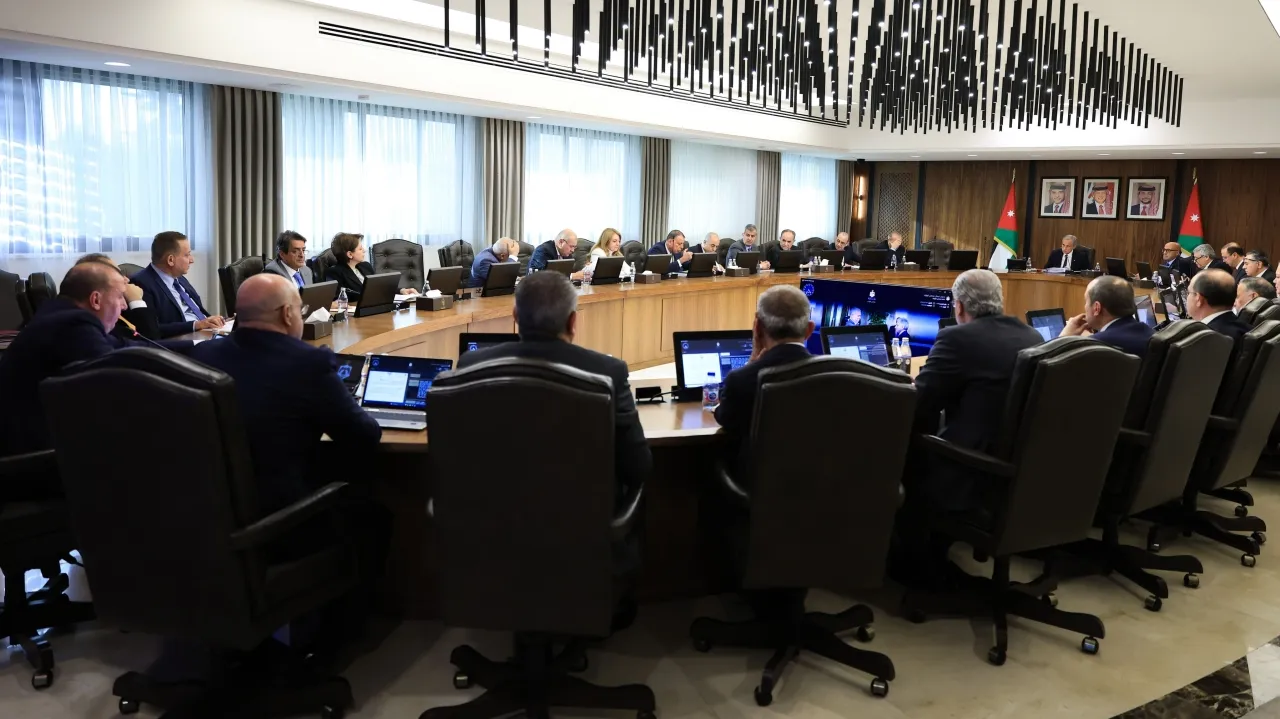
Khaberni - The Cabinet decided in its session held today, Sunday, chaired by Prime Minister Dr. Jafar Hassan, to approve the implementation of the second phase of the regular public transport development project between the provinces and the capital Amman.
The second phase will be implemented within 7 main routes: (Amman - Tafilah), (Amman - Ma'an), (Amman - Ajloun), (Zarqa - Mafraq), (Zarqa - Irbid), (Jerash - Mafraq), and (Irbid – Jerash) with a total of 180 buses, serving more than 13,000 passengers, according to the operational requirements needed for this phase.
The implementation of the second phase is based on the success of the first phase, for the purpose of expanding and building an integrated national public transport network that includes the majority of the kingdom's provinces, according to modern standards, addressing geographical connectivity gaps, enhancing integration and mobility between the southern, central, and northern provinces, and enhancing integration among them, to serve passengers including university students.
The second phase includes 180 mediumsized buses, having a capacity of more than 13,000 passengers daily, with an expansion in applying smart transport systems, electronic payment, tracking and monitoring systems, and television monitoring inside the buses to ensure the quality and regularity of the service in accordance with specific schedules, ensuring time and effort savings and financial costs for the citizens.
The total annual cost for the second phase is estimated at about 5.76 million dinars, representing operational support from the government, and financial allocations have been provided.
The project relies on a clear institutional framework that ensures governance of implementation, through which the Land Transport Regulatory Authority is responsible for contracting, providing support, and setting performance standards, while the Integrated Transport Company manages the project and oversees its operation, and the Amman Vision Transport Company operates smart transport and electronic payment systems.
The digital indicators of the first phase confirm the success of the public transport development project between the provinces and the feasibility of its expansion, while the second phase represents a strategic step to enhance the connectivity between the southern, central, and northern provinces within an efficient institutional operating model, forming a clear technical and financial basis for decision-making to proceed with the implementation of the second phase.
Under the decision, Amman Vision Transport Company, owned by the Greater Amman Municipality, has been tasked with supplying, installing, operating, and maintaining smart transport systems and passenger information systems, in continuation of the services implemented in the first phase of this project.
- Approval of the justifying reasons for the Licensing Service Regulation for the year 2026; for the purpose of promoting tourism and serving tourists.
In the context of the government's efforts to improve tourism transport services as well, the Cabinet approved the justifying reasons for the Licensing Service Regulation for the year 2026, in accordance with Passenger Transport Regulation Law No. 19 of 2017.
The system project primarily aims to regulate and license the vehicle rental service for transporting passengers, especially foreign tourists, by specifying the conditions and requirements necessary for licensing rental companies and offices, specifying the vehicle categories licensed for rental, such as buses and passenger cars, including motorcycles provided they are part of tourist groups, regulating the permitted business activities and imposing control over them.
The system project reflects a legislative direction towards diversifying rental transport means for foreign tourists, allowing new categories like motorcycles, setting the conditions, requirements and standards necessary for this purpose, along with lowering market entry barriers for certain activities by reducing the minimum number of buses from 15 to 10, and cars from 30 to 15, in addition to increasing flexibility to facilitate investment and entry into the job market in the sector, with a significant enhancement of regulatory aspects through data storage requirements, direct system access, and ensuring operational compliance through direct monitoring.
The system project keeps pace with all developments and updates that have occurred in the transport system and the rental sector, including small passenger cars and buses, while considering the preservation of the investment environment and encouraging it, in addition to promoting legitimate competition among investors in this sector.
- Establishing a duty-free area within the business lounges and travelers at both Queen Alia International Airport and Amman City Airport; in support of investment.
In the context of supporting investment, the Cabinet decided to establish a duty-free area within the business lounges and travelers at both Queen Alia International Airport and Amman City Airport in the contracted locations and spaces with the operators of these airports.
The decision aims to elevate services for investors and businessmen, support Jordanian property investment in this framework, and enable the opening of new investments in these locations to serve the existing economic activities therein.
- Approval of the national plan for multi-sectoral prevention and response to child protection and domestic violence against women and girls
In the context of social protection, the Cabinet decided to approve the national multi-sectoral prevention and response plan for child protection and domestic violence against women and girls for the years 2026 – 2030 and to circulate it to the ministries and governmental and non-governmental institutions concerned for implementation.
The plan represents a national reference framework that reflects the commitment of the kingdom to family protection standards and enhancing its cohesion, by building a comprehensive system focused on early prevention, effective response, support and rehabilitation, and enhancing governance and institutional coordination.
The plan is based on a broad participatory and scientific methodology, including a detailed analysis of national and international legislation, policies, and data, and direct participation of children, women, and service providers, ensuring the addressing of root causes of violence and providing fair, inclusive, and high-quality services, with access to justice for all categories, especially the most vulnerable.
The plan directly aligns with the economic modernization vision and the national social protection strategy, and the Sustainable Development Goals 2030, also embodying the international commitments of the kingdom, including its membership in the Global Initiative to End Violence Against Children and its pledges at the Global Ministerial Conference.
The plan is based on three main pillars including enhancing multi-sectoral services, developing legislative and institutional frameworks, and sustainable financing, and promoting prevention and community empowerment, contributing to building a safer, fairer, and violence-free Jordan.
Approval of solutions related to lands on which camps are established and owned by citizens, to ensure the resolution of existing judicial disputes and relieve financial burdens on the treasury, according to the principle of fair compensation.
The Cabinet approved solutions related to lands on which camps are established, similar to previous solutions that were approved for Talbieh Camp in Giza District, ensuring the resolution of existing judicial disputes, and in accordance with the principle of fair compensation, based on the owners' wishes.
Under the decision, lands owned by citizens on which camps are established in the governorates of the capital, Zarqa, and Madaba will be exchanged with lands owned by the treasury in locations within the boundaries of these governorates, equivalent in value.
Also, lands owned by citizens on which camps are established in the governorates of Irbid, Balqa, and Jerash will be exchanged with lands owned by the treasury in locations outside their boundaries, equivalent in value.
Under the decision, the areas of land, or any parts thereof, owned by the treasury and encroached upon, located outside the boundaries of Hattin Camp, will be included within the camp's boundary to be authorized to the Department of Palestinian Affairs.
The Cabinet instructed the Land and Survey Department to prepare a detailed study on the treasury lands proposed for exchange and their estimated values, and the Department of Palestinian Affairs to form a specialized committee to negotiate directly with the owners of the land plots, and to sign temporary lease contracts with them until the necessary studies are completed, to grant each owner in the exchange process a land plot or share equivalent to the value of his ownership, in accordance with the principle of fair compensation, and the lands on which camps are established are to revert to the state treasury.
In November last year, the Prime Minister decided to form a committee chaired by the General Director of the General Corporation for Housing and Urban Development to study the issue of utilizing treasury lands, especially those located in governorates with camps established on lands owned by citizens, for the purpose of exchanging land plots on which camps are established with treasury-owned land plots (similar to Talbieh Camp) and providing annual financial allocations for the development of projects for the General Corporation for Housing and Urban Development on them.
Exemption of ambulances and vehicles equipped for uso by disabled persons, from the total special tax.
The Cabinet decided to exempt ambulances and vehicles equipped for use by disabled persons from the total special tax, which amounts to 48%, to become zero.
- Adoption of the amended law project for the Constitutional Court Law
The Cabinet adopted the amended law project for the Constitutional Court for the year 2026.
The law project comes to align the Constitutional Court's membership conditions stated in the Court Law with the conditions stated in the Jordanian Constitution, whereby a member of the Court would be those who have served as judges in the Supreme Court, the High Administrative Court, law professors in universities holding professorship rank, or lawyers who have practiced law for at least twenty years, or experts who meet the membership conditions in the Senate.
The purpose of the law project is also to strengthen the Court's technical office with regular judges at the request of the Court president and with the approval of the Judicial Council.
The Council also decided to refer Dr. Jamal Qataishat, the Secretary-General of the Ministry of Public Works and Housing for Technical Affairs, to retirement.
The Council also decided to appoint Engineer Nabil Saad Eddin Al-Jiriri Al-Husban as the City Director in the Greater Amman Municipality, and to refer Counselor Ahmad Abdul Qader Al-Malkawi to retirement.
The Council also decided to appoint Ayman Abdul Rahman Abu al-Rub as the General Director of the General Budget, and also to appoint Engineer Ahmad Qasim Abdul Ababneh as the Commissioner for Radiological and Nuclear Work Affairs in the Energy and Minerals Authority.