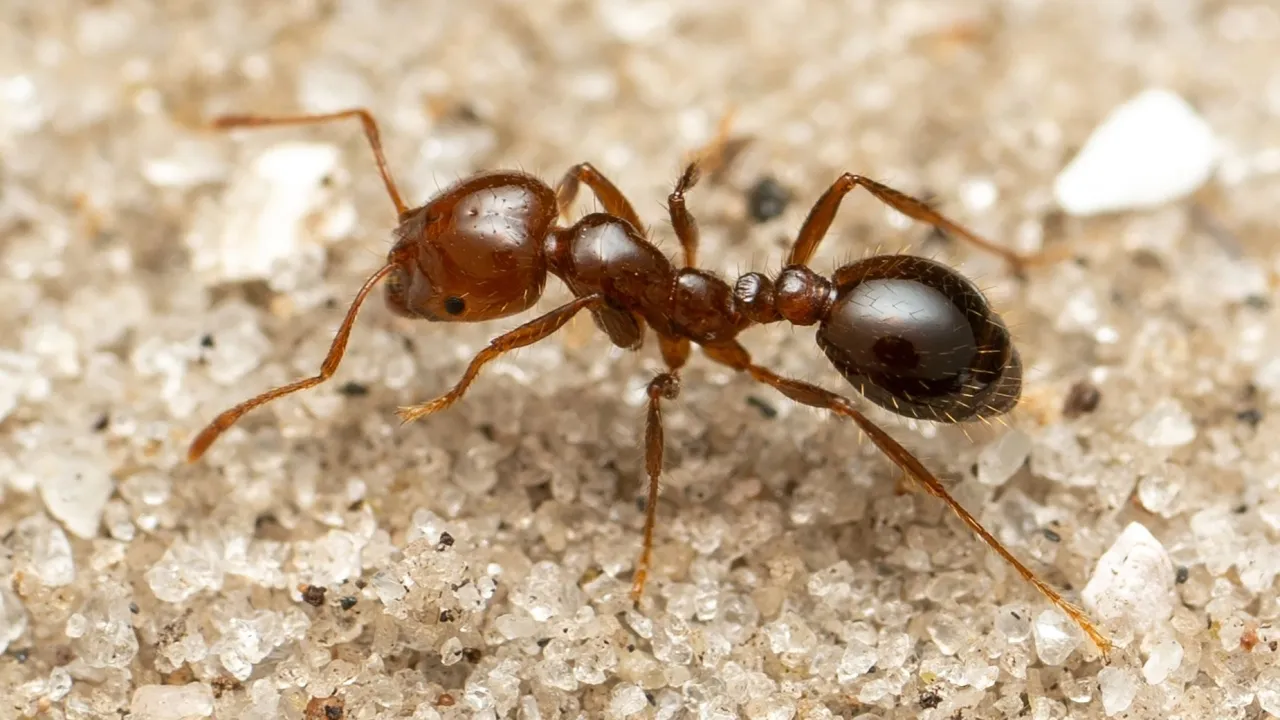
Khaberni - Researchers have managed to study a unique piece of amber about 40 million years old, containing an extinct ant preserved with amazing precision, which shows the finest anatomical details that are rarely available in fossils.
The sample also included a fungal mosquito and a black fly, containing the best-known example of the extinct species Ctenobethylus goepperti.
The scientists, according to "The Sun" newspaper, stated that the perfect preservation condition of this ant allowed them to examine the internal structures of its head and body, a step unprecedented in the study of fossil ants.
Using modern three-dimensional imaging techniques, highly detailed images were produced, documenting features never previously recorded in any Cenozoic-era fossil ant, which spans from 66 million years ago to present.
An unexpected cultural afterthought
What distinguishes this discovery is the source of the sample: it was part of the personal collection of the German writer Johann Wolfgang von Goethe, who gathered about 40 pieces of amber during his lifetime.
Despite Goethe's interest in natural science, it seems he did not realize the hidden scientific value of these pieces, as he did not mention them in his writings.
Today, the collection is preserved in the Goethe National Museum in Weimar, where it has been available for scientists to examine and discover the biological treasures that time has concealed within the amber, bridging cultural heritage and modern scientific research.
What did the ant reveal about its environment?
The study clarified that the discovered ant belongs to the "worker" class, and closely resembles the modern ant species Liometopum.
The researchers suggest that this ant was likely widespread in temperate warm pine forests, and possibly formed massive colonies on trees. Additionally, its strong mandibles suggest its capability to dig or burrow into wood.
The scientists summarized the importance of the discovery by saying that the piece of amber demonstrates nature's ability to preserve biological structures with unparalleled precision, and that the cultural heritage of the literary gem Goethe has today enabled the rediscovery of scientific secrets using modern imaging techniques, affirming that the intersection of culture and science can generate new, unexpected insights.