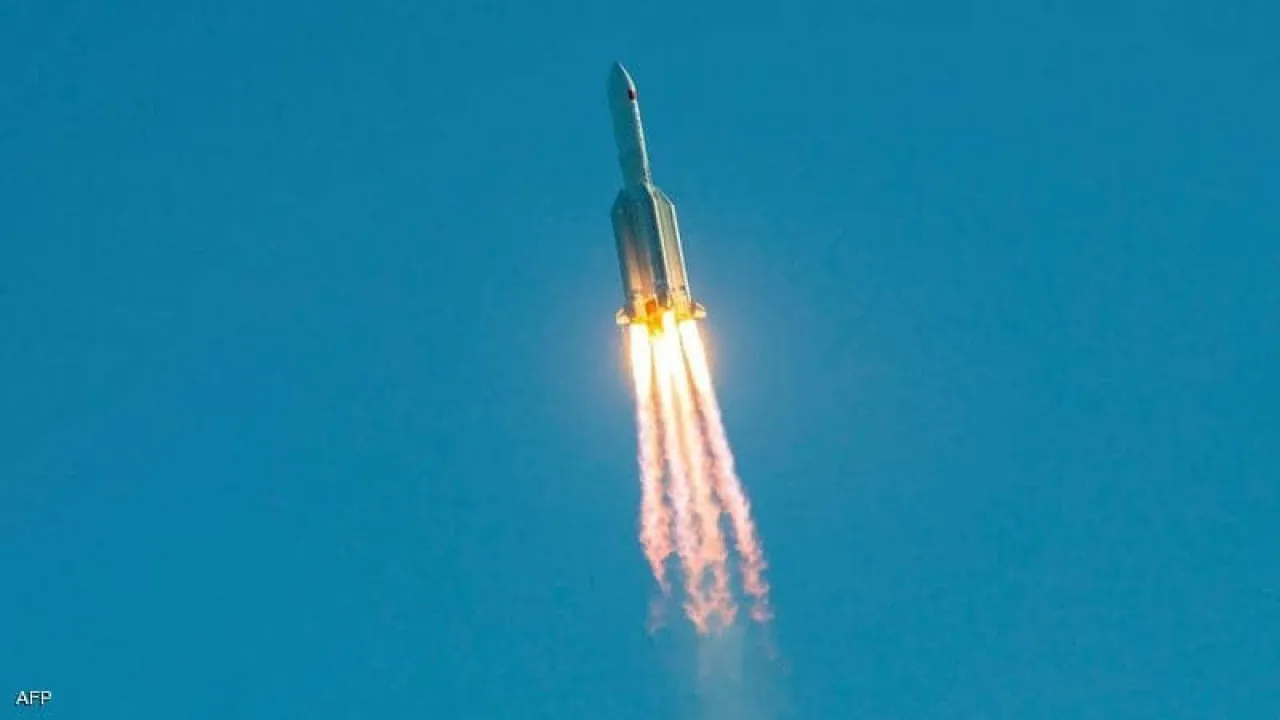
Khaberni - The British government is preparing to raise the readiness of the national emergency alert system, amid concerns about the possibility of an out-of-control Chinese rocket falling to Earth later today.
According to reports, the Chinese rocket, Zhuque-3, was launched at the beginning of last December, and is expected to re-enter the Earth's atmosphere within the coming hours, amidst uncertainty about where it will fall.
The government has asked mobile network operators to ensure the readiness of the alert system, in anticipation of issuing an urgent warning should there be any imminent danger to the population if parts of the rocket fall within the British airspace.
A massive Chinese rocket approaches Earth.. and the British government prepares for the worst
Uncertain timing
The American Aerospace Corporation estimates that the rocket will enter the atmosphere around 12:30 PM GMT, with an error margin of plus or minus 15 hours.
In contrast, the European Union's Space Surveillance and Tracking agency (SST) estimates the re-entry into the atmosphere at 10:32 AM GMT, with a smaller error margin of ±3 hours, reflecting the uncertainty surrounding the event.
A spokesperson for the British government told the Daily Mail: “It is highly unlikely that any debris will enter the UK airspace, and as expected, we have robust plans in place to handle various risks, including those associated with space, which are regularly tested in cooperation with our partners.”
Massive experimental rocket
The rocket was launched on December 3, 2025, from the Jiuquan Satellite Launch Center in Gansu province, China, by the private space company LandSpace.
Although the experimental rocket, known as ZQ-3 R/B, successfully reached orbit, its reusable booster stage, designed similar to SpaceX's Falcon 9, exploded during a landing attempt.
Since then, the upper stages of the rocket, along with a dummy payload consisting of a large metal tank, have gradually been descending from their orbit.
The rocket weighs about 11 tons and measures between 12 and 13 meters in length, prompting the SST agency to describe it as "a relatively large object that requires careful monitoring."
Is it a danger to Britain?
Due to its shallow entry angle into the atmosphere, it is difficult to accurately predict where any of the parts might fall.
Professor Jonathan McDowell, an astronomer and space debris tracking expert at the Harvard-Smithsonian Center for Astrophysics, said: “The latest predictions indicate that the re-entry into the atmosphere will happen between 10:30 and 12:10 GMT; during that period, the rocket will complete a full orbit around the Earth, passing over the Inverness Aberdeen area at about 12:00, which means there is a slight chance, not exceeding a few percentage points, of it entering over the UK.”
He added that if it does not happen within that time window, it will not fall over British territory.
Space debris
Authorities have confirmed that space debris passes over the UK about 70 times a month, and that the majority of rockets and satellites burn up completely upon entering the atmosphere due to friction.
However, large pieces or heat-resistant materials such as stainless steel or titanium might occasionally reach the Earth's surface, but they usually fall into oceans or uninhabited areas.
The government emphasized that checking the readiness of the alarm system is a routine measure and does not necessarily mean that an actual warning will be issued.
Rare danger but scientists warn
While the likelihood of this rocket causing damage to people or property is extremely low, scientists warn that the risks of space debris are increasing with the continued rise in the number of commercial launches.
There was only one recorded instance in history of a human being hit by space debris, which occurred in 1997 when a woman was struck by a small metal piece from an American rocket without suffering any harm.
A recent study by the University of British Columbia suggests that there is now a 10% chance of human casualties due to space debris over the next decade.
Other studies have also warned of a potential threat to aviation, with a probability of 26% that debris will fall in some of the busiest airspaces in the world annually, and the risk of a commercial aircraft being struck could rise to one in every thousand flights by 2030.
A massive Chinese rocket approaches Earth.. and the British government prepares for the worst
Previous incidents
This is not the first time a Chinese rocket has fallen to Earth; in 2024, parts of the Long March 3B rocket fell near residential houses in Guangxi Province, China, while another stage of the same rocket crashed over a rural village, creating a massive fireball.