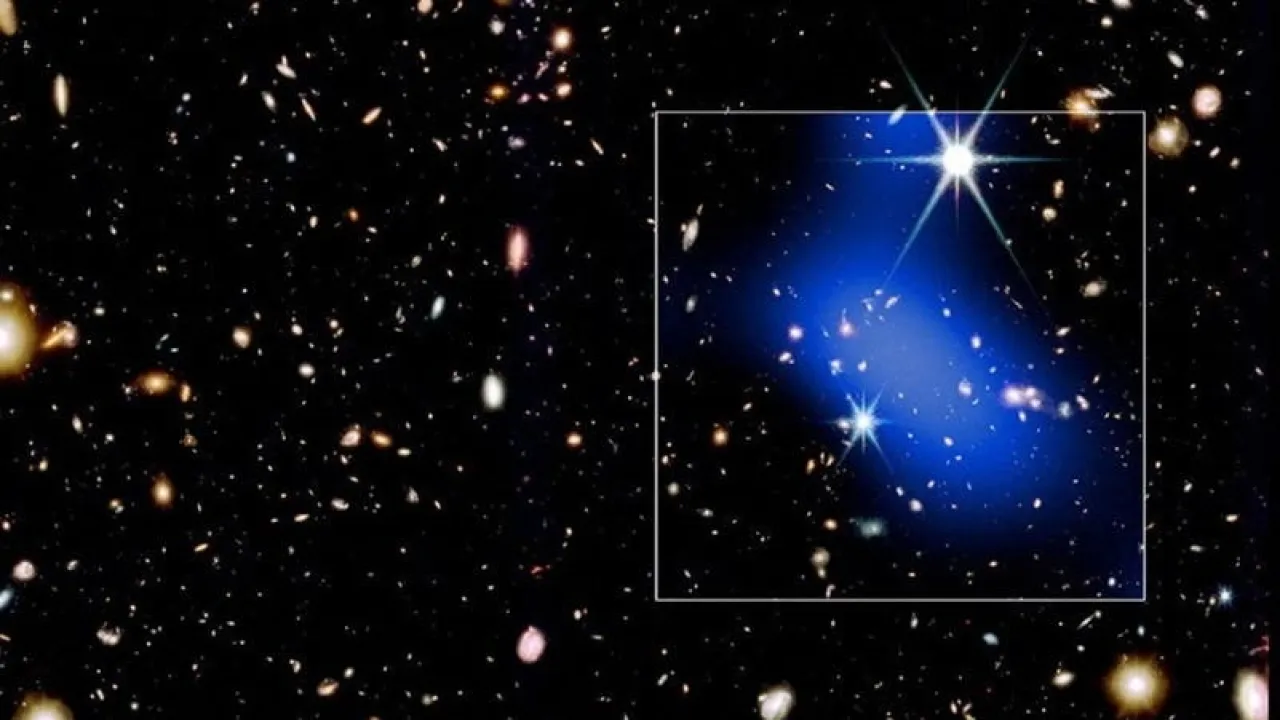
Khaberni - Observations enabled by NASA's James Webb Space Telescope and the Chandra X-ray Observatory provide new evidence that the universe grew at a much faster pace than previously known, with observations indicating the formation of a galaxy cluster or bundle soon after the Big Bang earlier than previously thought.
Researchers say these observations show an emerging galaxy cluster containing at least 66 possible galaxies, with a total mass of around 20 trillion stars the size of our Sun, dating back to about 1 billion years after the Big Bang, which initiated the universe around 13.8 billion years ago, according to Reuters.
While galaxy clusters are among the largest cosmic structures, it was believed they required much longer to form in the early universe. Our Milky Way galaxy is part of a galaxy cluster.
"Within a halo of hot gas"
In this regard, Akos Bogdan, an astrophysicist from the Harvard-Smithsonian Center for Astrophysics and the primary author of the study published in Nature, explained that "a galaxy cluster, as the name implies, is a collection of galaxies, usually ranging from hundreds to several thousand," noting that "these galaxies exist within a halo of hot gas reaching temperatures in the millions of degrees, and the entire system is held together by dark matter."
Dark matter, which does not emit or reflect light, accounts for about 85% of the matter in the universe. The remaining percentage is made up of ordinary matter, like stars, planets, and everything else visible.
Moreover, scientists infer the existence of dark matter based on its gravitational effects on a large scale, such as how galaxy clusters hold together.
Maturity phase
It is noted that the discovery of an emerging galaxy cluster reaching its maturity phase when the universe was about 7% of its current age came as a surprise to scientists. They also noted that this structure, which they called the "primary cluster," showed all features of a mature cluster such as the extremely hot gas halo and the central brightness distribution in X-ray emissions.
According to most models, the universe wasn't supposed to be mature enough or dense enough in galaxies to form an emerging galaxy cluster of this size at this early stage in its history. Until now, the oldest similar structure observed dates back to about 3 billion years after the Big Bang.