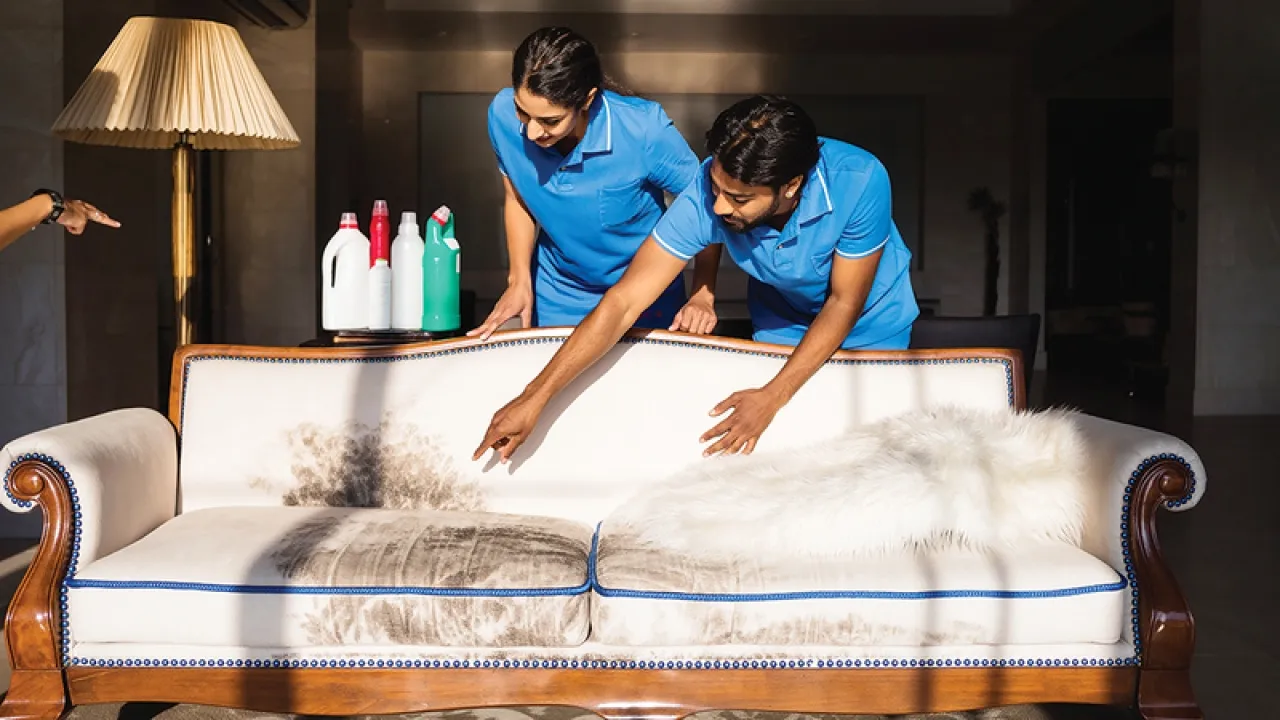
Khaberni - The Abu Dhabi Commercial Court (first instance) ruled that a furniture and upholstery cleaning company must pay a woman an amount of AED 10,000 as compensation for its failure to remove a stain on her sofa, causing damage to the fabric of the sofa, pointing out that the company's fault resulted in material and moral damages to the claimant.
In detail, a woman filed a lawsuit against an upholstery cleaning company, demanding it to pay her AED 10,000, including the value of the damaged sofa, material and moral compensation for the damage she suffered, the legal interest on the due amount from the date of filing the lawsuit until full payment, along with imposing on it the fees and expenses incurred in the case, and she attached to her claim photos of conversations between her and the defendant company, and an invoice for a sofa valued at AED 4375.
On the other hand, the representative of the defendant company submitted a responsive memorandum stating that the claimant had contacted the company to clean a sofa, and that they did what they could to remove the stains present on the sofa, but were unable to remove them completely. However, it is difficult to definitively remove stains. They contacted her again and offered her a solution to fix the sofa, stating it would involve completely changing the upholstery with original material, but she exaggerated the matter, demanding AED 3000 even though the sofa's price does not exceed AED 2000, pointing out that the company has not shied away from admitting their fault, despite no negligence on their part, but only because the customer service manager had promised the claimant to remove the stain without confirming the cause of the stain. This led them to take responsibility out of respect for their customers, and in conclusion, they sought to dismiss the claim due to the claimant's extortion and absolute arbitrariness, and alternatively, to be satisfied with obliging the claimant to hand over the sofa for reupholstering to remove the damage or estimate the value of the damages as the court sees fit, which would only compensate for the damage, and oblige the claimant to pay for the fees and the lawyer's fees.
For its part, the court explained in the rationale of its decision that, according to the law of civil transactions, every damage to another obliges the doer even if not distinguished to guarantee the damage, pointing out that the claimant sued the defendant company on the basis that the latter provides furniture and some upholstery cleaning services, and that she contacted them to clean a particular sofa of hers, and that the employees of the latter came to her home to clean the sofa. After finishing the cleaning, she was surprised by their use of unsuitable cleaning materials, which led to damage to the sofa, and by communicating with the defendant they tried to solve the problem three times until they confirmed that the sofa fabric was damaged and could not be restored as evidenced from the social media application "WhatsApp" conversations, and an agreement was reached amicably between the parties to compensate the first party by replacing the sofa, then the company revoked the agreement and asked her to take it for reupholstering, which did not satisfy the sofa owner, the claimant.
The court pointed out that a fault from the defendant company in damaging the sofa owned by the claimant was proven, and this was linked to the damage incurred by the latter due to the damaged fabric of the sofa owned by her, which necessarily will lead to her bearing the cost of repair or replacement in addition to compensation for the moral damages incurred on her by not providing the latter the required service in a proper manner, forcing her to lodge a complaint with consumer protection, then turning to the court to seek compensation. Consequently, she is entitled to compensation for the material and moral damages she suffered, and the court ruled that the defendant must pay the claimant compensation of AED 10,000 for material and moral damages, and the delay interest thereon at a rate of 5% annually from the date this decision becomes final until full payment, and imposing on them the expenses of the lawsuit.