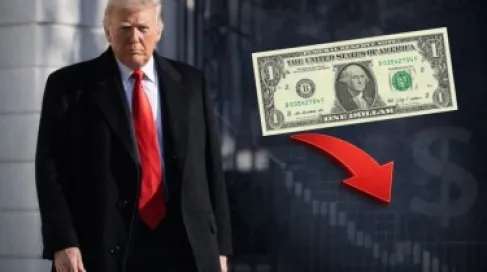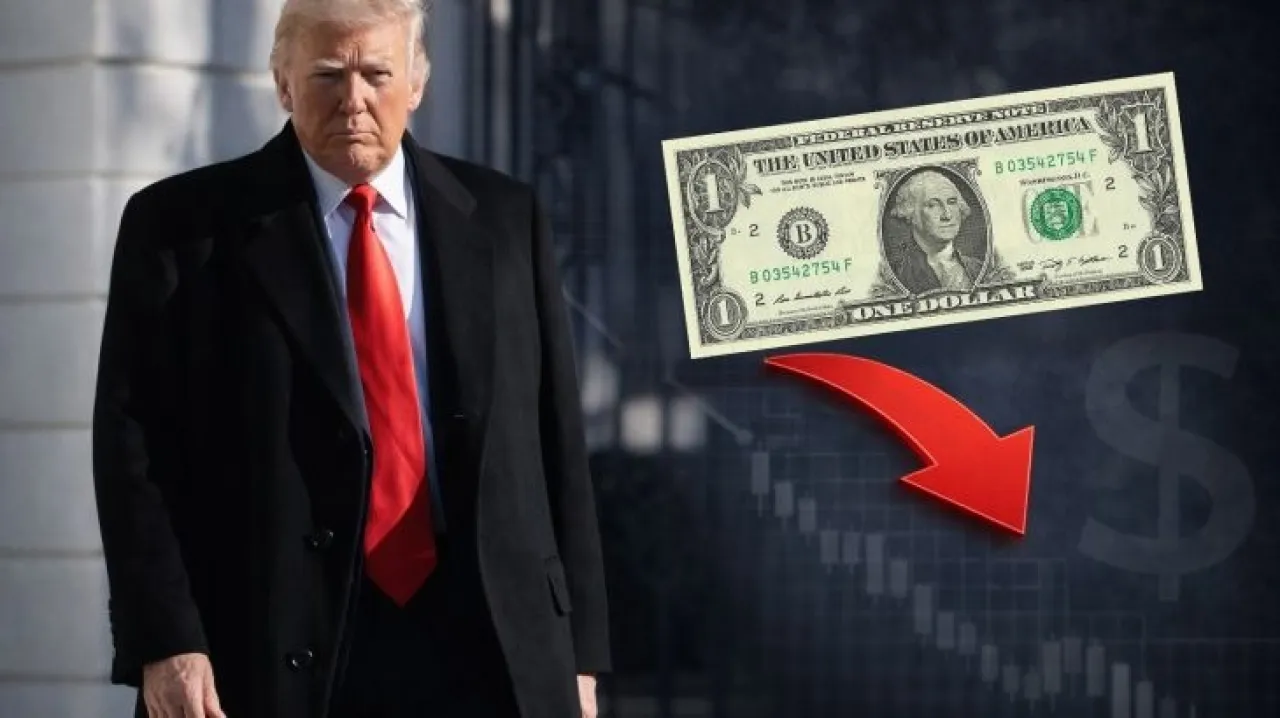
Khaberni - President Donald Trump's remarks about the decline in the US dollar exchange rate have elicited widespread reactions in global markets, and his statements have received significant attention from analysts, amid expectations that the dollar might see further declines in the coming period.
Trump said during his visit to the state of "Iowa" whether he was worried about the declining dollar exchange rate: "No.. I think it's great," adding: "Look at the value of the dollar and the size of our business.. The dollar is in great shape."
The Financial Times stated that concerns have escalated in currency markets due to what it described as the "President's erratic policies," noting that the dollar fell by 1.3% against a basket of other major currencies, reaching its lowest level in four years. It also has dropped by 2.6% since the beginning of the year.
Conversely, according to the newspaper, the demand for safe havens has increased, where the price of gold rose to surpass $5200 per ounce (ounce), while the price of silver reached $112 per ounce.
The newspaper quoted the head of investment at Royal London, Trevor Greetham, saying that the strength of gold and the weakness of the dollar "highlight the uncertainties about Trump's chaotic and unthought-out policies."
Reasons for the Decline in Dollar Exchange Rate
Economic journalist Hatem Ghandir stated that the dollar has been on a decline for over a year now, explaining that the American currency is subject to several pressures that have caused its exchange rate to decrease, including:
• Geopolitical pressures linked to political and trade tensions, and the US administration's policy towards partners and adversaries.
• The current state of the American economy, especially with regard to the US budget deficit and massive public debt.
• That the United States is on the verge of another government shutdown that could remind of the previous one due to disagreements between Republicans and Democrats.
• Meetings of the Federal Reserve regarding the interest rate, which is expected to stabilize the rate after three previous cuts. Reducing the interest rate, as mentioned by Ghandir, means that the dollar becomes less attractive to investors compared to other havens like gold.
• Ghandir clarified that the relationship between the dollar and gold is generally inverse. As the price of gold rises, the interest in the dollar decreases because investors have other alternatives to hedge against inflation.
What Are the Reasons Behind Trump's Statements About the Weak Dollar?
The CEO of investment strategies at the Fortress Investment, Mustafa Fahmi, explained that there are many factors behind Trump's specific comments about the dollar, some of which are domestic and some are attempts to anticipate upcoming developments.
Regarding the domestic US issue, Fahmi said Trump is trying to influence decisions of the Federal Reserve, which he knows will not cut the interest rate, explaining that "not cutting the rate is a nightmare for Trump at this time in the midst of a declining economy, high real inflation, waning popularity, and a debt nearing explosion."
Fahmi added that Trump "is always seeking to appear in control, that he is the one moving things," noting that the US president "anticipates upcoming crises and a significant decline for the dollar during 2026."
Fahmi sees that "markets will take Trump's statements as a negative signal for the future of the American economy, which no longer relies on the natural data of the world's largest economy but on the whims of the president," adding that this "will threaten the bond markets and holders of American debt who will definitely opt to sell."
Impact on American Exports
Analysts from Bloomberg stated that the Trump administration views the decline in dollar exchange rate as an advantage for American exports that would reduce their prices, potentially increasing their demand in international markets.
The chief economist at Nassau Bank in New York, Wayne Thain, said, "Many in the Trump administration want the dollar to be weak so that exports can be more competitive," but he warned that this represents "a calculated risk," as lowering the dollar's exchange rate might have undesirable outcomes.
Stephen Jin, the founder of "Yurizun", told Bloomberg that the Trump administration's view of the dollar signifies the beginning of a new phase of its decline, indicating that this administration aims for an exchange rate that supports American exporters.
Meanwhile, Rodrigo Cartel, the currency market strategic analyst at National Bank of Australia in Sydney, said that Trump's statements clarify that his administration is not against a drop in the dollar's exchange rate, as it increases the Chinese yuan and Japanese yen exchange rates, thereby raising the prices of Chinese and Japanese imports.
What Are the Risks of a Weak Dollar Policy?
However, the policy of lowering the dollar's exchange rate—which aims primarily to increase American exports and raise import prices—might carry risks for the American economy, according to what Robert Kaplan, vice president of Goldman Sachs Banking Group, told Bloomberg.
Kaplan added, "The weak dollar boosts exports, but the United States has $39 trillion in debt, heading towards $40 trillion."
He continued, "When you have debts of this size, I think currency stability trumps increasing exports," adding, "The United States wants a stable dollar and stability. It wants to be able to sell long-term treasury bonds, and a stable dollar assists with that." Al Jazeera