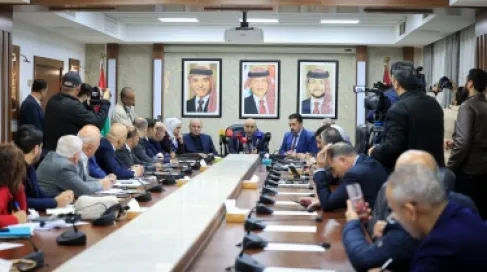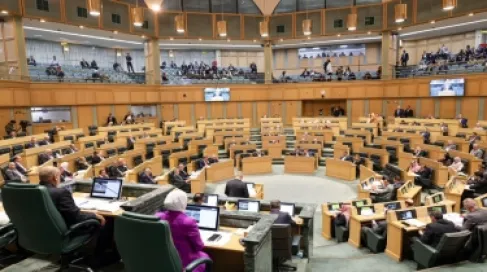
Khaberni - The parliamentary health and food committee, chaired by MP Ahmad Alsarrahneh, held a meeting on Tuesday to discuss the tax imposed on private sector doctors, attended by the head of the Jordanian Medical Association Dr. Issa Al-Khashashneh, the Director General of the Income and Sales Tax Department Dr. Hossam Abu Ali, and a number of specialists.
Alsarrahneh confirmed that the meeting aims to come up with outputs that satisfy all parties, and to reach a balanced tax formula that achieves tax fairness, without harming the medical staff or imposing additional financial burdens on citizens.
He explained that the committee is keen to discuss all the comments and complaints received transparently and responsibly, emphasizing the rejection of any attempts at tax evasion, and the necessity of protecting public funds, to ensure the sustainability of the health sector and the quality of its services.
Meanwhile, committee members Hikmat Maadatat, Hail Ayash, Ayman Abu Al-Rub, Shaher Al-Shatnawi, Hussein Al-Tarawneh, Baker Al-Haissa, and Mohamed Al-Marayat stressed the importance of adopting fair and transparent standards in imposing the tax, taking into account the nature of medical work and the different income levels among doctors, with the need to protect patients from any potential increase in the cost of health services.
On his part, Al-Khashashneh confirmed that what is issued by the Income and Sales Tax Department is an implementation of the law and not personal decisions, and that everyone is subject to the tax legislation in force.
Al-Khashashneh pointed out the union’s rejection of tax evasion in all its forms, calling at the same time to address some tax practices that may harm a number of doctors, and demanding the review of several axes to ensure fairness and transparency, especially the mechanism for calculating the tax, taking into account actual expenses of doctors, and reconsidering the penalties due for late submission of tax declarations, in addition to addressing the mechanism for counting free operations to prevent imposing unjustified burdens.
In his turn, Abu Ali reviewed the mechanism for calculating tax and expenses, and dealing with free operations, emphasizing the necessity for the doctor to provide an official letter specifying the names of the beneficiaries of the free operations, whether for humanitarian reasons or for family members or friends, to ensure transparency and accuracy in the procedures.
Abu Ali also announced the department’s readiness to provide support and clarification through educational courses at the Medical Association headquarters or via the "Zoom" application, in addition to setting up a hotline to answer tax inquiries, committing to expedite the audit of tax decisions for previous years.
He emphasized that the tax procedures take into account the specificity of the medical profession and the current economic conditions, assuring that the goal of the tax audit is not to limit the humanitarian aspect of the profession, but to achieve fairness, protect compliant taxpayers, and deter tax evasion cases.
At the end of the meeting, the committee recommended forming a joint committee comprising the Medical Association and the Income and Tax Department, with the aim of reaching consensual decisions that serve the public interest of both parties.