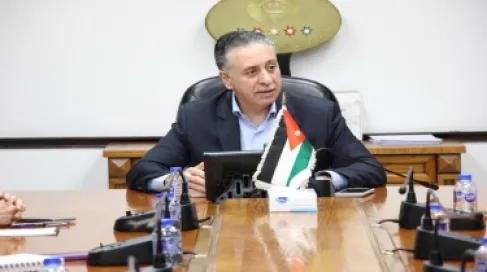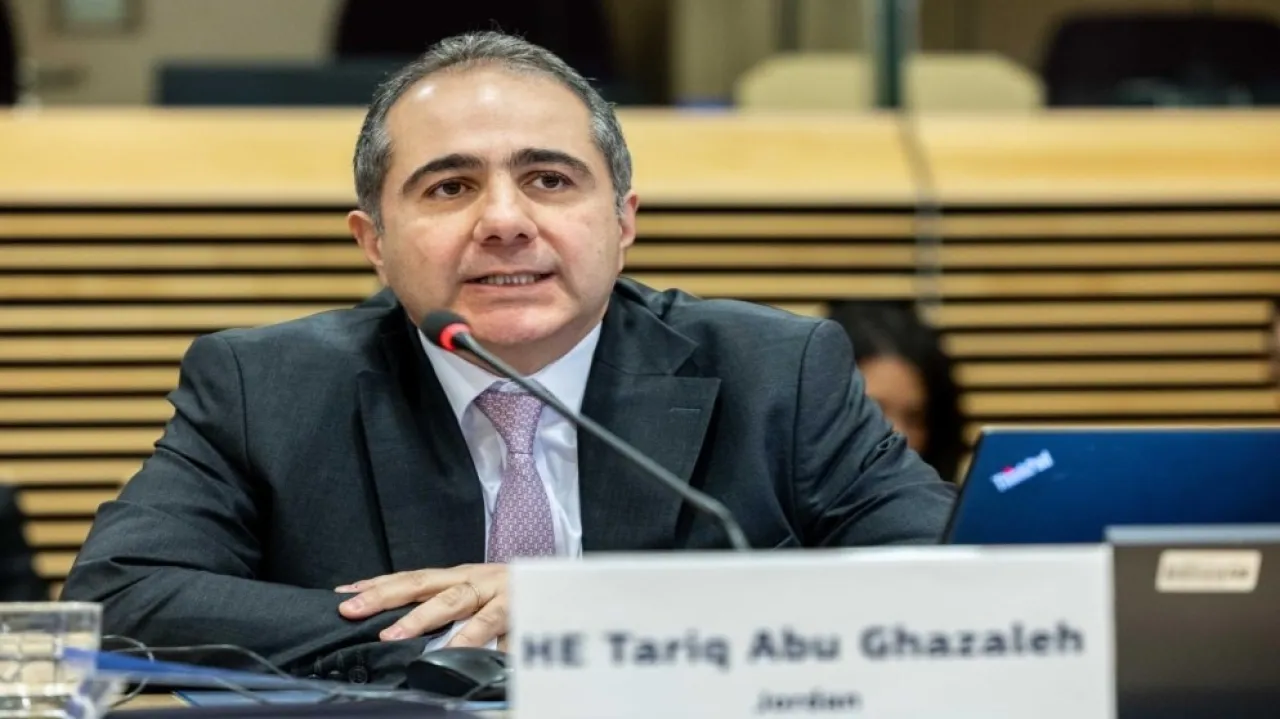
Khaberni - Minister of Investment Tareq Abu Ghazaleh said on Monday that Jordan is moving forward in implementing the economic modernization vision in its ten-year plan, pointing out that the vision has allowed each government to build on what was accomplished by the previous one to enhance integration and benefit from achievements and continue efforts within a fixed goal for each sector and the economy.
He added during a high-level dialogue session to highlight the investment environment and advantages in Jordan at the European Commission headquarters in Brussels, that Jordan will "launch on new pillars" where it will enhance the role of the private sector further through partnerships, making business practices easier, and offering enticing incentives to ensure success and profitable investments.
Abu Ghazaleh explained that the vision is based on eight growth engines, and among the main engines is "Invest in Jordan," noting that the investment proposal highlights aspects of openness, employment, and opportunity, and then presents general sectoral opportunities at a high level that will be launched this year.
The minister said that Jordan's strategic location is a fundamental element, not only as a market itself but also as a gateway to other markets, noting that Jordan holds extensive trade agreements that cover and link it to large and attractive markets.
He mentioned that Jordan has eight major free trade agreements that provide access to 140 countries, in addition to 49 bilateral agreements for the protection and encouragement of investment with certain countries, linked to 39 agreements to avoid double taxation, explaining that recent amendments to the Investment Law and the Environmental Law were made, allowing greater flexibility and quicker government response to meet the needs of the private sector.
He added that direct foreign investment is rising steadily, recording a 30% increase compared to the previous year, and that foreign reserves are close to 26 billion dollars, reflecting the robustness of the "central bank and monetary policy" and contributing to a GDP of approximately 57 billion dollars.
Abu Ghazaleh confirmed that Jordan is looking into the future and sustainability, moving forward as a leader in the region in renewable energy, noting that many projects established in the early millennium are now yielding outputs, and that Jordan aims to double its percentage in renewable energy.
He added that there are good initial indicators, figures, and outputs from exploring the Risha region in eastern Jordan, and that the Risha gas field remains open for private investment and exploration.
He clarified that energy storage in the future, whether through batteries or hydroelectric energy storage, is a main station, noting that two main projects will be announced and tendered this year, in addition to expanding wind energy generation.
Abu Ghazaleh said that Jordan continues to move forward with producing green hydrogen as a main direction for energy, noting that Jordan has 14 memorandums of understanding with several countries around the world, and that shared infrastructure use represents an open business opportunity to support these future investments.
He noted that Jordan has invested heavily to provide good infrastructure for private businesses, and that it has specialized sites for business practices including development zones, free zones or special economic areas.
Abu Ghazaleh said that the map of the areas shows about 20 major developmental areas spread geographically, many of which specialize in particular sectors, considering that Jordan's strategy is based on enhancing the specialization strength of each area and ensuring the integration of backward and forward supply chains, reducing investment costs and business practices, and putting the cost of manufactured goods in a very good position.
He noted that Jordan possesses some minerals, explaining that it has the fifth-largest phosphate reserve, and as for potash, Jordan is the seventh largest producer in the world, considering that this creates an opportunity especially in the manufacture of fertilizers and food security not only for the Middle East but also for Europe.
He noted that Jordan hosts a large number of successful multinational brands that are key drivers of employment, noting that their success extends beyond Jordan to the Middle East, and that many companies serve the world through their back offices in Jordan.
In the transport sector, Abu Ghazaleh said that Jordan is working on using a toll road system, light rail, and the dry port to provide good infrastructure that supports logistics and mobility.
He also pointed to mining opportunities from uranium to silica and basalt and other elements, and to agriculture to support Jordan's food security, and to water in all its aspects including the resilience of the systems, unaccounted water, and wastewater treatment.
In the urban development axis, he said that Jordan is looking forward to building a new city to alleviate pressure in current population centers, describing it as a major accomplishment that is starting to be established, and that the first phase will include four major projects over the next three years.