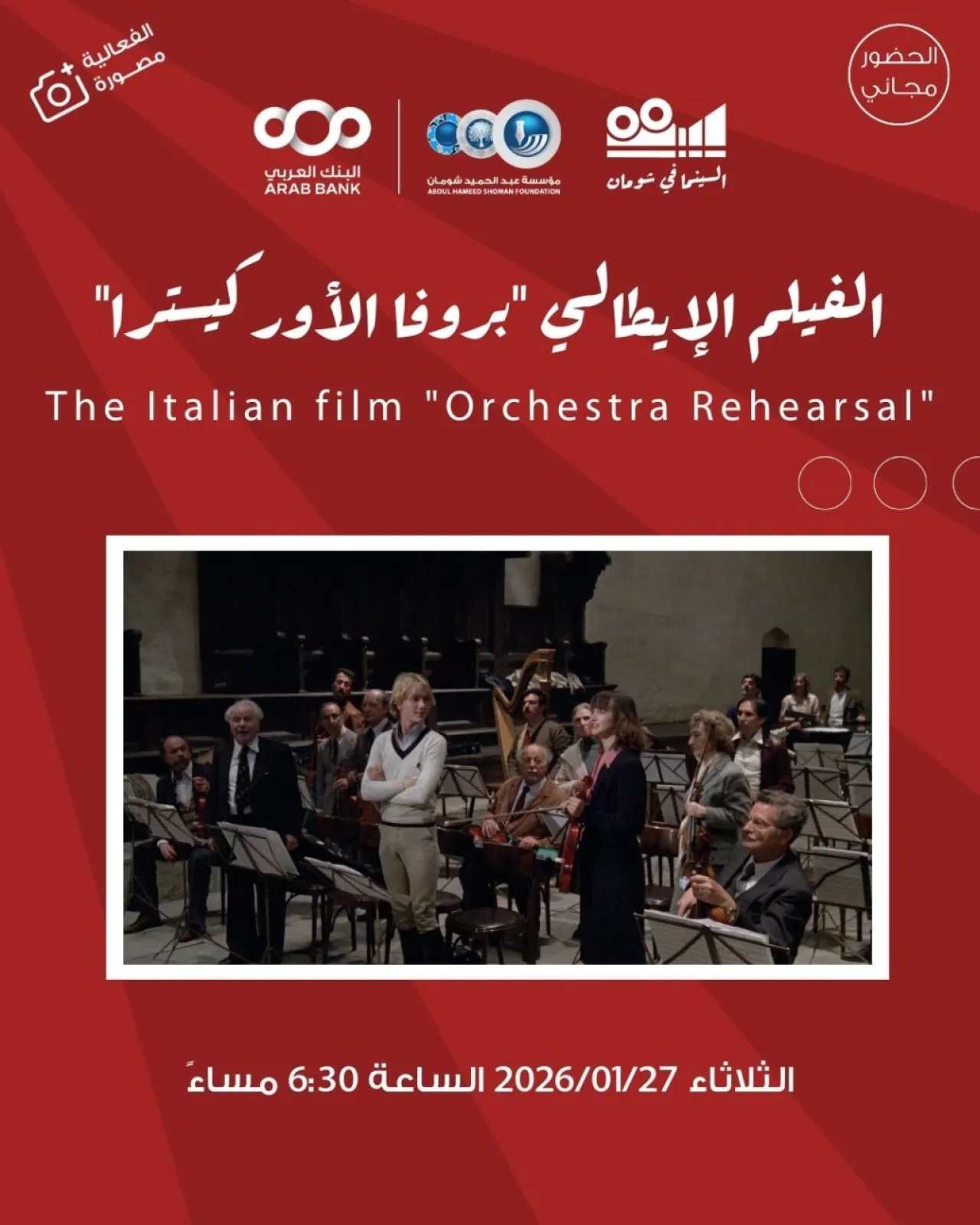
Khaberni – The Cinema Committee at Abdel Hamid Shoman Foundation, tomorrow Tuesday, at exactly six-thirty PM, presents the Italian film "Orchestra Rehearsal" directed by Federico Fellini, at the foundation's headquarters in Jabal Amman.
The film initially suggests that it is a documentary about a musical band practicing some music, but soon the film takes on new various dimensions, becoming a magical show befitting Fellini's genius.
Fellini writes in his memoirs describing his work on this film: "The time and place of 'orchestra rehearsal' are comments on the twentieth century. After the titles appear on a darkened screen, with the jarring noises of Rome's streets in the background, the image gradually shifts to a candle-lit church. The old copyist who distributes the parts to the band members wears clothes as if from another century. He turns to the camera and says: This church was built in the thirteenth century, and three popes and seven bishops are buried in it. Because its acoustics are excellent, it was renovated to be used as a music rehearsal hall. Musicians come to this sacred place in groups, and many seem as if they are here to watch a football game rather than to play music, and one of them even carries a small radio to keep track of the game and relay the results to his fellow wind instrument players during the rehearsal. Not all musicians are this indifferent. Some of the senior ones, including the copyist and the 93-year-old music teacher, remember a time when musicians were more serious, and therefore played better."
The musicians speak in all Italian dialects, and there are also some foreign accents. The German band leader reverts to his native language when agitated. Perhaps he is resentful; because he is leading a second-tier Italian orchestra instead of conducting a symphony orchestra in Berlin.
Rehearsal begins like traffic in Rome, which is heard at the beginning, and most players wish it would end so they could go somewhere else. For them, playing is just a job, like working in a car factory. The band members joke with each other, listen to the results of a football game on the radio, chase a mouse, get distracted by other trivial diversions easily, the conductor becomes vulgar, and a union dispute follows leading to a ragged revolution where dung is thrown at posters of famous German composers.
This boyish chaos is interrupted by a wrecking ball unexpectedly penetrating the wall, killing poor fat Clara, the sympathetic harpist. Thus, order is restored through chaos, a recurrent human process overall. However, as with any revolution, something psychological is destroyed, and now the music must continue without the harp's role.
In the end, after the remorseful players realize their need for a leader, the orchestra conductor returns to the high podium. The band resumes playing from the beginning and trivial squabbles resume as well. Meanwhile, their leader delivers a forceful speech in German on a darkened screen.