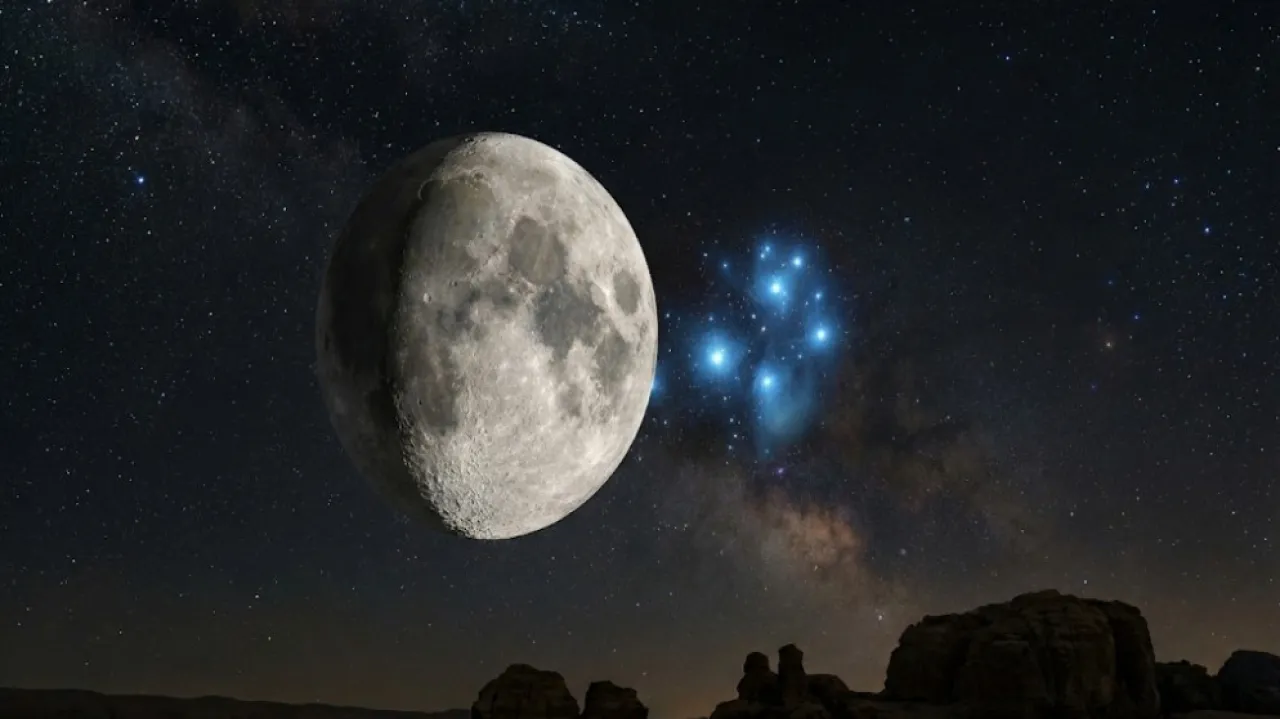
Khaberni - The night of upcoming Tuesday/Wednesday will witness a conjunction of the moon at the age of nine days with the Pleiades star cluster (The Seven Sisters), both in the constellation of Taurus, observed from the skies of Jordan and most parts of the Arab region, according to Ammar Al-Sakaji, president of the Jordanian Astronomical Association.
Al-Sakaji explained that the moon approaches the Pleiades throughout the night, with the peak proximity around 12:18 AM to 2:51 AM Jordan time on Wednesday. During this period, the moon will obscure some stars of the Pleiades in a beautiful phenomenon that combines conjunction and occultation.
Geographically, from the city of Amman and its suburbs, the angular distance between the moon and the Pleiades star cluster at 12:18 AM is approximately one degree and fourteen arc minutes. The moon then gradually approaches, reaching a distance of about 47 arc minutes by around 1:50 AM, before they both set together about an hour later.
According to Al-Sakaji, this spectacle can be observed with the naked eye, particularly from areas with less light pollution, especially desert regions far from cities. It can be seen more clearly with binoculars and telescopes, and is an ideal target for astrophotography using both professional cameras and mobile phones. We look forward to iconic images from astronomy enthusiasts and astrophotographers.
Al-Sakaji pointed out that this conjunction occurs when the moon is approximately nine days old, appearing close to the Pleiades in the winter sky. The Arabs summarized the significance of this scene with their traditional saying: 'Conjunction at Nine... Biting Cold', a modern astronomical reading within the ancient Arab star calendar (the science of weather prediction).
Al-Sakaji also explained that this phrase was not just a fleeting expression among desert folk, but a summary of extensive practical experience, written across the sky, where 'Nine' here refers to the age of the moon when it reaches about nine days, and 'Biting' describes an intense, sudden cold that often coincides with this conjunction in mid-winter.
Astronomically, the conjunction of the moon with the Pleiades occurs during a period when the sun is at its lowest elevation, the night is nearly at its longest, and solar radiation is at its lowest. Under such conditions, a significant drop in temperature occurs at night, intensifying the cold significantly, even if preceded by mild days. From this was born the description 'Biting': a cold that penetrates the bones and is not to be underestimated, according to Al-Sakaji.
Al-Sakaji added: "The desert folk did not see the moon and the Pleiades as mere celestial ornaments, but as a practical calendar for life. When the nine-day-old moon 'embraces' the Pleiades, they realized that a harsh phase of winter had begun; they would tighten their travel plans with caution, add layers of wool, bring firewood closer, and postpone long journeys," he said, noting that it was a complete lifestyle management based on a single celestial conjunction.
He continued: This conjunction this year occurs at the end of the forty days of winter and approaching the fifty days, just days before the season of 'Saad the Slayer,' which begins with the rise of the star Suhail in early February, a season historically known for its severe cold and fluctuations, as our ancestors said: 'The reputation is for the mid-winter, but the action is in February.'
Al-Sakaji pointed out that this folk wisdom perfectly aligns with modern astronomy; the phases of the moon determine the conditions for nighttime observation, and the position of the Pleiades in the sky determines the season. Their meeting at a specific lunar age announces a seasonal peak of cold. What our ancestors said in poetry and wisdom is confirmed today by modern astronomical calculations with numerical language.
He added: "But today, with the advancement of science and technology, weather knowledge no longer depends solely on astronomical events as in the past, but is determined with high precision through modern weather forecasting models, satellite images, and direct measurements of basic weather parameters such as temperature, humidity, atmospheric pressure, and wind speed. These scientific tools allow for highly accurate forecasting of weather changes in the short and medium term, tracking the development of air masses and atmospheric depressions moment by moment, making weather reading today a science based on data and physical modeling, not just on traditional observation, though this tradition retains its cultural and knowledge value in understanding the ancient human relationship with the sky and seasons."