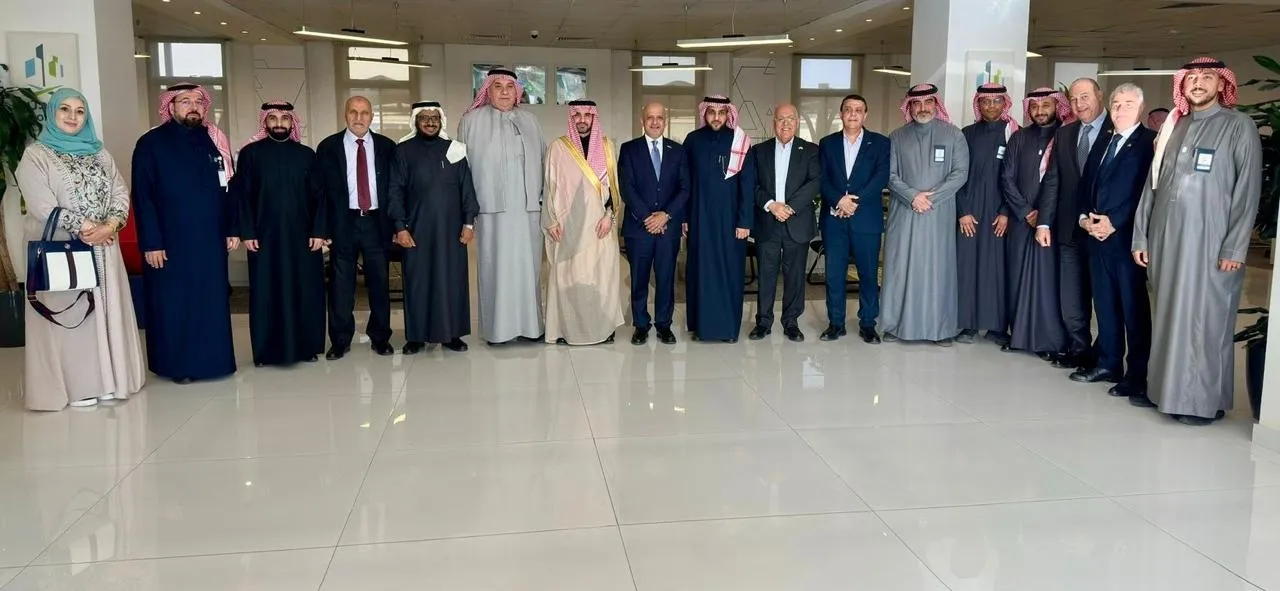
Khaberni - The Jordanian economic delegation participating in the Saudi-Jordanian Business Forum in Riyadh discussed, during meetings with the Saudi Standards, Metrology and Quality Organization and the Saudi Industrial Cities Authority, ways to enhance economic and trade cooperation between the two brotherly countries.
The meetings, chaired by the President of the Chambers of Commerce of Jordan and Amman, the head of the Jordanian-Saudi side, Senator Khalil Al-Hajj Tawfiq, and with the participation of representatives from various commercial sectors, heads of chambers of commerce from several provinces of the kingdom, in addition to representatives of economic sectors and union presidents, and a number of Jordanian businessmen and investors, aimed to support the flow of goods and expand partnership opportunities between the two countries.
Al-Hajj Tawfiq said that the visit of the Jordanian economic delegation to the Saudi Standards, Metrology and Quality Organization came within the framework of keenness to open wider prospects for cooperation and institutional coordination between the two sides, which serves the trade exchange movement and enhances the presence of Jordanian products in the Saudi market.
Al-Hajj Tawfiq explained that the visit aimed to activate direct communication channels through the Jordanian-Saudi Business Council, by adopting liaison officers and a dedicated window for inquiries, enabling structured and effective delivery of observations and suggestions of Jordanian exporters, and contributes to addressing the technical and procedural challenges they may face.
He mentioned that an agreement was made to facilitate the entry of Jordanian goods from various sectors into the Saudi market, by clarifying the requirements, documents, and technical instructions, so they are clear and updated in front of the producer and Jordanian exporter, reflecting positively on the speed of the procedures and the smoothness of the trade flow.
Al-Hajj Tawfiq added that, on the level of importers, an agreement was reached to establish a joint coordination platform managed by the Chamber of Commerce of Jordan to monitor observations from both sides, whether from exporters or importers, ensuring continuous communication around any updates or modifications to the related systems and instructions, to keep all parties immediately informed.
He confirmed that, through its specialized sectorial committees, it will continue to directly follow up on these files, stemming from a firm conviction of the importance of facilitating the flow of Jordanian goods into the Saudi market, enhancing mutual trust, building an economic partnership based on clarity and integration, and serving the interests of the private sector in both brotherly countries.
In related developments, Senator Al-Hajj Tawfiq confirmed that the visit to the Industrial Cities Authority represents an opportunity to learn about the kingdom's experience in developing industrial cities and linking them with its ambitious economic vision "Vision 2030."
He said what we saw at the Industrial Cities Authority reflects the integration between various investment loops, starting from industrial specifications and standards to fostering an investment-friendly environment, confirming that this experience can be a model to benefit from in Jordan.
He pointed out that the Industrial City of Tabuk, close to the Jordanian border, offers real opportunities to enhance trade cooperation between the two countries, noting that Jordan possesses an ambitious economic vision extending from 2023 to 2033, under the direct supervision of His Majesty the King and the Crown Prince, aiming to achieve legislative stability and ensure clear and sustainable investment projects.
He highlighted that Jordan and Saudi Arabia are striving to enhance the economic partnership between the private and government sectors, which achieves market integration and opens new investment and trade exchange opportunities between the two countries.
In turn, Mohammed Al-Sanee, the Director of Quality Mark Management at the Saudi Standards, Metrology and Quality Organization stated that the tasks of Saudi Standards involve
establishing and adopting Saudi standard specifications for goods, products, services, and measurement and calibration devices, issuing regulations governing compliance evaluation activities and other certifications, in addition to implementing the national measurement and calibration system in the kingdom.
He added that the tasks also include ensuring the implementation of mandatory Saudi standard specifications (technical regulations) and compliance evaluation procedures adopted in coordination with related bodies, and participating in regional and international organizations related to standards, metrology, and quality, representing the kingdom in these organizations.
Al-Sanee explained that the goals of the organization include issuing Saudi standard specifications, quality systems, and compliance evaluation guides, aligned with international standards, fulfilling the requirements of the World Trade Organization agreement in this field, and compliant with Islamic law, serving the kingdom's interests.
He noted that the organization works on ensuring health, environmental, and public safety protection by verifying that products conform to approved standard specifications, along with ensuring the quality of national products through adopting appropriate Saudi standard specifications that enable national products to compete in local and international markets, and working to protect kingdom's markets from counterfeit and fake goods.
On his part, Engineer Badr Al-Madi, Vice President of the Saudi Industrial Cities and Technology Zones Authority, confirmed that the industrial cities in the kingdom, totaling about 42 cities, provide advanced infrastructure and integrated services to investors.
He pointed out that the authority is working on developing new industrial cities and is open to cooperation with regional partners, including the Jordanian market, noting that the Industrial City of Tabuk is the closest to the Jordanian border, facilitating enhancing cooperation and benefiting from this proximity in boosting trade exchange between the two countries.
The Industrial Cities Authority presented an introduction to investors about the available opportunities and services and providing the necessary support to enhance industrial partnerships between the two brotherly countries.
The visit included a field tour of the industrial cities, where the delegation was able to learn about several factories and their success stories, like the Al-Dekheil Oud factory.