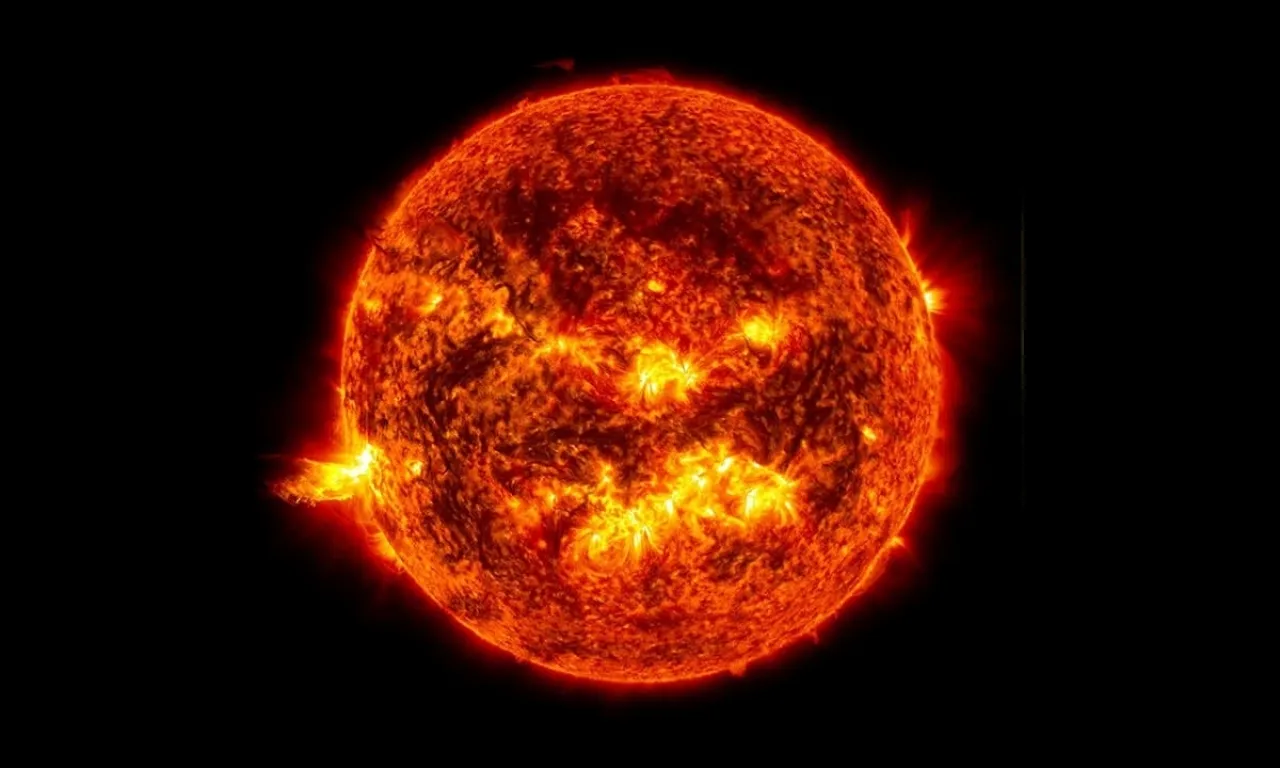
Khaberni - Russian and international astrophysicists, using the "Solar Orbiter" probe, have discovered a unique phenomenon in the solar corona that plays a pivotal role in the formation and primary energy source of solar flares.
Micho Janvier, co-leader of the Solar Orbiter project, said, "This is one of the most significant scientific results we have obtained using the probe. We discovered the central mechanism that generates the flare and the pivotal role of magnetic field energy release in a collapse-like manner during its formation. We are eager to know if this phenomenon is characteristic of all solar flares, as well as in other stars."
According to scientists, the Sun is a boiling plasma sphere, its upper layers constantly in motion, which, coupled with the high electrical conductivity of its material, generates a strong magnetic field. The lines of this field often extend beyond the sun's denser layers and then break apart, leading to the formation of sunspots, solar flares, and strong coronal mass ejections.
Solar Orbiter was the first to study in detail the processes preceding these phenomena on the sun's surface during one of its close approaches to it, which occurred in late September 2024. By coincidence, at that moment, a strong solar flare began to form, allowing the probe to observe the preceding processes in the solar corona using the EUI ultraviolet camera and three other scientific instruments.
The images and data showed that about 40 minutes before the flare began, a bright magnetic "loop" appeared in the solar corona. This loop then distorted and became unstable, leading to the reconnection of magnetic field lines in one of its regions and the release of energy. This resulted in a series of reconnection processes similar to an avalanche, increasing in size and energy emitted, ultimately generating a flare on the sun's surface.
These processes are accompanied by the acceleration of plasma particles to speeds approaching the speed of light, around 430–540 million kilometers per hour, and the release of strong X-ray bursts. These processes continue for some time after the solar flare forms. Researchers have not yet determined precisely how these magnetic collapses generate these X-ray bursts, but they hope that subsequent observations will reveal the mechanism.
It should be noted that Solar Orbiter is a joint project between NASA and the European Space Agency, with a cost of approximately 1.5 billion dollars. The probe is equipped with ten different instruments, six of which are continuously aimed at the sun, while the other four are used to study the environment surrounding the probe itself. The probe is also equipped with a special heat shield that allows it to approach the sun up to a distance of 42 million kilometers.