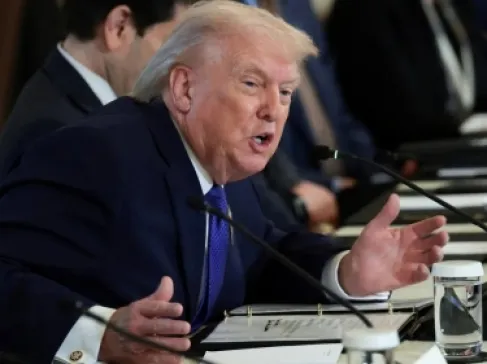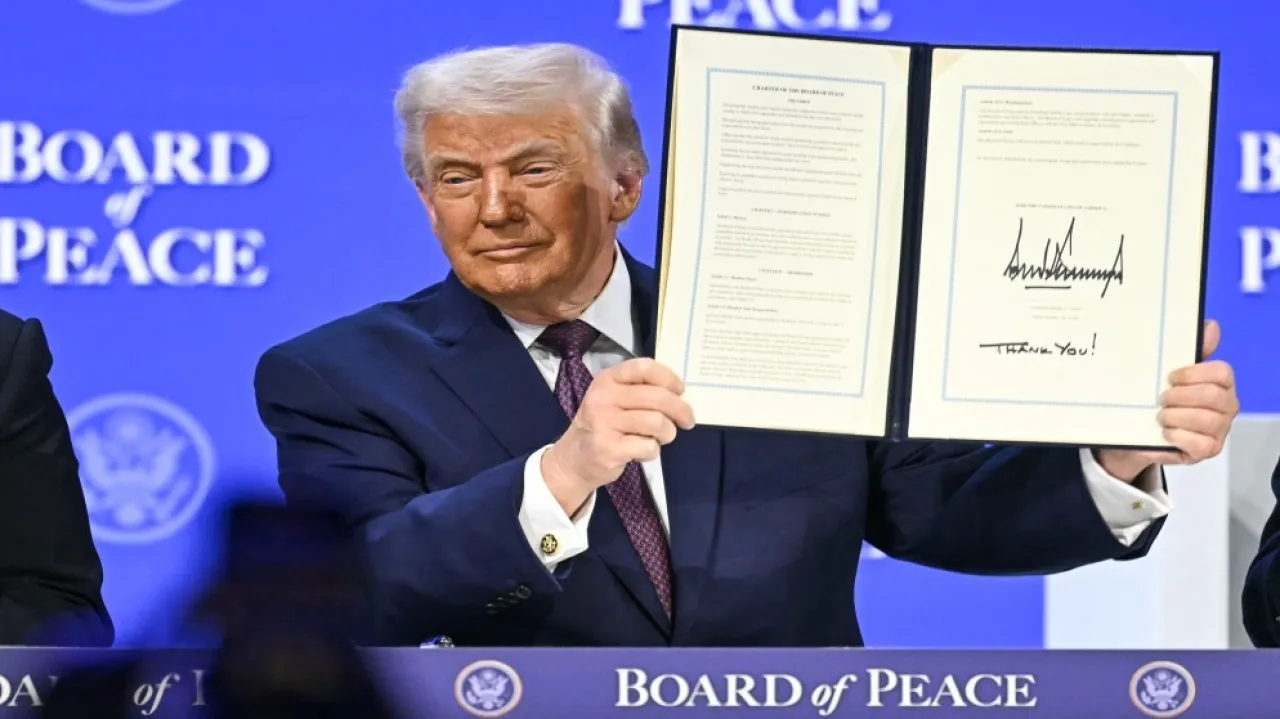
Khaberni - U.S. President Donald Trump officially signed the documents on Thursday that will establish the Peace Council Charter in a formal ceremony on the sidelines of the World Economic Forum in Davos, Switzerland.
Trump, who will chair the council, invited dozens of other world leaders to join him, stating he believes the council will address global challenges beyond the fragile ceasefire in Gaza, although he says it is not intended as a replacement for the United Nations.
Deputy Prime Minister and Minister of Foreign Affairs and Expatriates Ayman Safadi represented Jordan at the Peace Council launch ceremony, a day after Jordan accepted President Trump's invitation to His Majesty King Abdullah II to join the council.
Safadi affirmed in a joint statement with the foreign ministers of the United Arab Emirates, Indonesia, Pakistan, Turkey, Saudi Arabia, Qatar, and Egypt their support for the peace efforts led by Trump, and their commitment to supporting the implementation of the Peace Council's mission as an interim body as outlined in the comprehensive plan to end the conflict in Gaza, as adopted by United Nations Security Council Resolution 2803, aimed at establishing a permanent ceasefire, supporting the reconstruction of Gaza, and advancing towards a just and lasting peace based on fulfilling the Palestinian people’s right to self-determination and statehood as per international law, paving the way for achieving security.
Peace Council Draft
The administration of U.S. President Donald Trump has asked countries interested in obtaining a permanent seat in the new "Peace Council" he proposes, to contribute at least one billion dollars.
According to the Peace Council Charter draft, President Trump will chair the council as its first chairman, and will personally decide who is invited to be a member of the council, with decisions being made by a majority of votes, whereby each present member state gets one vote, subject to the president’s approval.
The draft states:
"Each member state will serve for a term not exceeding three years from the date this charter takes effect, with the possibility of renewal by decision of the president. The term condition of three years does not apply to member states that contribute more than one billion U.S. dollars in cash to the Peace Council during the first year of the charter taking effect."
The council is defined in the charter as "an international organization seeking to promote stability, restore trustworthy and lawful governance, and secure permanent peace in conflict-affected or threatened areas." The council will officially become an entity once three member states approve the charter.
The document also mentions that Trump will be responsible for adopting the official seal of the group.
Trump has invited several world leaders to participate in a "Gaza Peace Council," which will be established under the broader umbrella of the new Peace Council.
This plan quickly drew criticism from Israeli Prime Minister Benjamin Netanyahu, who stated that the details were not coordinated with his government.
According to informed sources, invitations have been extended to several European countries to join the council. The draft shows that Trump himself will control the funds, a matter deemed unacceptable by most countries that could have joined the council. The sources spoke on condition of anonymity due to the sensitivity of the topic.
They added that a number of countries strongly oppose the draft charter and are working collectively to counter these proposals.
An American official confirmed to Bloomberg News that member states can join for free, but paying one billion dollars grants them permanent membership. He clarified that the funds collected will be used directly to achieve the goals of the Peace Council, primarily the reconstruction of Gaza, ensuring that "nearly every dollar" is used to fulfill its mission.
According to the draft of the charter, the Peace Council will hold voting meetings at least once a year, "at times and places deemed appropriate by the president," and agendas will be subject to his approval. The council will also hold regular non-voting meetings with its executive board, at least on a quarterly basis.
Trump will also have the authority to dismiss any member, subject to a two-thirds majority veto by the member states. The charter states: "The president must appoint a successor at all times to serve as chair of the council."