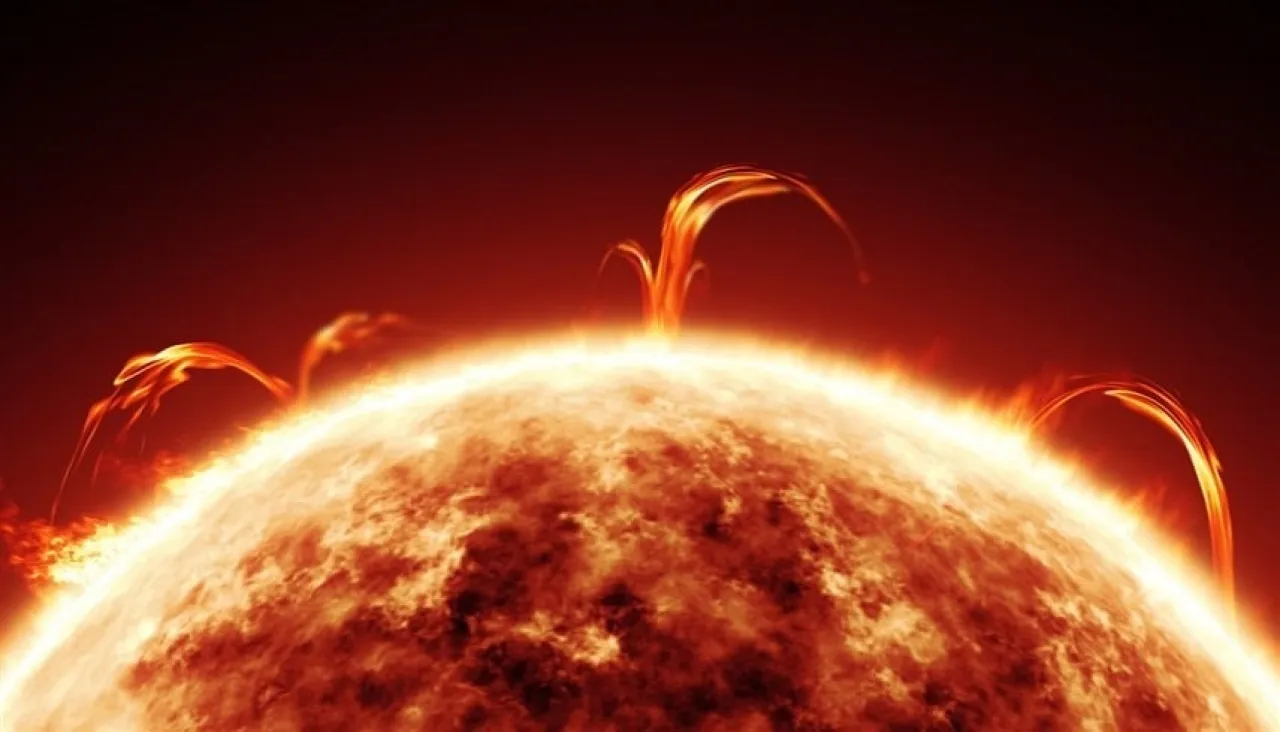
Khaberni - The Solar Astronomy Laboratory at the Space Research Institute of the Russian Academy of Sciences reported that the magnetic storm which started last night, Monday, on Earth, reached a level of G4.7, which is considered highly dangerous, with expectations that it could reach the maximum level of G5 within an hour to two hours, if the characteristics of the solar wind remain unchanged.
The laboratory explained that this geomagnetic disturbance was caused by the arrival of a dense stream of solar plasma to Earth, followed by the strongest solar flare recorded since the beginning of this year, which occurred on Sunday and was of the X1.95 category, marking the first X-category flare observed in the year 2026.
The scientists noted that the flow of solar protons near Earth has reached its highest levels in over twenty years, levels not recorded since October 29th, 2003, which preceded one of the most severe magnetic storms of the 21st century.
Simultaneously, the Space Weather Prediction Center affiliated with the National Weather Service of the USA announced that a level four (S4) solar radiation storm went into effect, described as the strongest in more than two decades, and the center explained that the potential effects are primarily focused on aviation, the launching of space vehicles, and satellite operations.
Space weather experts warned that these storms could lead to disruptions in navigation systems that rely on satellites, a decrease in the accuracy of the Global Positioning System (GPS), in addition to radiation risks to astronauts and passengers of flights that pass through polar routes.
The center confirmed that airlines, NASA, aviation authorities, emergency services, and electricity networks have been notified to take necessary precautionary measures, noting that widespread impacts on the general public are not expected to be significant yet.
Meanwhile, a severe terrestrial magnetic storm reached the planet on Monday afternoon, resulting from a coronal mass ejection from the sun, increasing the likelihood of disturbances in electric power networks, similar to what occurred during the October 2003 storms that caused power outages in Sweden and damage to electrical transformers in South Africa.
On a positive note, it is expected that this storm will lead to exceptional displays of auroras which might be visible in unusual areas, and predictions indicate the possibility of seeing the aurora in wide parts of the northern United States, and perhaps even southern areas like Alabama and northern California, as well as parts of the Midwest and the Northeast, depending on clear skies.
Upcoming Explosions
Solar physics experts explained that the aurora might appear as short, intense bursts known as substorms, lasting about 20 minutes, allowing it to be seen in areas further than usual. They also mentioned that smartphone cameras might capture the colors even if they are not clear to the naked eye.
The scientists concluded by noting that the active sunspot which caused this flare is still capable of releasing more explosions over the coming days, meaning that Earth could experience additional solar disturbances in the coming week.