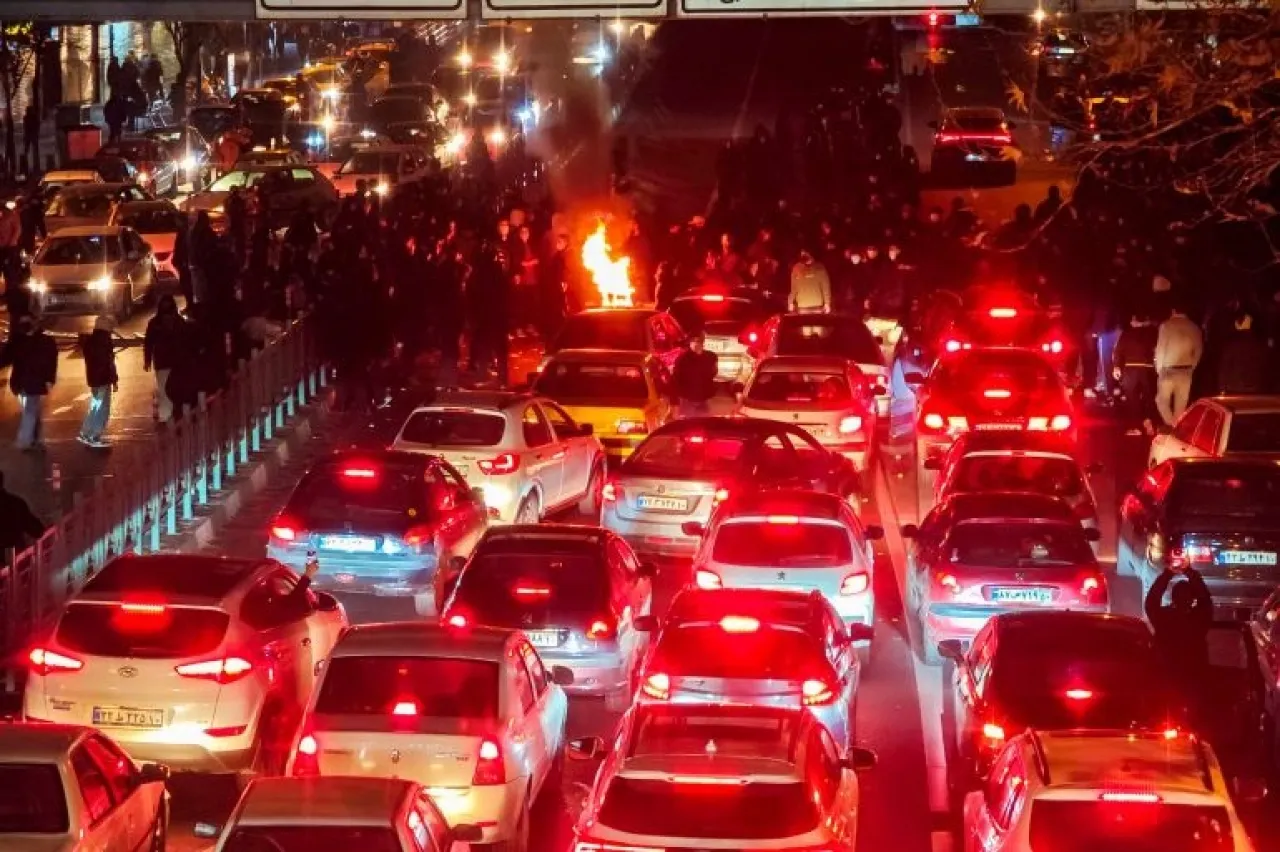
Khaberni - Once the dust of the protests that swept most Iranian cities in the past weeks settled, official institutions began to assess the material and human losses resulting from the confrontations that accompanied the living demands, while observers believe that the features of the indirect losses and their real ramifications have not yet become clear.
Tehran's Mayor Ali Reza Zakani announced approximate losses to public facilities belonging to the capital's municipality amounting to 30 trillion rials (about 20.7 million US dollars), confirming in a statement to journalists on the sidelines of the Iranian government meeting last Wednesday that 89 buses were damaged, some completely burned, in addition to two municipal buildings during the recent protests. (The US dollar is equivalent to 1.45 million Iranian rials)
Financial Losses
The Governor of Tehran, Mohammed Sadegh Mo'tamedian, revealed the destruction of a thousand vehicles including taxis, public transport buses, and private cars of citizens, in addition to the destruction of 54 ambulances, and 71 fire service vehicles, confirming—at a statement on the sidelines of the ministerial meeting—the damage to 44 mosques and 26 shopping centers, and a number of citizens' homes due to the recent events.
The official Iranian television broadcasted, on Friday, a comprehensive report about the most significant material and moral losses that affected the national economy due to the recent protests, confirming the burning of 3 large libraries, and major damage to 8 archaeological sites in addition to partial damages to 450 other archaeological sites.
The report confirmed damages to 4 cinemas, 250 mosques, 20 Husseiniyas, 265 educational centers, 182 ambulances, 1400 ATMs, 364 large stores, and 419 commercial shops across the country.
The concerned authorities estimate—according to Iranian television—the damage to the electricity sector at about 10 trillion rials (about 7 million US dollars), and to the banking network at about 21 trillion rials (about 14.5 million US dollars), in addition to the losses that affected service institutions such as municipalities, fire departments, public transport, medical centers, and sacred shrines.
Indirect Losses
The economic expert Saeed Laylaz believes that the features of the indirect losses of the recent events and their ramifications on the national economy have not yet become clear, pointing out that these events accelerated the decline of the Iranian rial during the past days and weeks.
The Iranian researcher noted the size of the sums the government needs to pay for reconstruction efforts post-protests, describing these sums as "large," according to Al Jazeera.
Saeed Laylaz mentioned that this level of expenditure would raise the budget deficit and push the central bank to print money again, adding that this would negatively reflect on the value of the rial and inflation.
He also expected that the recent events would lead to increased political tensions with the United States, resulting in heightened international pressures on the Iranian economy.
Digital Economy
Observers in Tehran believe that the decisions and policies adopted at the national level imposed an additional burden on an economy already burdened by American sanctions, warning of the dangers of continuing the policy of internet cuts, which could destroy what remains of the digital economy.
Bisoten Porbizshek, vice president of the Iranian Digital Business Union, warned that the widespread and repeated internet outages cause severe damage to the country's digital economy and threaten the existence of small and medium-sized companies operating through electronic platforms.
He confirmed that sales of more than 90% of these small companies experienced a sharp decline, causing losses estimated at trillions of rials.
According to Porbizshek's estimates—who also manages the "Badoro" electronic services platform—the current situation has led to the actual stoppage of more than 100,000 electronic stores on the Badoro electronic platform he manages.
He mentioned that more than a million jobs related to commercial activity on other social platforms like "Instagram" face several challenges, with the small digital companies' ability to withstand these successive shocks declining.
Porbizshek, in an interview with the "Zoomit" news site, described the state of uncertainty and lack of clarity regarding when the internet would fully return as "the main factor of psychological and economic pressure" on the sector's workers, expressing his concern about the close intervals of internet outages.
He also warned that the continuation of this situation would lead to the gradual withdrawal of many actors from the digital economy.
While the full picture of the human losses remains absent amid complete internet cut-offs and restricted telephone communications, the official authorities announce that the precise statistics on the number of victims are being estimated, while the Iranian opposition abroad speaks of thousands of casualties during the recent events amid official denial of these figures.
The Iranian sociologist, Majid Abhari, raised warnings regarding the deep psychological and social ramifications of the recent events in the country, considering that the real damage "far exceeds" merely the material losses.
He spoke about the difficulty of overcoming psychological shocks, particularly those affecting women and young people, asserting that evaluating these events in purely financial terms is a mistaken approach and fails to capture the true dimensions of these events' impact.