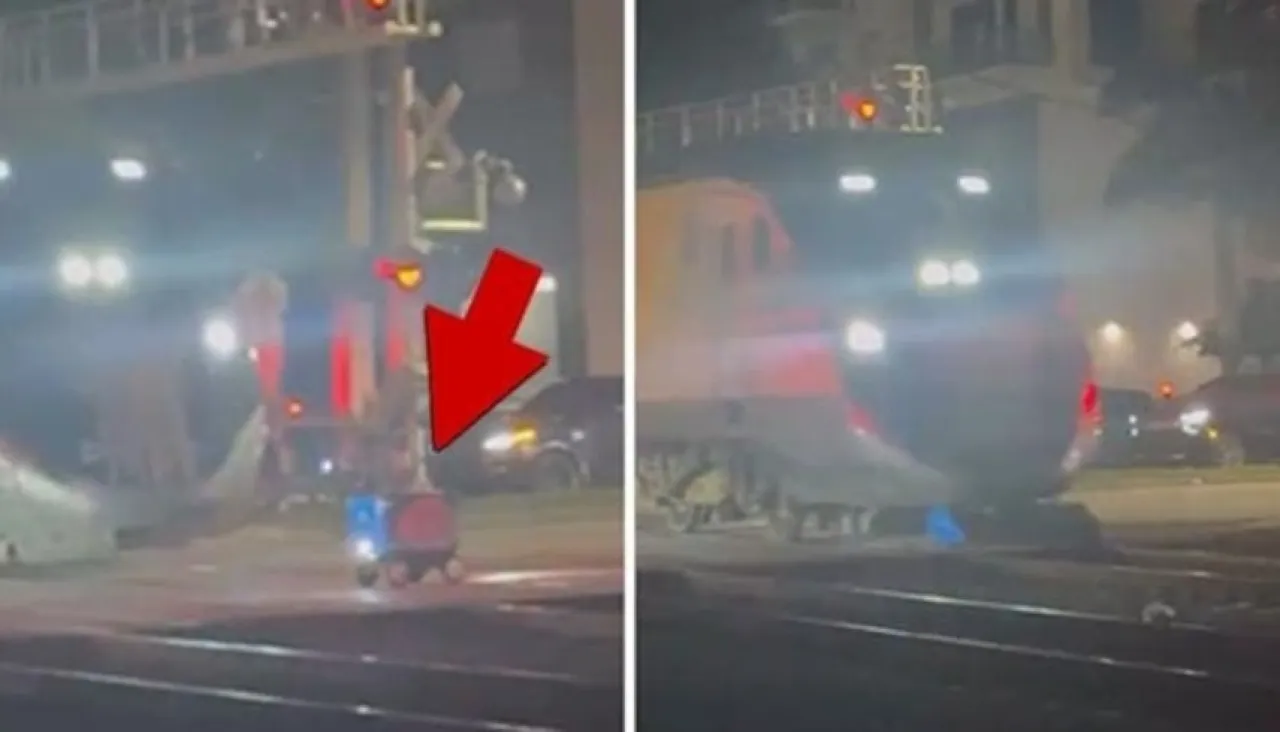
Khaberni - Miami witnessed a notable accident after a delivery robot belonging to the "Uber Eats" service was completely destroyed, following its malfunction and halt on a railway track, before being struck by a speeding passenger train, in an incident captured by a widely circulated video on social media.
According to "People" magazine, the robot was not carrying any delivery orders at the time of the incident. The footage, filmed by a Miami resident named Guillermo Davilo, showed the robot remained stationary on the tracks for about 15 minutes, while the "Brightline" train approached at full speed, before crushing and completely destroying it.
Davilo said in media statements, "I was walking my dogs around 8 PM, and I noticed the food cart stopped on the train track.. One of the Uber Eats representatives had contacted the company to inform them of the robot's location, and just a few minutes later, the train appeared and the collision was caught on video."
In the video, Davilo is heard saying, "Oh, it's going to hit it," before the train rushed in and completely destroyed the robot. Despite the shocking scene, reports confirmed that there were no human injuries, while the robot stood no chance of survival.
Safety rules issued by "Operation Lifesaver" indicate that a train traveling at 55 miles per hour needs about a full mile to stop, while the average weight of a single locomotive is about 200 tons, compared to small delivery robots that do not exceed the size of a suitcase and travel at a speed of about five miles per hour.
The "Uber Eats" robots can carry up to 55 pounds of food or beverages and contain secure charging compartments that can be opened only through the "Uber Eats" app by the customer.
These robots rely on artificial intelligence, cameras, and sensors to avoid obstacles while moving on sidewalks. Although largely autonomous, human operators can intervene remotely in complex situations, such as crossing streets or railways.
"Uber Eats" first launched its delivery robot program on a limited trial basis in Santa Monica, California, before expanding it to Beverly Hills and West Hollywood. The significant success of the trial motivated the company to expand the service to include other American cities.