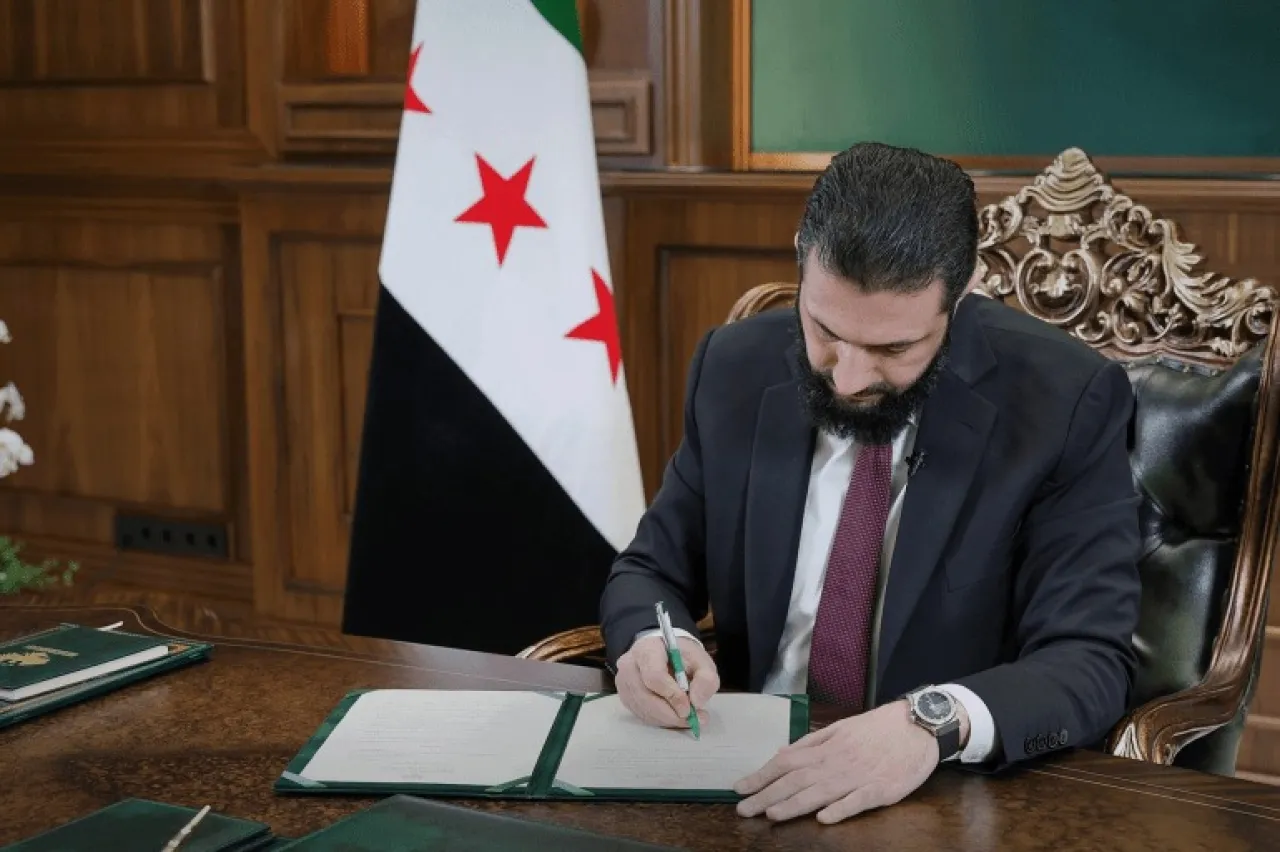
Khaberni - Syrian President Ahmad Al-Sharaa, on Friday, issued a special decree that guarantees the rights of Kurdish citizens in Syria and their specificities, urging them to ignore what he called "narratives of discord".
Al-Sharaa, in a televised speech, said the new decree "ensures the rights of our Kurdish people and their specificities to be protected by the law", affirming that Syrian Kurdish citizens "are an integral and authentic part of the Syrian people, and that their cultural and linguistic identity is an indivisible part of the diverse and united Syrian identity".
First, a new decree: Kurdish as a national language and citizenship for all
The decree, consisting of 8 articles, commits the Syrian state to protecting cultural and linguistic diversity, and ensures the right of Kurdish citizens to revive their heritage, arts, and to develop their mother tongue within national sovereignty.
The decree states that the Kurdish language is a national language, permitting its teaching in both public and private schools in areas where Kurds form a significant population, whether within optional curricula or as part of cultural and educational activities.
The decree also abolishes all laws and exceptional measures resulting from the 1962 census in Al-Hasakah governorate, and grants Syrian citizenship to all citizens of Kurdish origin living on Syrian territory, including those with unrecorded status, reinforcing the principle of full equality in rights and duties with other citizens.
However, the decree raises a historical question: What is the historical trajectory of the Kurds' presence in Syria , when were they granted official documents, and then stripped of them?
The following is an exploration into the history of Kurds in Syria, based on information from the Syrian Ministry of Information.
Secondly: The historical trajectory of the Kurds' presence in Syria :
The roots of the Kurdish presence in Syria trace back to two intertwined historical paths, according to the Syrian Ministry of Information: the first being the ancient historical path (early integration).
The presence of Kurds in Syria dates back to centuries ago, since the Middle Islamic ages, where Kurdish groups settled in Damascus, particularly in the Kurds’ neighborhood – Rukn al-Din, and the Kurdish Mountain on the Syrian coast and parts of Homs, Hama, and Idlib.
This presence deeply integrated into the Syrian social fabric, and many of its members became Arabized linguistically and culturally, while retaining their Kurdish heritage memory, without any separatist or organized clash with the state.
The second is the modern path (political migration in the 20th century).
The Directorate of Monitoring and Media Policies in the Syrian Ministry of Information states that the areas of north and east Syria witnessed, during the 20th century, intense Kurdish migrations from Anatolia (Turkey), whose inhabitants settled in the Jazira region of Syria, particularly in Al-Hasakah, Qamishli, and Al-Malikiyah.
The ministry notes that these were legally recognized as Syrian citizens, participating in economic, agricultural, and social life, before later policies of exclusion and discrimination affected a broad segment of them.
The report issued by the Ministry of Information highlights Aleppo’s role in the history of the Kurdish presence: Aleppo is one of the oldest and most significant centers of the Kurdish presence in Syria, and their settlement there dates back centuries before the modern Syrian state was established.
Kurdish presence historically centered in neighborhoods like Sheikh Maqsood and Ashrafieh, in addition to the northern countryside of Aleppo (Afrin and Ain al-Arab – Kobani). The Kurds of Aleppo were not affected by the 1962 census, which was limited to Al-Hasakah governorate, so most of them retained full Syrian citizenship.
The 1962 census conducted by the Syrian state in Al-Hasakah was executed in just one day and under stringent conditions requiring Kurds to prove residency in Syria before 1945, which led to hundreds of thousands being deprived of citizenship.
This resulted in two categories: the first being called foreigners who were Kurds stripped of citizenship and registered in official records as foreigners, and the second being those with unrecorded status, who have no records in the official civil status registries.
Thirdly: When did the Kurds possess Syrian documents? And when were they withdrawn?
Thus the answer is before 1962 until 1962, Kurds in Syria held full Syrian identity and enjoyed citizenship rights in fields of education, employment, elections, and other basic civil rights.
But in 1962 came a pivotal turning point; on October 5th, 1962, an exceptional census was carried out in Al-Hasakah under the pretext of "verifying illegal presence on the northern borders".
The census resulted in stripping about 120,000 Kurds of Syrian citizenship, categorizing them into two groups: "Al-Hasakah foreigners": holding a red card. and those with unrecorded status: having no legal existence in official registries. Over time, this number doubled to hundreds of thousands due to the transmission of statelessness intergenerationally.
The consequences of citizenship withdrawal (post 1962 census):
It was not just a matter of withdrawing "official documents"; it represented an actual deprivation from civic life, including:
- Withdrawal of legal citizenship status: stripping the individual from their official state affiliation.
- The right to ownership: preventing the registration of properties and assets in the person’s name.
- Higher education: many students were deprived of completing their university education.
- Government employment: excluding them from working in state institutions.
- Travel rights: inability to obtain a passport or travel internationally.
- Official marriage: significant difficulties in legally registering marriage contracts in some cases.
And this action was by its nature an administrative political measure not based on judicial rulings.
As for the fourth question, is Ahmad Al-Sharaa the first to grant these rights to the Kurds?
According to a report from the Syrian Ministry of Information, President Ahmad Al-Sharaa is not the first to take steps to grant citizenship to the Kurds or to address the consequences of the 1962 census, but he is the first to fully abolish the legal root of this problem through a comprehensive decree.
Comparison between the decree of Ahmad Al-Sharaa and the 2011 decree (in the era of Bashar Al-Assad)
In 2011, a presidential decree was issued during the rule of the ousted president Bashar Al-Assad, considered at the time a step towards addressing the situation of the Kurds, but it remained a partial and selective solution for the following reasons:
- Granted citizenship to a specific segment of "Al-Hasakah foreigners" only.
- Excluded a large number of those with unrecorded status.
- Did not abolish the legal basis on which the 1962 census was conducted.
- It was issued in a political context aimed primarily at containing the protests at the time, more than being a comprehensive structural reform.
The current decree of President Ahmad Al-Sharaa
In contrast, the decree of President Ahmad Al-Sharaa goes one step further, as it:
- Explicitly abolishes all legal effects arising from the 1962 census.
- Restores citizenship to all those stripped of it, without exception, including those with unrecorded status.
- Achieves full legal equality between Kurds and other Syrian citizens.
- Explicitly recognizes the Kurdish cultural and linguistic identity as part of the national Syrian identity.
- Transforms the issue from an "administrative security file" into a matter of fundamental constitutional rights linked to the structure of the new state.
This decree not only changes the legal situations that have lasted for more than half a century, but it also opens, according to observers, a new approach to the relationship of the Syrian state with its national and cultural components, based on recognition and equal rights within a comprehensive national identity.