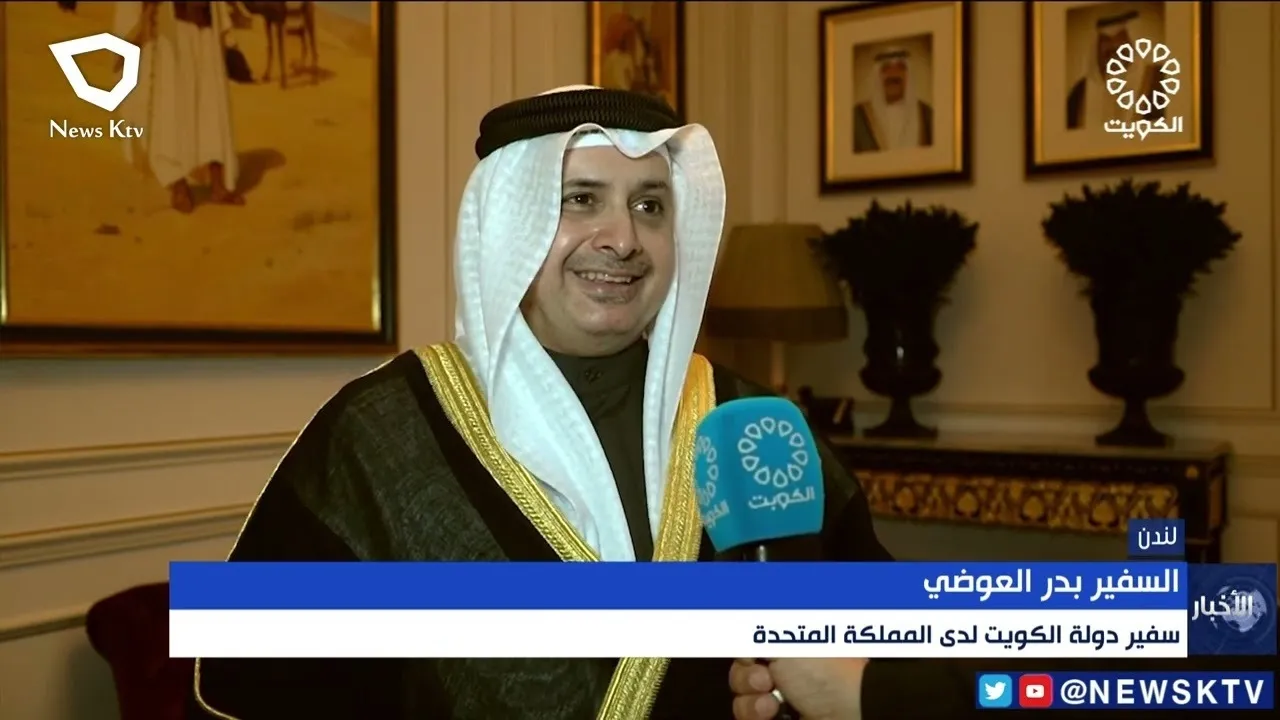
Khaberni - A royal decree was issued in Kuwait stripping Badr Mohammed Al-Awadhi, the Kuwaiti ambassador in London, of his Kuwaiti citizenship. This forms a precedent as the first case of stripping an ambassador who occupies his position of his citizenship, and the legal and diplomatic consequences that may arise from it.
The decree was issued based on a recommendation from the High Committee for the Investigation of Kuwaiti Citizenship, in the context of the campaign launched by the country’s Emir, Meshal Al-Ahmad Al-Jaber Al-Sabah, following his accession to power at the end of 2023.
The citizenship was withdrawn from the Kuwaiti ambassador in Britain "by consequence" after his late father, the former officer Mohammed Ibrahim Al-Awadhi's citizenship was withdrawn, where provisions in the nationality law impose its withdrawal if its acquisition involved false statements or forgery in the original father's file, which automatically leads to its fall from those who acquired it by consequence.
The decision caused widespread controversy and created a crisis for the Kuwaiti Foreign Ministry, given that Al-Awadhi was officially representing the state in one of the most important capitals in the world until the decision was issued.
Ambassador Badr Al-Awadhi did not issue any statement, and it is likely that he will maintain administrative silence pending the arrangements for his return to Kuwait, or taking other measures.
Investigation of Kuwaiti Citizenship
These calls began, politically, after the liberation of Kuwait in 1991 from the Iraqi invasion, where rhetoric concerning Kuwaiti identity and nationality escalated. Proponents of this rhetoric called for a return to the pre-invasion phase, when citizens were divided into 3 categories: those who resided in Kuwait before 1920 until the Nationality Law in 1959, who enjoyed all political rights; those who were granted Kuwaiti citizenship, who and their children are not entitled to engage in political life; and, finally, the “Bidoon” category, whose individuals possess no nationality but were born and lived in Kuwait, considered by authorities as illegal residents, yet they cannot be expelled elsewhere.
Following the invasion, matters evolved towards democratic gains that included naturalized citizens and women; however, the situation also saw the growth of "Kuwaiti identity" rhetoric against those described by its proponents as "forgeries" and "dual nationals."
The matter shifted from merely a prevalent political rhetoric to the rhetoric of power with the accession of Emir Meshal to power at the end of 2023, transforming the demands into a campaign to withdraw the citizenship of residents on Kuwaiti soil, changing the lives of tens of thousands of Kuwaitis.
In March 2024, Kuwait launched the largest campaign of withdrawal and dropping of citizenships in the history of the Arab region, with more than 68,500 people stripped of their Kuwaiti citizenship by August 2025, which constitutes 4.4% of the Kuwaitis, whose total population amounts to 1.545 million people.