Khaberni - The National Office for the Defense of Land and Resistance to Settlement stated in its periodic report today, Saturday, that Jerusalem, as a city and governorate, is facing the hammer of demolition and displacement and the anvil of settlement and isolation.
The office indicated in its report that the Jerusalem district planning and building committee began last week to discuss approving two settlement projects that would reshape the political and demographic landscape in occupied Jerusalem. These are the Atarot plan for construction on the land of the old Jerusalem airport and the "Nahalat Shimon" plan in the Sheikh Jarrah neighborhood in the heart of the city.
The report added, "The Atarot plan includes the establishment of a new settlement consisting of 9,000 housing units on lands of the Jerusalem airport south of the city of Ramallah, between the neighborhoods of Kafr Aqab and Beit Hanina. The plan (number 764936) is located in the heart of a connected Palestinian urban area that extends from Ramallah, through Kafr Aqab and Qalandiya, to Beit Hanina and Shuafat, an area densely populated with Palestinians."
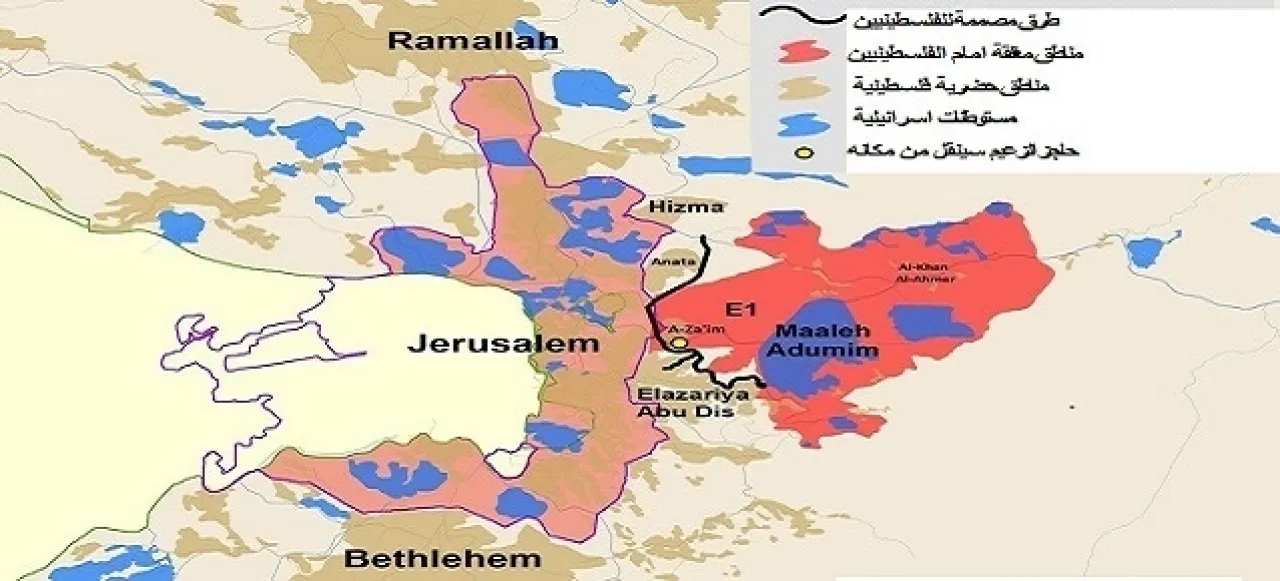
The report continued, "This settlement project aims to establish an Israeli pocket that hinders Palestinian development of the central urban area and in the future Palestinian state, i.e., the Jerusalem-Ramallah-Bethlehem area. Similar to the settlement project in the (E1) area, its implementation would deliver a crushing blow to the possibility of resolving the conflict on the basis of a two-state solution."
The report continued, "This project was scheduled for discussion in December 2025, but the discussion was postponed until after the meeting held by Netanyahu with President Trump on the twenty-ninth of December last year. A new date was set as if Netanyahu had received a green light to proceed."
The report added, "The "Nahalat Shimon" project (number 1237767) in Sheikh Jarrah involves the demolition of the Palestinian Um Haroun neighborhood, building a settlement neighborhood in its place consisting of 316 housing units. The Israeli organization “Ir Amim” confirmed in its latest reports on the situation in Jerusalem, released at the end of October 2025 titled “Strangling Sheikh Jarrah: New Tools for Israeli Control and Palestinian Displacement,” that “the Israeli government has entered a new and dangerous phase in its efforts to control Sheikh Jarrah, one of the most prominent and symbolic neighborhoods of East Jerusalem,” and warned that the State of Israel is now using unprecedented legal, planning, and administrative tools to achieve the same goal: displacement of Palestinian residents and consolidation of the settlement presence in the heart of the neighborhood. Among these tools according to the report, "extensive urban renewal projects, including about 2000 housing units for Israeli settlers, completely excluding Palestinian residents." This also includes "land registration (settlement of property rights) for several plots, which allowed government institutions and settlers to register them in their names, in addition to confiscating public spaces and reallocating them to serve Jewish religious institutions and projects."
Also, "in Jerusalem, the occupation authorities notified the Bedouin communities and the al-Eizariya municipality of their actual intention to implement their dangerous settlement project known as “Fabric of Life,” 45 days after the notification issued by what is called the military prosecution for the occupation. The Jerusalem governorate stated in a statement issued last Thursday that this project represents the practical implementation of the Israeli annexation plan for the area known as (E1) where it aims to achieve full geographical continuity between the “Ma'ale Adumim” settlement and occupied Jerusalem, which will lead to the swallowing of a new area of West Bank land to be officially annexed within the plan called "Greater Jerusalem."
The start of implementing what is called "Fabric of Life" road in East Jerusalem culminates Israeli efforts to execute the annexation of lands outside the municipal boundaries of Jerusalem from the east, particularly the large Ma'aleh Adumim settlement, and to adjust the Israeli municipal boundaries of Jerusalem to add 3% of the West Bank lands, so that they are officially annexed to Israel.
The idea of the project is based on digging a tunnel that extends from north to south in East Jerusalem, turning it into a road exclusively for Palestinians, thus preventing Palestinians from using road number 1 which extends from the center of Jerusalem city and passes through the Arab neighborhoods in the city, then in front of the Ma'aleh Adumim settlement entrances on its way to Jericho. Palestinians were forced to use part of this road designated for settlers to travel between the northern and southern West Bank, where they enter road number 1 near the Anata area (north of Jerusalem) and exit from the area south after passing near Ma'aleh Adumim settlement to enter the Ramallah – Bethlehem road, known as (Wadi Nar road). This project is not new as it was proposed and approved for the first time in spring 2020 during Netanyahu's coalition government, though its implementation was halted due to obstacles faced by Israeli governments at the time. The government fell just two months after the project was approved, to be followed by a new government led by Netanyahu, which did not last more than one month, to fall in mid-2020, and be replaced by a coalition government led by Naftali Bennett in cooperation with Yair Lapid, to fall at the end of 2022, for Netanyahu to return in his current government formed in cooperation with the Religious Zionism movement, led by Bezalel Smotrich, who is considered the actual ruler of the civil administration
Jerusalem also faces a wide-ranging demolition campaign against Palestinian citizens' homes, as 29 houses inhabited by 33 families including 219 Jerusalemites face the nightmare of forced eviction in the Batn al-Hawa neighborhood in the town of Silwan within 21 days, for the benefit of settler associations. The so-called "Israeli Execution and Procedure Department" along with the occupation police delivered eviction notices under the pretext of land ownership by Jews of Yemeni origin. All these buildings are part of a settlement plan led by the "Ateret Cohanim" association aimed at taking control of an area estimated at about 5 dunams and 200 square meters in the middle district of the neighborhood, and the occupation plans to establish a large settlement enclave in the targeted area at the expense of the Palestinian presence in it, exploiting all current conditions and situations to move forward with its policy of displacement in Jerusalem and emptying it of its original inhabitants. The occupation authorities demolished a number of citizens' homes on the thirtieth of December last year under the pretext of building without a license after deploying military reinforcements in a step considered by the Jerusalem governorate as an extension of the policy of ethnic cleansing and forced displacement
In addition to this, the West Bank is witnessing displacement operations not limited to Bedouin and pastoral Palestinian communities in Area (C) but extending to Palestinian citizens in areas under Palestinian civil control.
Recently, these operations have begun to extend to areas (B) administratively under the control of the Palestinian National Authority, amidst testimonies documenting direct participation from the Israeli army in preventing return and evicting residents, and this pattern has become an actual policy being practiced. In a qualitative development and in increasingly frequent cases with direct participation from the Israeli army, whether by preventing residents from returning to their homes or through actual intervention alongside settlers during the eviction and displacement process.
According to an extensive report published by "Haaretz" newspaper, this shift reflects a transition in the pattern of eviction that was used in recent years to empty areas (C) of Palestinian communities, to areas (B) although Israel and its army, as well as the settlers, have no legal authority to evict these residents or prevent them from returning to them. Examples of this are numerous and clear.
In late November, dozens of residents from the town of Tarqumia, west of Hebron, tried to accompany Palestinian families to their homes located on the outskirts of the town in Area (B) after they were evicted in October 2023 by settlers. The newspaper says: When they arrived, they found a gate erected by the settlers on the divide between the two areas to prevent access to five isolated Palestinian homes. During the return attempt, armed settlers on four-wheel-drive vehicles arrived, and Israeli soldiers joined them in this mission. In the northern Jordan Valley near the village of Beit Hassan, the Abu Saif families, each with ten children, had to leave their homes after years of escalating harassment. According to the testimonies, soldiers from the Israeli army came to the home accompanied by a settler running a nearby farm and informed the family that they had a week to leave. The home is located just meters inside Area (B) but after the family left, the settler's control in the area expanded, preventing Palestinian farmers from accessing their agricultural lands. In the village of Atara near Ramallah, a settler outpost was established inside Area (B) near the home of a Jerusalemite citizen in his sixties, who had legally purchased the land about 25 years ago. After establishing the outpost, the army was summoned to the scene and imposed a military closure order, forcing him and his neighbors to leave their homes, while allowing the settlers to stay.
It is worth noting here that the Israeli government decided on June 28, 2024, to withdraw the powers of the Palestinian National Authority in the Jerusalem Desert (classified as area "B") according to the agreement (Wye River or Wye Plantation 1998), and returned it to the civil administration controlled by Minister Smotrich. The Palestinian side filed a petition to the Israeli Supreme Court to prevent the implementation of the decision, and the settler organization "Regavim" responded with a counter-petition urging the court to enforce the decision of the Israeli government, starting with the demolition of a Palestinian school expected to open at the beginning of the 2025 school year. The Israeli court chose to manipulate and enter into judicial mazes and asked the Palestinian side to provide an explanation about the construction of the school, whether it was legal or not, and whether there were violations of the authority's commitments, granting it 30 days to respond to Regavim's petition ending on December 12, 2025, before deciding on the continuation of the legal proceedings. For clarification, the Jerusalem Desert or (Hebron Wilderness) extends from the outskirts of Beit Sahour to the east reaching the Jordan River in a desert strip extending about 85 kilometers from north to south, with a width of about 25 kilometers, in an area that includes a rich environmental and natural system, most notably 19 permanent and seasonal water streams, including Wadi Qelt and Wadi Siyal, in addition to five extensive archaeological caves and five prominent heritage sites. Despite its rugged nature, the desert hosts small Palestinian pastoral communities while also witnessing an increasing presence of settler activities established as agricultural and pastoral outposts.
In the latest settler activities, the Northern West Bank Settlements Council (Shomron) announced last Sunday the establishment of a new settlement east of Nablus named Rehavam, as part of a government-backed plan to rapidly expand sett