Khaberni - Haider Freihat, the Director General of the General Department of Statistics, said that the comprehensive review project of the national accounts and the re-estimation of Jordan’s GDP came in response to a national and professional need to reach the full statistical truth and to provide a more accurate reading of the size of the Jordanian economy and its visible and invisible activities.
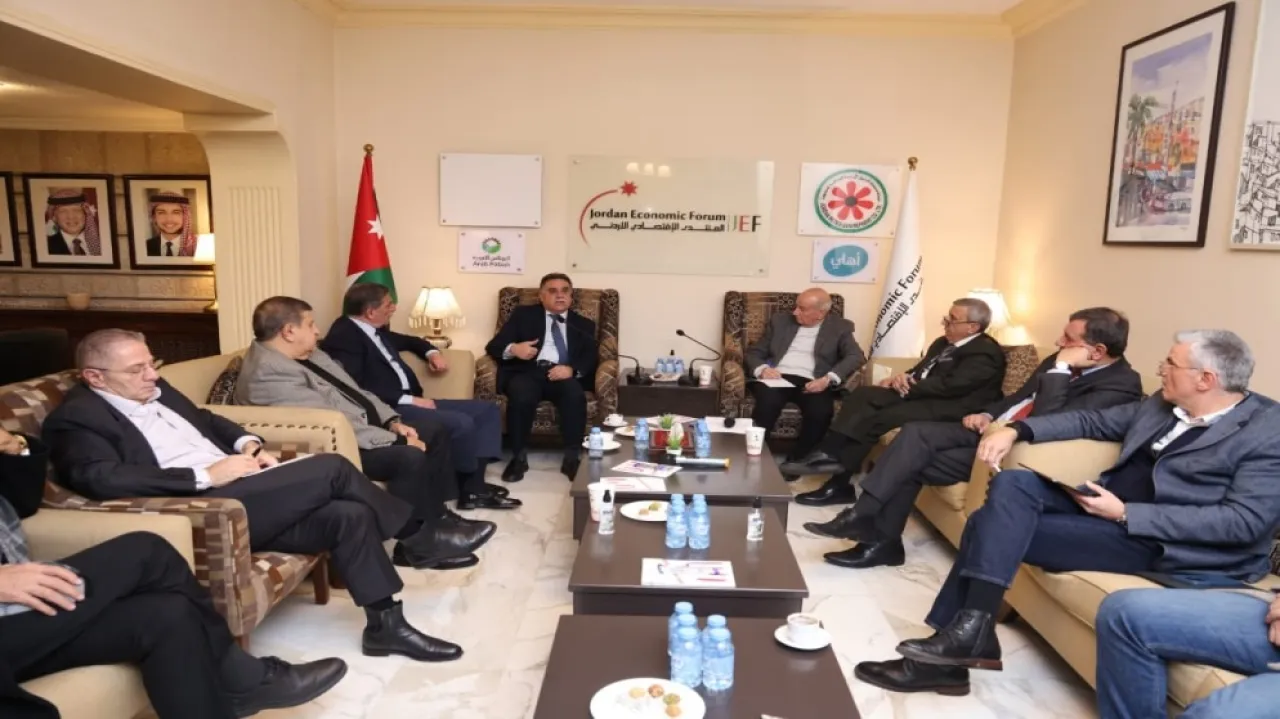
This was stated during a dialogue session held by the Jordan Economic Forum as part of the Economic Salon program to discuss the methodology in reviewing national accounts and the results of job creation surveys, attended by the president of the forum, Mazen Al-Hamoud, and a number of members of the board of directors and the general body of the forum.
He added during the session, which was moderated by forum board member Bashir Al-Za'bi, that the results of the work over the past four years showed an addition of 3.6 billion dinars that had not been previously captured in the accounts, equivalent to about 10% compared to an economy estimated at about 36 billion dinars before the review.
He explained that the story of re-estimating the GDP began about five years ago, when there was a 'widespread feeling inside and outside Jordan' among local entities and international organizations concerned with economic affairs that the Jordanian economy was 'larger than what the published figures reflected', adding that this feeling was translated into an organized research work project "to reach the truth".
He stated that the dialogues at the beginning of the project took place with the government represented by the Ministry of Planning and other specialized entities, and a comprehensive project was designed, methodologies were established, budgets were allocated, experts were used, governance was established and executive units were established within the General Department of Statistics.
He noted that the project started practically from the foundations on which the statistical work is based: frameworks, samples, surveys, and forms, aiming to ensure that the collection of economic data is carried out correctly.
Freihat indicated that the improvements included integrating surveys, updating and canceling surveys that no longer served the purpose, and introducing new projects, alongside adopting reliance on administrative records, noting that the department no longer relied solely on data collected via forms directed to companies, but expanded to databases owned by institutions with organized records of economic activity, providing additional sources for estimating added value more professionally.
He continued that the project also included the introduction of advanced statistical tools, including the expansion in the use of input-output tables, development of supply and use tables and other statistical tools, as part of a process that lasted four years and saw cooperation and exchange of expertise with international entities, including experts from the United Nations system and the International Monetary Fund.
He said that the department provided a specialized unit that includes experts in national accounts, in addition to encouraging field staff to improve the efficiency of data collection and verification.
Freihat confirmed that the review was not limited to one sector but occurred activity by activity, and the results led to the discovery of figures that were previously not apparent in what is known as the visible and invisible economy.
He gave examples, including the agriculture sector, before the department expanded to databases of agricultural wholesale markets that witnessed automation and technological development, providing a more detailed and accurate source for tracking the actual movement of trade and production.
In the industrial sector, Freihat noted that previous measurements captured only the major known industries, but after updating the frameworks and samples, it appeared that there are smaller companies, which necessitated rebuilding the statistical framework from which the samples are drawn.
He also spoke about the rental sector, explaining that old averages were reducing the actual value, saying that updating the systems led to noticing that the figure that was supposed to represent the average rent in Jordan no longer reflects reality, and they record lower rent levels than in reality.
He added that the review also included sectors such as insurance, information technology and communications, transportation, trade, and others, noting that the department moved in economic activity classification from an older classification level to a more detailed one, which separated activities that were previously combined into one category, like merging transport, storage, and communications, so that each activity gets a more accurate estimation.
Freihat stopped at an important methodological shift in foreign trade, explaining that Jordan moved from a special system to a general system according to international standards, which led to the incorporation of actual trade in free zones into the national accounts. This was in line with global methodologies.
According to Freihat, the outcome of four years of work resulted in the addition of 3.6 billion dinars that were not visible and became visible, out of an economy that was around 36 billion dinars before the review, meaning an increase of nearly 10%.
He noted the extension of the project to 2026 to focus on the informal economy, using methodologies based on technology and databases, benefiting from the rapid transformation in payment systems and electronic billing and transfer options, such as electronic billing systems and various payment and transfer options, as tools that help monitor economic activity.
Freihat emphasized that all these measures are far from any connection with taxation, confirming that the department is keen not to share citizen data or link it with any other government database, pointing out that the Statistics Law of 2025 enhanced data confidentiality and increased penalties for disclosing information.
In the second axis related to job creation, Freihat said that unemployment is not just a number, but a set of concepts that include measurement, general feeling, and social reading, noting that the department measures unemployment according to the methodologies of the International Labour Organization, and that methodological reviews previously led to redefining some categories within the employed and unemployed according to global standards, impacting the figures.
He mentioned that the measurement of unemployment has developed over time from once a year to twice and then four times a year, and that the current sample for the labor force survey reaches about 17,000 households, allowing the results to be issued at the governorate level.
Freihat revealed that the General Department of Statistics launched an optional additional survey to monitor newly created job opportunities, explaining that this survey relies on a large sample reaching 100,000 households in two annual batches, 50,000 households each time, and that the department goes to households instead of companies to avoid sensitivities and ensure the cooperation of respondents, in a manner consistent with separating statistical work from any tax considerations.
He said that the results of 2024 showed the creation of about 96,000 new jobs, while the results of 2025 are still under scrutiny in preparation for their announcement.
Freihat concluded by affirming that the department's goal is to provide a more accurate and fair picture of the economy and labor market, calling for continued dialogue with experts and various sectors to develop measurement tools, which enhances confidence in the data and makes it a basis for economic decision-making and guiding policies towards growth and job creation.