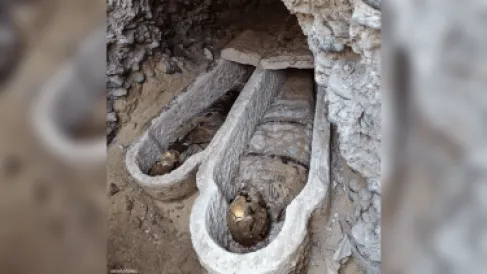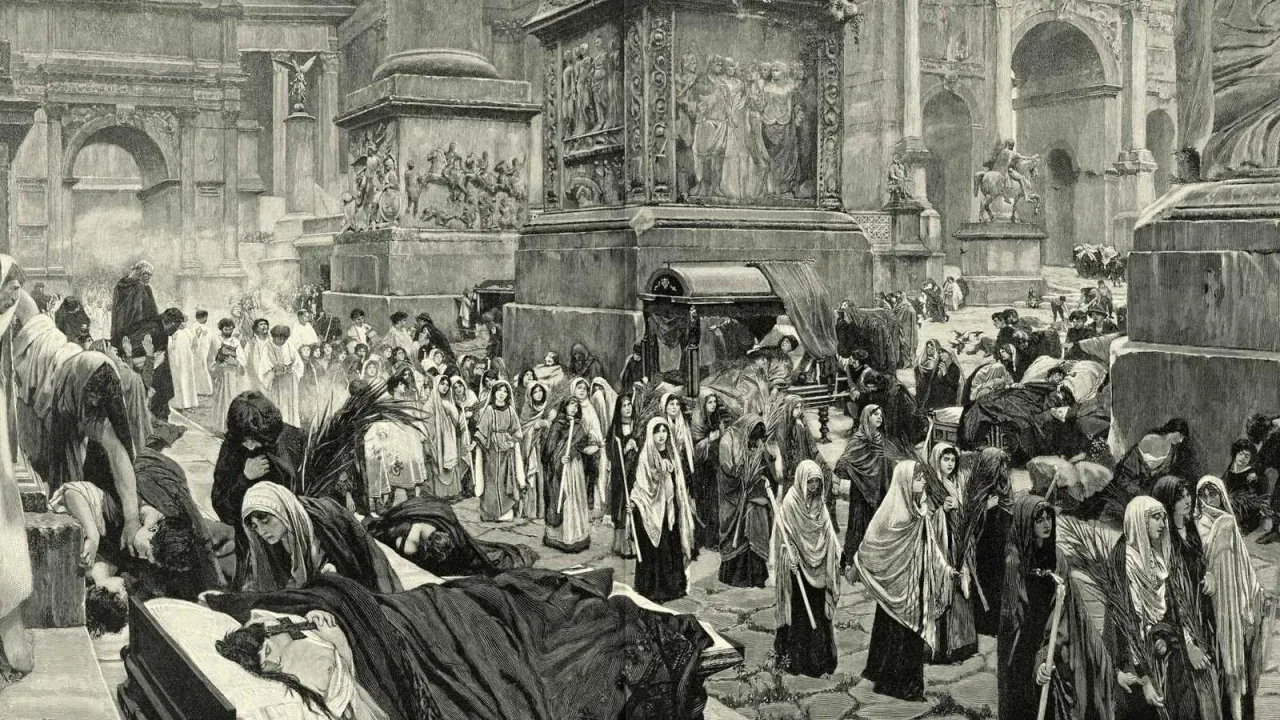
Khaberni - Archaeologists in Germany announced today (Wednesday) the discovery of strong evidence of what is considered the first systematically and scientifically identified mass grave connected to the Black Plague in Europe (not accidentally found during construction works).
The scientists discovered what may be the first systematically identified mass grave linked to the victims of the Black Plague in Europe; providing a rare insight into one of the deadliest pandemics in history, found by a multidisciplinary international research team from Leipzig University.
The grave is located near the deserted village of Neuzelle outside the city of Erfurt, and is believed to contain the remains of thousands of people who died during the plague outbreak between 1346 and 1353, which killed nearly half of Europe’s population in some areas, according to the «Telegraph» newspaper.
Giant Cemetery
The researchers used a sophisticated mix of non-invasive methods including historical analysis of records and contemporary events, geophysical sensing through measuring soil electric resistance, sediment sampling with exploratory drilling, and carbon-14 dating.
The findings revealed a large subsurface structure about 10 × 15 meters in size and over 3.5 meters deep, containing unnaturally mixed sediments and human bone fragments, where carbon-14 dating clearly dated the bone remains to the 14th century, specifically during the period of the Black Plague outbreak.
The Black Plague (1346–1353) is known as one of the deadliest pandemics in human history, causing the death of between 30–50% of Europe’s population, with percentages rising to 60–70% in some areas, causing significant social and economic changes that effectively ended the early medieval period.
12,000 Died in Erfurt Alone
In the city of Erfurt, one of the main urban centers in Germany at the time, contemporary records documented that about 12,000 people died during the outbreak in 1350, and were buried in 11 large mass graves outside the city walls, most of them in the cemetery of the nearby village church of Neuzelle, which was chosen as an emergency mass burial site.
Geographer Dr. Michael Heine from Leipzig University, one of the study's authors, said, «Our findings strongly indicate that we have identified one of the mass plague graves mentioned in the Erfurt records, the final confirmation will require archaeological excavations».
The researchers found that the burials were most likely in the dry Chernozem soil rich in organics and carbonates on the edge of the Gera River valley, while the wet clay soils were avoided due to the slow decay of bodies, in line with the beliefs of the «miasma theory» that prevailed in the Middle Ages, which linked the spread of diseases to the foul air emitted from rotting organic materials.