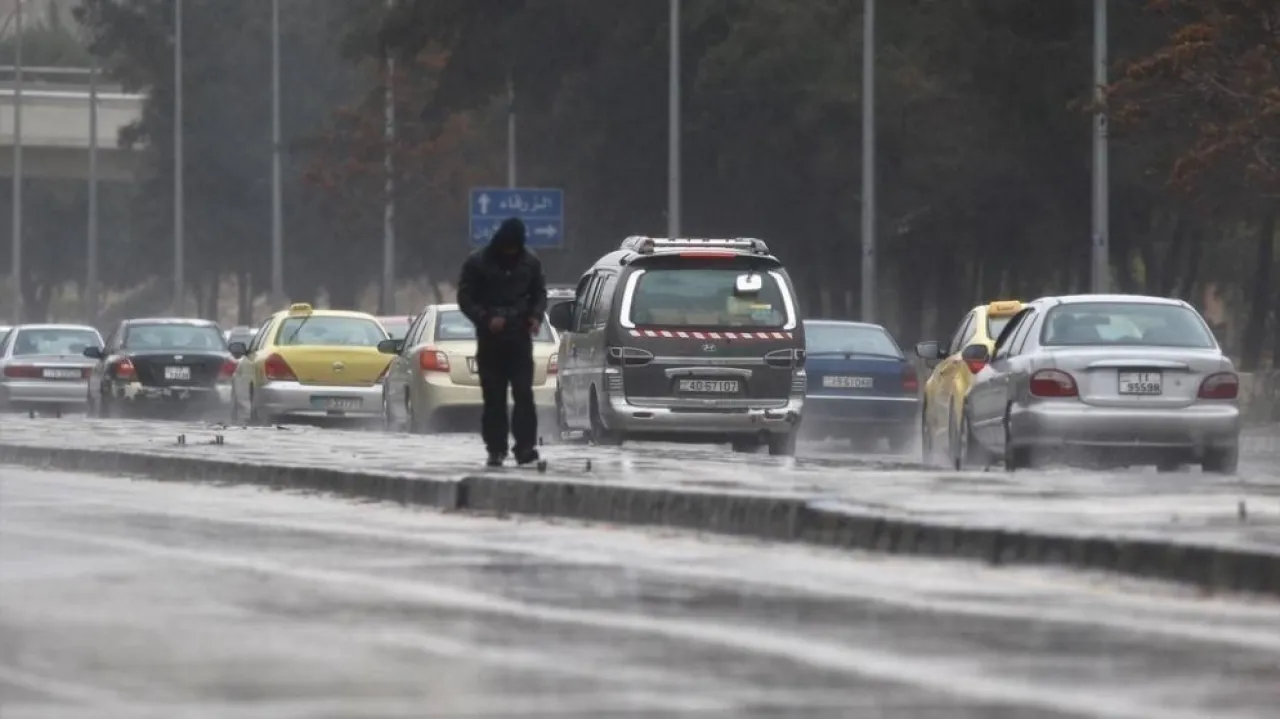
Khaberni - The Director of Meteorology, Raed Rafed Al-Khatab, stated that the Kingdom was affected during the early hours of Monday, January 12, 2026, by the fifth atmospheric depression of the season of winter 2025/2026, accompanied by a very cold and humid air mass, which led to a noticeable and sharp decrease in temperature, and cold, rainy conditions in several parts of the Kingdom.
Al Khatab explained that the northern areas experienced rainfall at the start of the weather event, gradually extending to the central areas. The rain was heavy at times accompanied by thunder and occasionally hail, which caused flash floods in valleys and low areas and a rise in water levels. The rainfall also extended to parts of the eastern and southwestern regions of the Kingdom.
Al Khatab noted that the weather event was associated with significant activity of the west winds, where strong gusts reached up to 90 km/h at the Tafilah and Jubeiha observation stations.
The Director of Meteorology also indicated that the total rainfall from the beginning of this depression until 9 AM on Wednesday contributed to an increase in the current rainy season of 2025/2026 by percentages ranging from 1% to 32% of the overall seasonal rainfall average, especially in the central and northern regions and parts of the southwestern regions.
Al Khatab confirmed that the Jordan University observation station in the capital, Amman, recorded the highest rainfall total during this depression at 73.0 mm, equivalent to 14% of its annual average. It was followed by the Salt monitoring station in central areas with a rainfall total of 69.9 mm, and at 14% of its annual average, and then the Ras Munif station in Ajloun Governorate with a total of 63.7 mm, and at 11% of its annual average.
He added that the Husain Gardens observation station in Amman recorded a rainfall total of 63.0 mm, and at 13% of its annual average, while the Al-Rabba station in Karak Governorate recorded the highest rainfall in the southwestern regions at 46.8 mm and at 14% of its annual average. Meanwhile, the Queen Alia International Airport station recorded the highest achievement of its annual average at 32%, with a total rainfall of 47.3 mm.
Al Khatab clarified that the Al Zarqa observation station achieved its annual seasonal rainfall rate early with the rains from this depression, following the southern Jordan Valley areas, noting that this is a significant climatic indicator at this time of the rainy season, Praise be to Allah. The central-eastern regions also approached achieving their annual rainfall rate, reaching about 91% of their annual average to date.
The Director of Meteorology also explained that the meteorological statistics adopted in the climate record of the Meteorological Administration indicate that the intensity of rainfall during the winter 40-day period of 2025/2026, when measured by the accumulated rainfall and number of rainy days, is the highest for the same period since the 40-day period of the 2012/2013 season, which saw the Sawileh observation station record the highest rainfall during a 24-hour period in its climate record at 150.0 mm on January 7, 2013.
The attached graph shows the performance of the current rainy season 2025/2026 up to the date of January 14, 2026, showing the percentage that should have been achieved from the general seasonal rainfall average by that date, compared to the actual percentages achieved in various regions of the Kingdom.
In conclusion, the Director of Meteorology, Raed Rafed Al Khatab, stressed the importance of following the weather forecasts issued by the Meteorology Administration and adhering to the warnings and advisories, in order to preserve public safety.