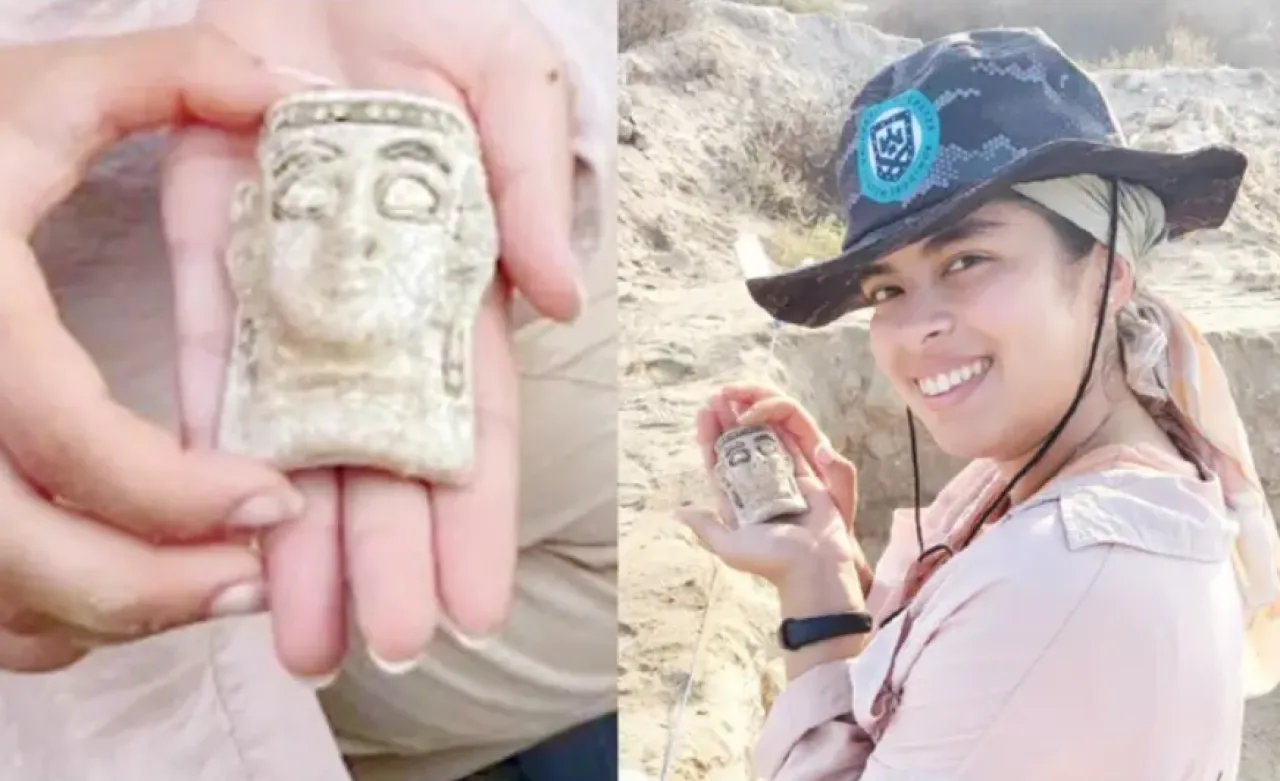
Khaberni - Today, the Bahrain Authority for Culture and Antiquities unveiled a discovery of a rare archaeological artifact represented by a ceramic mask known as the faience mask, dating back to more than 3,300 years, which was found in a collective grave containing two women from the Dilmun civilization in Hilla, southern Bahrain.
The Bahrain Authority for Culture and Antiquities stated that the mask represents one of the rarest archaeological finds in the Kingdom of Bahrain, marking the second instance of its kind discovered so far.
Archaeologist Miss Mashael Al-Shamsi announced this discovery during her participation in the symposium on Gulf archaeology: Between Discovery and Conservation, organized by the Bahrain Authority for Culture and Antiquities in cooperation with the General Secretariat of the Gulf Cooperation Council.
Al-Shamsi pointed out that the mask still requires in-depth studies, as it is one of the rare pieces that has not received sufficient research, indicating that work is currently underway on producing a specialized scientific study covering the mask and other associated funerary finds like beads.
Al-Shamsi added that the current excavation work focuses on the soil layers dating back to the middle Dilmun period, where the team continues its efforts to publish a comprehensive study shedding light on the details of these discoveries and their importance in understanding the civilizational context of that era.
The other finds included rings made of seashells, sewing needles, a traditional tool for applying kohl, discovered through meticulous sieving of sand at the site.
It is mentioned that the site of Hilla was named after the village of Hilla Al-Abd Al-Saleh, and it is considered one of the important sites for understanding the developmental stages of the ancient Dilmun civilization, which is regarded as one of the most prominent civilizations in the history of the Arabian Gulf.