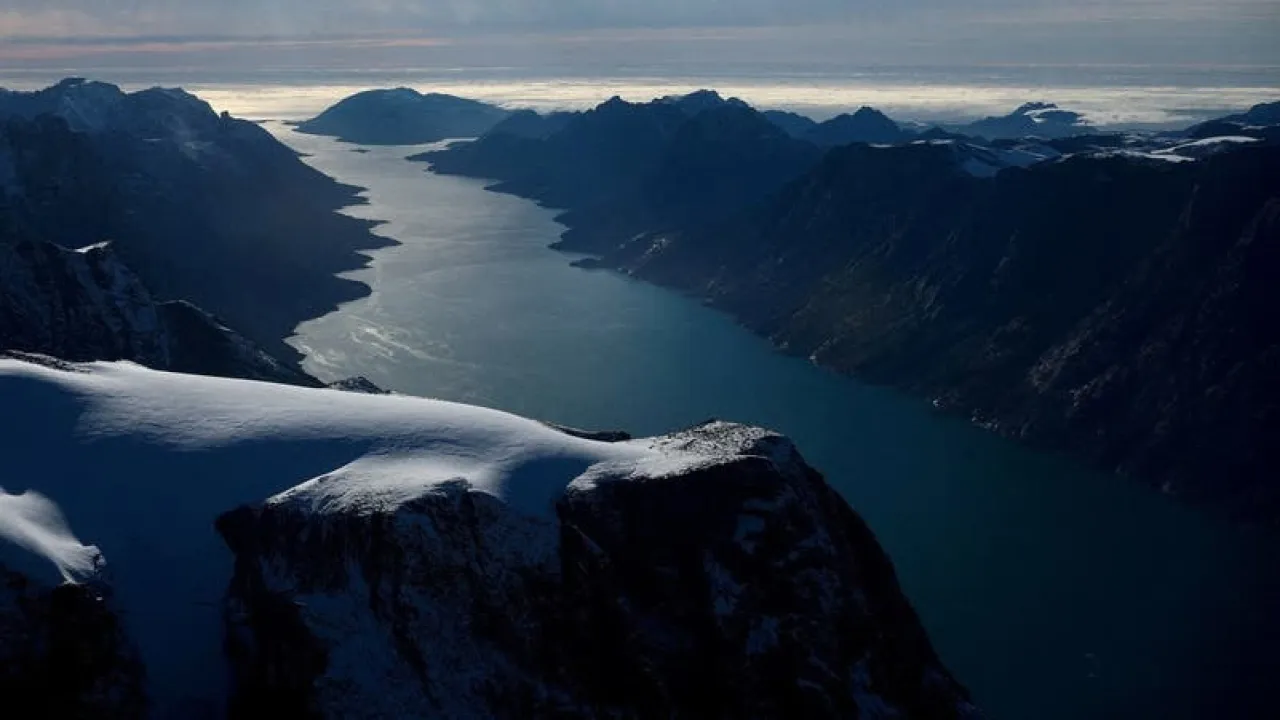
Khaberni - Denmark always insists that Greenland is not for sale, but a White House spokesperson said a few days ago that President Donald Trump and his team "are discussing a potential purchase process".
But even as a purely theoretical idea assuming the existence of a willing seller, any discussion about the hypothetical sale of an autonomous territory like Greenland quickly encounters tough issues, such as how to determine a meaningful price at all.
Nick Kounis, chief economist at Dutch bank "ABN Amro," said "there is no market for buying and selling countries," indicating that there is no accepted framework for the valuation of nations.
Apart from that, attempts to find historical benchmarks for comparison in order to estimate a fair value also run into difficulties.
In 1946, the United States offered to buy the mineral-rich vast polar island from Denmark for $100 million, an offer that was refused at the time.
That amount would be roughly $1.6 billion in today's calculations. But even this amount, originally minimal, isn't applicable as a comparison due to the massive growth in the economies of the United States and Denmark over the 80 years since that time, nor does it reflect any "value" of Greenland and its resources in the global economy during the third decade of the 21st century.
Nor are the United States' purchases of Louisiana for $15 million in 1803 and Alaska from Russia in 1867 for $7.2 million helpful precedents.
The clearer truth here is that both France and Russia chose to sell.
Although it is clear that those amounts would be much higher in today's calculations, the amount of increase would depend on considering variables such as inflation, rising land prices, and the growth of local economies, and whether these variables should be included in the calculations in the first place.
What if it were a company?
Even if we tried to use an approach similar to evaluating the acquisition of a company, based on the income the target party can achieve, it would still be complicated.
The Danish central bank estimated Greenland's GDP, based on fishing, at $3.6 billion in 2023, a paltry sum approximately one-tenth the GDP of its smaller polar neighbor, Iceland.
Even if that was a starting point for some valuation, what would be the appropriate multiplier (the right rate to estimate the value compared to similar assets) to use to determine a price based on that?
And how could one also account for the fact that Danish subsidies cover about half of Greenland's public budget and fund hospitals, schools, and support infrastructure for the sparsely populated region?
While Trump denies that the United States is focused on Greenland's mineral resources and energy wealth, Reuters reported in October that his administration had discussed acquiring a stake in the company "Critical Metals Corp," which seeks to build the largest project for rare earth elements there.
Some estimates suggest that the value of Greenland's mineral and energy reserves could be worth hundreds of billions of dollars or more. No comprehensive geological studies of the entire island had yet been conducted, but a survey in 2023 showed that 25 of the 34 minerals deemed "critical raw materials" by the European Commission are found there.
Mining and energy companies have a long history of setting prices for assets worldwide. But there are at least two obstacles here.
First, the extraction of oil and natural gas in Greenland is banned for environmental reasons, and the development of the mining sector on the island has been hampered by administrative complexities and opposition from indigenous people. Would this be a political constraint perhaps warranting a discount for a potential buyer? And if so, how much could this discount be?
Secondly, mining and energy deals inherently do not involve the transfer of national sovereignty, which complicates the situation given the presence of the Inuit people in Greenland who make their own property claims.
Andreas Osthagen, director of research for polar and ocean policies at the "Fridtjof Nansen Institute" in Norway, said: "Because you add intangible concepts related to the culture and history of indigenous peoples, you cannot do that.. There is no way to price them.. That's why that idea seems absurd".
Currently, the Trump administration says all options are on the table, including military action, to secure a territory it says is crucial for U.S. national security, and it already has a limited military presence there.
The meeting scheduled next week between U.S. Secretary of State Marco Rubio and Danish leaders may provide more indications about the U.S. plans toward Greenland.
Kounis from ABN Amro said that Trump uses a similar approach to what he has used in other situations, such as trade tariff negotiations, by putting an "extreme scenario" on the table merely to push the other party to a conciliatory stance.
Kounis views that if reaching a mutually agreed settlement that the United States sees as serving its military and economic interests are among the possible outcomes, then "part of this may relate fundamentally to gaining leverage in future negotiations".