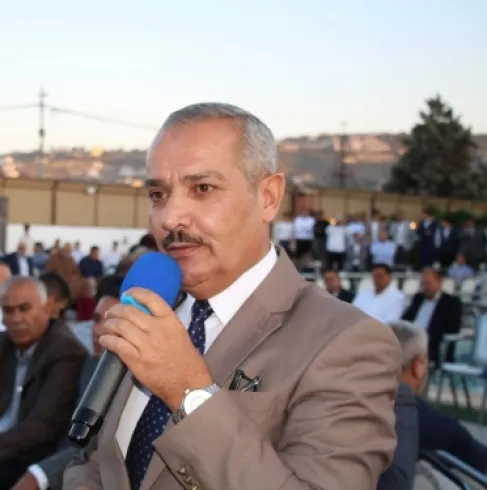
Khaberni - Written by Ambassador Dr. Ali Abu Ali Kreishan:
The statements by Dr. Ghassan Al-Ahsan, a member of the jury in the program (Million's Poet), sparked a widespread debate and critical responses after he suggested that Jordanian poetry and poets had not been recognized or known in the Arab context before this program. This statement was considered by many Jordanian intellectuals, poets, and writers as a disregard and negligence of the historical depth and civilizational root of Nabati poetry, which considers the Jordanian environment as a main source.
In a careful reading of the cultural history of the region, we find that the term "Nabati poetry" is not just by chance, but is a direct designation derived from "the Nabateans," our Arab ancestors who established one of the most ancient Arab kingdoms in Ma'an, south Jordan, with its capital Petra, over two thousand years ago.
Historical and linguistic studies indicate that the Nabateans' Arab dialect formed the fundamental building block for the linguistic and literary development that paved the way for the emergence of Bedouin Nabati poetry with its known characteristics. Thus, the land of the Jordanian desert was not merely a stage for reciting poetry but was an authentic cradle for its genesis and development, implying that any claims of its absence before the modern media era is an oversight of a historical trajectory spanning thousands of years.
The positive role of the program "Million's Poet" in casting a wide media spotlight on a large number of talented poets from various Arab countries, providing them with an unprecedented public platform that contributed to revitalizing general interest in Nabati poetry, cannot be denied.
However, the essential difference lies in distinguishing between "media fame" and "historical authenticity" between "the sound" and "the echo of the sound". While the program, as any sizable media platform, succeeded in "showcasing" talents and "generalizing" their presence, it did not impart "legitimacy" or "intrinsic value" to Jordanian poetry; this legitimacy is derived from a deep-rooted history and the ongoing presence through the centuries in the desert camps of Jordan, its councils, tales, and its oral narrative. In brief, media presence is enhanced, but it does not create the roots.
I can understand some of the responses that attempted to place Ghassan Al-Ahsan's statement within the framework of criticizing "the crisis of presence" of Jordanian poetry on the Arab stage, in contrast to "the creativity crisis". That is, the problem lies in the weakness of mechanisms and elites that were insufficient in presenting this heritage beyond its local scope before the emergence of major media platforms.
Nevertheless, this interpretation does not absolve the statement's owner from the responsibility of accuracy and historical fairness. The way the statement was phrased, as reported, led to significant misunderstandings, and many felt it as a desperate and hopeless attempt to undermine our civilizational legacy, our poetic and cultural heritage, thereby dwarfing it and measuring it with unobjective scales linked to a fleeting television program, affecting the collective sentiment and cultural identity of the great Jordanian people and the honorable Jordanian nation, which gave the Arabs one of the oldest and richest poetic experiences.
I see it is very beneficial to transform this debate from a transient emotional state into a strategic opportunity to genuinely revalidate Jordanian Nabati poetry. This requires institutional and collective actions on several pathways:
· Documentation and academic research: Supporting profound studies that root for Nabataean origins of Nabati poetry and its relation to authentic Bedouin Arabic dialects, pursuant to the directives of His Royal Highness Crown Prince Hussein bin Abdullah II, may God protect him and watch over him, in preserving the Jordanian national narrative.
· Empowering national platforms: Developing programs and Jordanian platforms of institutional and media quality comparable to regional programs, benefiting from already existing leading experiences, such as the "Literature of the Desert" program, to celebrate poets and local heritage first, and with a logic of cultural parity, not begging.
· Integrating heritage into education: Introducing selected models of authentic Jordanian Nabati poetry into educational curriculums, to acquaint new generations with the depth of this civilizational and historic humanity, enhancing their connection to their heritage.
Regardless of the intentions, this debate has revealed an urgent need to restore collective awareness of cultural roots and to defend them with the weapon of knowledge and research, not just emotion. Jordanian Nabati poetry is not a new arrival in the Arab poetry diwan, it is the loyal and oldest son of that land and this civilization, carrying in every poem the memory of the Nabateans, the spirit of the desert, and the voice of history. And the most important truth remains that while the media platform is a means to convey the voice, it does not create the voice from nothing, for authenticity comes from the land, and fame comes from the screen; truth is the voice of the land, not the echo of the screen.
All honor and pride to the Jordanian desert, its literature, and its poets. …