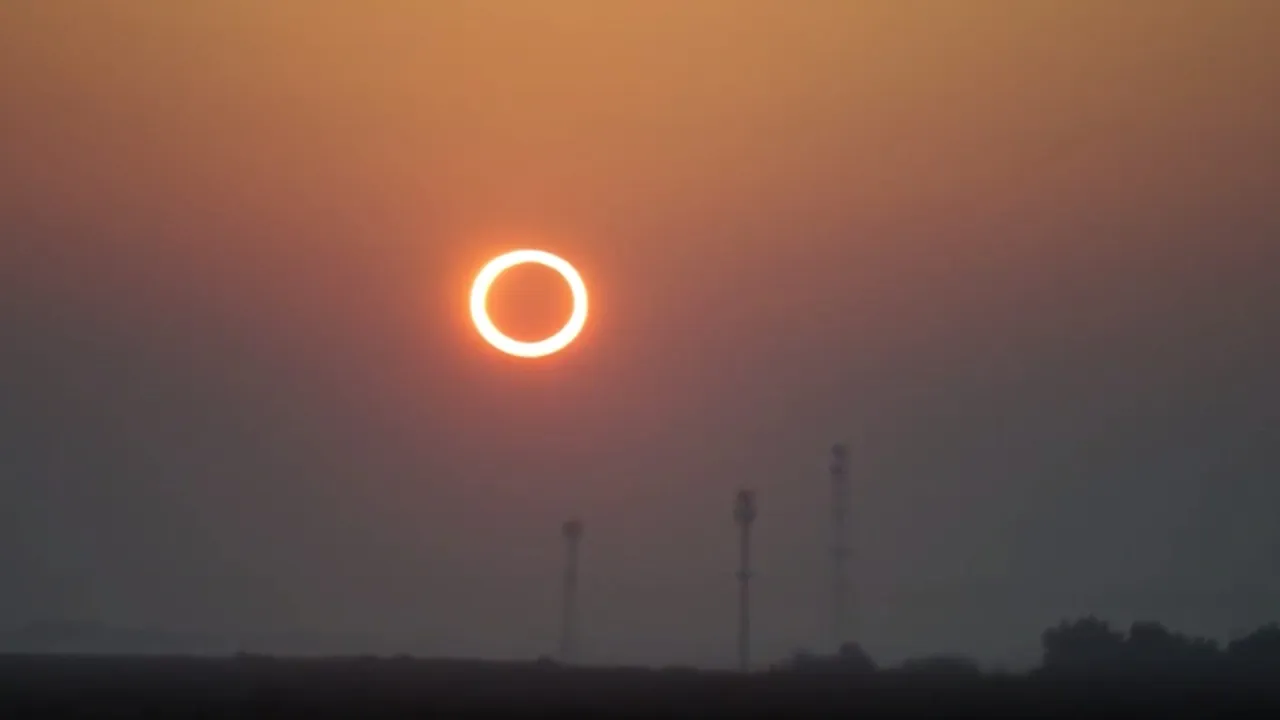
Khaberni - Less than two years away, the world is preparing to witness the longest total solar eclipse of the century, an astronomical event that will turn day into night for a few minutes, captivating millions around the globe.
According to astronomical calculations, this eclipse will occur on August 2, 2027, when the sun will be completely obscured by the moon, creating a stunning spectacle on Earth's surface.
The path of darkness will extend across densely populated areas, including parts of North Africa, Europe, and the Arabian Peninsula, allowing millions of people the opportunity to witness this unique natural display, as per ecoportal.
Estimations suggest that about 88.9 million people will be able to experience the total eclipse, while around 931 thousand will see a partial eclipse, and over 4.6 billion people will enjoy various stages of the event worldwide. Astronomy enthusiasts can follow the spectacle via live broadcasts and specialized applications, making this event a chance for researchers to conduct advanced scientific studies on solar phenomena and their effects on Earth.
Amid all this excitement, experts warn of the dangers of looking directly at the sun during the eclipse without appropriate protection, as it can lead to solar retinopathy, or what is known as "eclipse blindness," which may be permanent. Specialists recommend using special glasses with internationally certified solar filters or relying on indirect viewing methods such as pinhole projection to avoid any risks to the eyes.
According to NASA, the moon's shadow will pass over parts of Europe, North Africa, and the Middle East on August 2, 2027, completely obscuring the sun for up to 6 minutes and 22 seconds, making it the longest total solar eclipse visible on land this century. It will be visible in countries including: Spain, Morocco, Algeria, Tunisia, Libya, Egypt.
It is noted that the eclipse of April 8, 2024, in North America lasted only about 4 minutes and 28 seconds, highlighting the exceptional nature of the 2027 event.
A total solar eclipse is a rare phenomenon that occurs when the moon passes directly between the Earth and the sun, completely blocking its light in a specific path, temporarily turning day into near night and revealing the sun's outer atmosphere, known as the corona.
The world is set to witness other eclipses before this event:
February 17, 2026: An annular eclipse to be seen in Antarctica and a partial eclipse in several regions.
August 12, 2026: A total eclipse to be seen in Greenland, Iceland, Spain, Russia, and parts of Portugal.
August 2, 2027: The anticipated total eclipse that will dazzle the world with a day turning into night.
This rare event provides an exceptional scientific and visual experience, making it a unique opportunity for astronomy enthusiasts, scientists, and observers around the world to witness nature in its finest form.