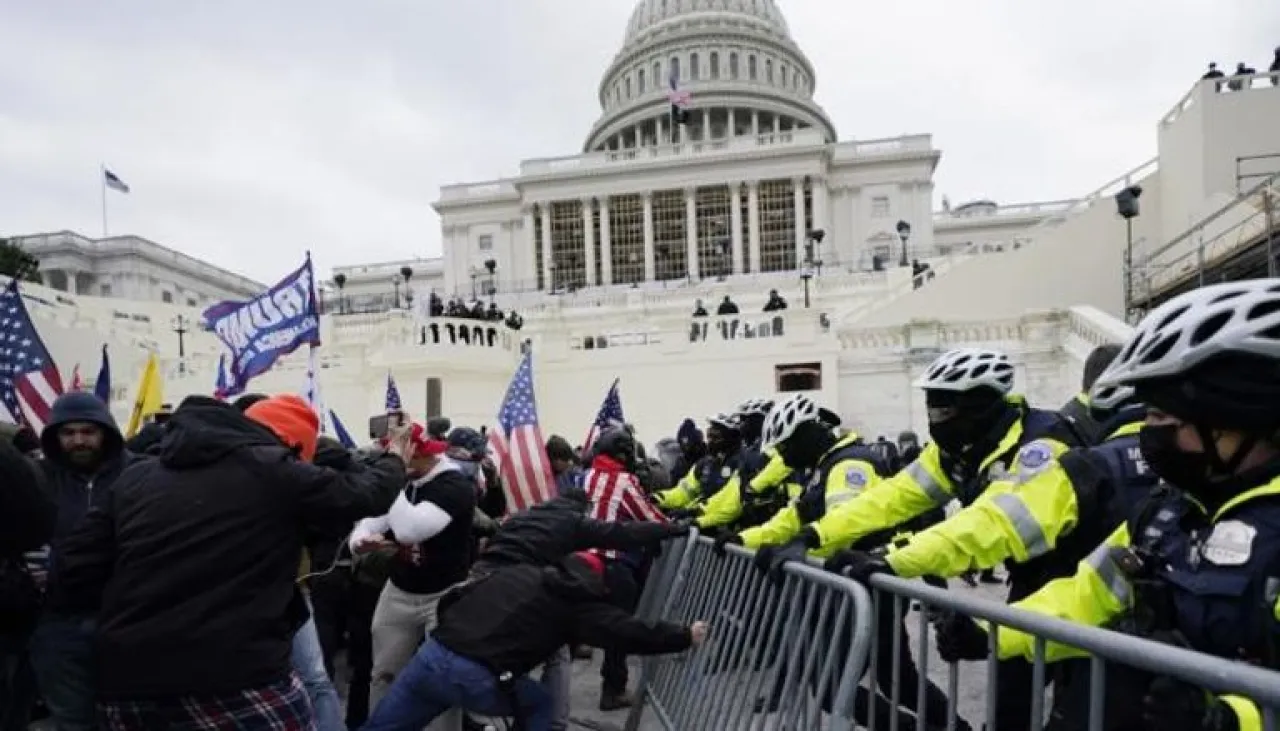
Khaberni - Five years ago, supporters of Donald Trump stormed the Capitol building in protest of what they claimed was "rigging" of the presidential election.
During that period, Trump returned to the White House and successfully erased the political and legal repercussions of the incident and transformed it into a springboard for a bolder and more expansive second presidential term in using power, according to American magazine "Politico".
Since the last days of his first term, Trump realized that the American Constitution is filled with loopholes and ambiguities that make it extremely difficult to hold a president accountable.
This lesson later led to his return to the White House and acquiring a strong form of judicial immunity, as sanctioned by the Supreme Court.
"Politico" explained that within hours of assuming the presidency again, Trump issued a mass pardon covering about 1500 people involved in the Capitol siege, including hundreds who assaulted police officers.
Trump's decision came despite federal judges' warnings that this pardon would be interpreted as a justification for violence, and would annihilate the chance to understand how ordinary citizens, many without criminal records, were drawn into acts of violence because they believed the narrative of the 2020 election fraud.
The events of January 6, 2021, remain a key to understanding Trump's second term, as the political spirit of this term was formed in the last days of his first term, where today he acts as an almost unrestrained president, testing and exceeding the limits that his predecessors avoided approaching.
For example, Trump used emergency powers to impose unprecedented customs tariffs, challenged Congress's financial authority by slashing billions of dollars in foreign aid, and deployed the National Guard in states and cities without the consent of their leaders.
He also used wartime powers to deport hundreds of people without legal guarantees, and ordered lethal strikes on boats he claimed were transporting drugs to the United States.
All these actions, according to "Politico," lie in legal gray areas or are questionable in terms of constitutionality, but they reflect an extreme expansive view of executive power, executed by a president who realizes that he is now beyond the reach of judicial prosecution or political accountability.
This sense of unaccountability intensified as most of the state-level criminal cases related to his attempts to overturn the 2020 election results collapsed, in addition to issuing a second pardon covering prominent figures like Rudy Giuliani, John Eastman, and Sidney Powell.
In this context, Trump seeks to redefine the narrative of January 6, 2021, and consider the judicial prosecutions as "a severe national injustice".
Trump also purged law enforcement institutions of investigators who sought to hold him and the participants in the attack accountable.
Meanwhile, the U.S. administration says that the media's continued focus on January 6 is the reason for the declining trust in journalism, considering that the people re-elected Trump for issues like border security and the economy.
"Politico" highlights stories of some accused in the Capitol attack indicating that many of the convicts were ordinary people, some of whom served in the military, and who faced psychological and economic crises during the coronavirus pandemic and were swayed through social media into conspiracy theories.
In contrast, some of the most dangerous individuals involved received either pardons or sentence reductions, such as leaders of extremist militias like the "Oath Keepers" and "Proud Boys," who were convicted of conspiracy and sedition to stop the peaceful transition of power.
Despite all of Trump's attempts, ongoing efforts are made to preserve the memory of January 6, 2021, as former Congressional Committee members have reinvestigated the events.
Former Special Counsel Jack Smith also continued to hold Trump directly responsible for the violence, asserting that he was confident of a conviction had the case gone to trial.
Some civil and criminal cases still continue, including investigations around attempts to form fake voter lists and uncovering new threads related to explosive devices found on the eve of the attack.