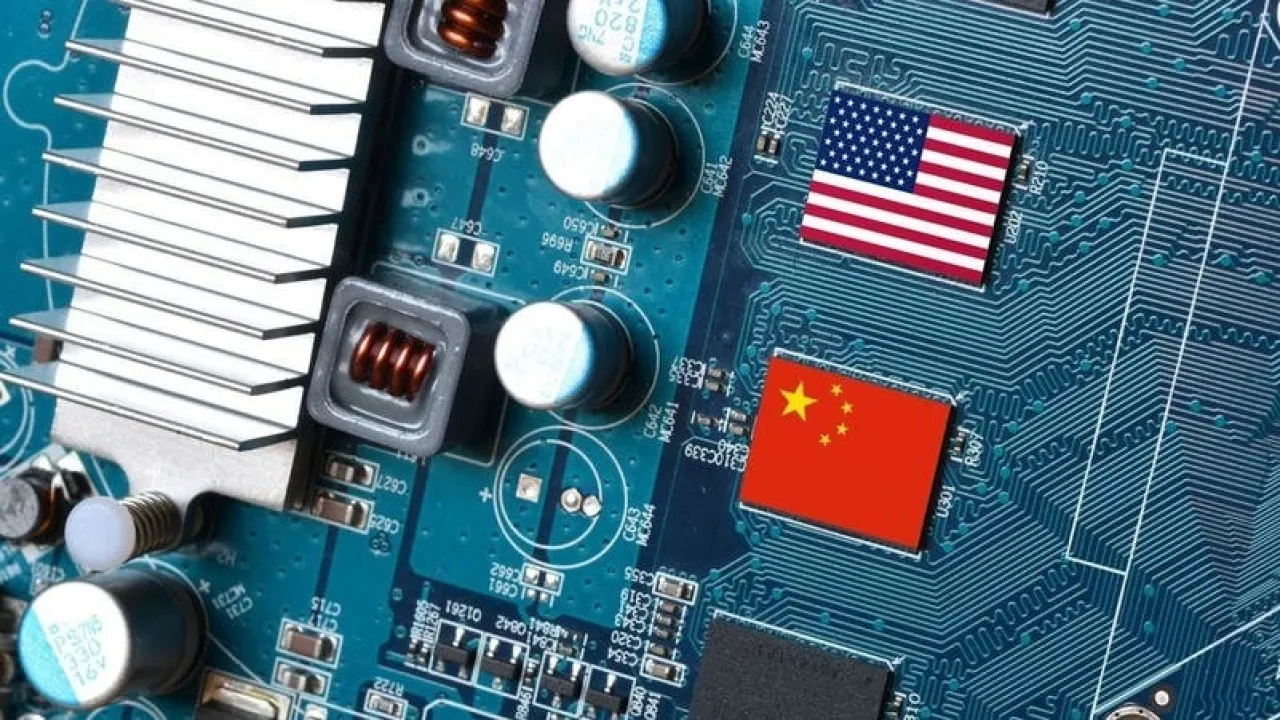
Khaberni - At the end of 2025, China sent a clear message to the world, indicating that it is confidently advancing in the artificial intelligence race.
On the last day of the year, Deep Seek company published a new technical paper, co-authored by its founder and CEO Liang Wenfeng along with 19 researchers, addressing an advanced framework for training artificial intelligence systems on a large scale, and pointing to promising pathways for the development of foundational models.
This announcement, at the height of the end-of-year holiday season, reminded that Chinese AI companies have become more focused on innovation, in an attempt to maintain their edge in a rapidly changing industry, according to a report published by "scmp".
"Deep Seek" ignites the spark
Nearly a year ago, "Deep Seek" began to attract global attention after launching its large language model DeepSeek-V3, followed weeks later by the inference model DeepSeek-R1.
The two models succeeded in outperforming or matching their competitors across a wide range of standard performance tests in the sector.
What’s more significant is that these models were developed at a much lower cost compared to what major American tech companies spend.
The result was a shock in the markets, where tech stocks experienced a sharp sell-off on January 27, losing nearly one trillion dollars, including about 600 billion dollars in market value from Nvidia alone.
Government support and global ambition
Analysts expect Chinese AI companies to continue their momentum during 2026, driven by government policy support, improved financing opportunities, and wider adoption of AI across various sectors, alongside a substantial talent pool.
One of the founders of startups in this field, who preferred to remain anonymous, indicated that China might surpass the United States to become the world leader in artificial intelligence by 2027, noting that the human depth of competencies represents a crucial competitive advantage.
In his New Year’s speech, Chinese President Xi Jinping emphasized that the domestic market is witnessing fierce competition among large AI models, parallel to breakthroughs in the semiconductor industry, making China among the fastest-growing economies in terms of innovation.
Open-source models compete with America
According to a report issued by the DigiChina project of Stanford University, China today has more than ten companies developing powerful, open-source AI models, among them Qwen of Alibaba Cloud along with startups such as "Moonshot AI", "MiniMax", and "Zhipu AI".
The report indicated that Chinese open-source models have perhaps caught up with or even surpassed their American counterparts in terms of capabilities and spread.
It mentioned that Meta is using Qwen models in training a new model, while major American companies like "Airbnb" depend on these models in their AI-supported services.
Within China, AI applications such as ChatGPT have become a part of daily life, often used for free, even in preparing reports and official documents within local governments.
From chatbots to human-like robots
China’s ambitions are not limited to chatbots, as humanoid robots have emerged as a major application of what is known as embodied artificial intelligence.
The founder of "Unitree Robotics" anticipates significant advancements over the next few years, despite ethical and security challenges.
Chinese companies are betting on AI-powered devices such as smart glasses and smartphones, in a step that "Alibaba" considers a real revolution in the interaction between humans and machines.
The real challenge: profitability
Despite this optimism, achieving profitability remains the biggest challenge for many startups.
Analysts anticipate that 2026 will be a turning point, where profitability becomes the primary criterion for evaluating AI companies.
With companies like "MiniMax" and "Zhipu AI" preparing for IPOs in the Hong Kong Stock Exchange, alongside massive funding rounds for other companies, bets are increasing that China is not only competing in innovation but also striving to build a economically sustainable AI sector.
However, this rapid progress, in turn, raises concerns among some sector employees, who fear that advanced AI tools might reduce the need for programmers, indicating that the innovation race may bring with it societal challenges as complex as the technical challenges.