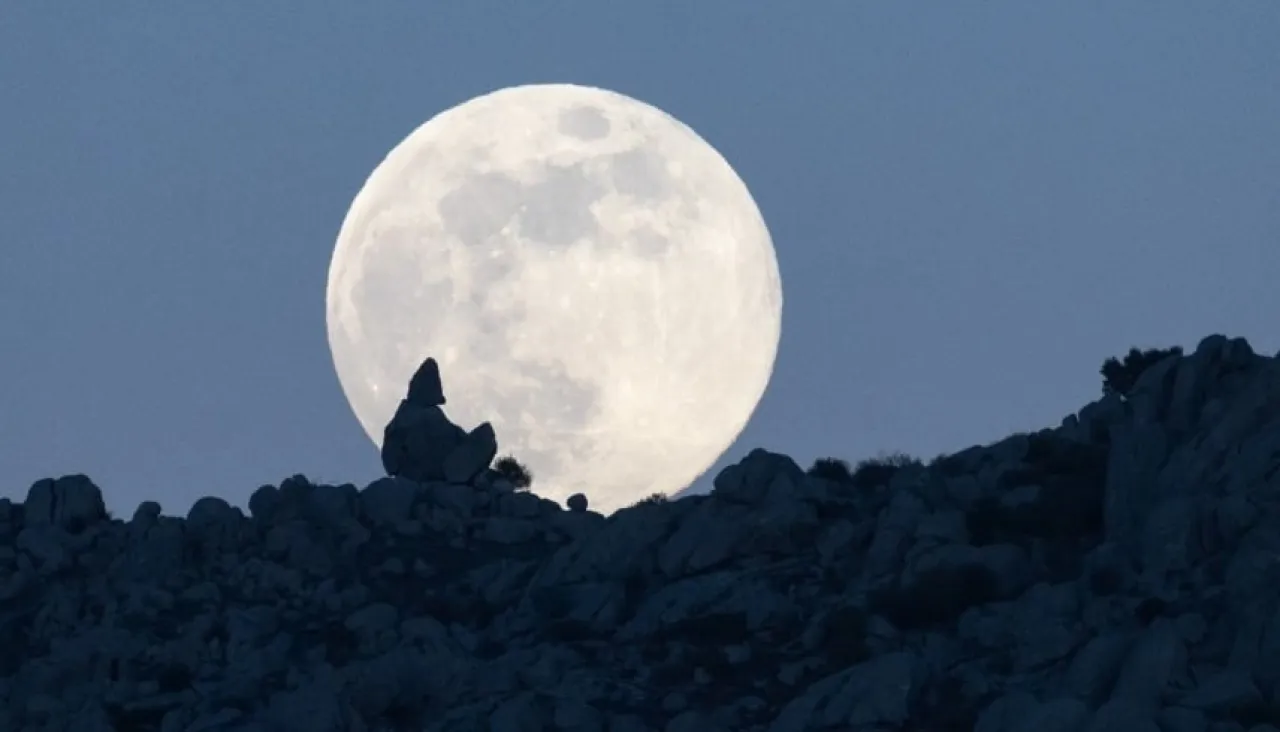
Khaberni - Astronomy enthusiasts and sky watchers are treated to a unique astronomical event as the first giant moon of 2026, known as the "Wolf Moon," brightens the eastern horizon from the second to the fourth of January, offering a stunning natural display for both astronomy fans and families alike.
This moon is notable for being the first full moon of 2026 and continues a series of four consecutive giant moons seen in the last months of 2025.
The giant moon occurs when the moon is at its closest point to Earth in its elliptical orbit, making it appear up to 14% larger and 30% brighter than a regular full moon.
What does the moon look like?
As the moon approaches the horizon, it takes on an orange to coppery color due to its light passing through denser layers of the atmosphere, which scatters the blue wavelengths and preserves the red light.
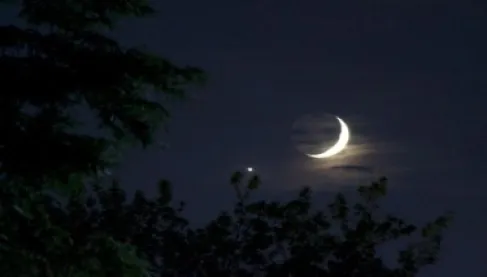
The celestial scene is not limited to the moon alone, as its appearance coincides with Jupiter coming close to it throughout the night, alongside the prominence of the Orion constellation, while Saturn can also be seen in the southwestern horizon at moonrise.
This event coincides with the peak of the Quadrantids meteor shower during the nights of January 2 and 3, which is among the brightest meteor showers of the year. Although moonlight may obscure some meteors, the brighter fireballs remain visible, especially during the pre-dawn hours.
How to watch the "Wolf Moon"
According to Noah Petro, the head of planetary sciences and geological and physical chemistry at NASA's Goddard Space Flight Center in Maryland, the moon will appear as a full moon on the day before January 3 and the following day as well.
For the best viewing experience, no special glasses are needed; you can safely watch the moon with the naked eye, and using a telescope or binoculars can provide clearer vision. It's best to choose a dark location with an unobstructed horizon, and if that’s not possible, beaches or any open gathering spots remain suitable options.
If you are looking to capture high-quality photos, it’s recommended to use a camera with a long-range lens mounted on a tripod, choosing the timing of moonrise where it appears larger and warmer in color.
When shooting with smartphones, it's preferable to rely on optical zoom instead of digital, including natural elements or architectural landmarks in the frame to highlight the moon's size more clearly.
The origin of the name "Wolf Moon"
Ibrahim Al-Jarwan, the chairman of the Emirates Astronomy Association and a member of the Arab Union for Astronomy and Space Sciences, mentioned that the full moon of January is known as the "Wolf Moon", a name that goes back to old traditions in the North American and Western European farmers' almanacs, where it was commonly believed that wolves howled more during this month due to the severe cold and scarcity of food.
Al-Jarwan explained that the names of full moons in those cultures reflected natural phenomena and agricultural cycles, noting that one of the most famous is also the "Harvest Moon", which appears at the end of summer or beginning of fall, coinciding with the crop harvesting season.
He added that the full moon of January 2026 is one of the giant moons, an astronomical phenomenon that occurs when the completion of the moon coincides with its closest approach to Earth, known as perigee, at a distance less than 365,000 kilometers. Normally, the average distance between the Earth and the moon ranges between 354,000 and 406,000 kilometers.
Al-Jarwan pointed out that this relative proximity causes the moon to appear bigger and brighter compared to a regular full moon, an optical effect that is noticeable with the naked eye without the need for astronomical instruments.