Khaberni - The Supreme Leader of the Islamic Republic, Ali Khamenei, acknowledged on Saturday the "just demands" of the protesters, while simultaneously calling for an end to the "instigators of disorder", during the seventh day of the protests that started over living conditions in Iran.
The protests began last Sunday in Tehran in response to the high cost of living and economic deterioration, before expanding to include political demands and other regions. Clashes between protesters and security forces have so far resulted in the deaths of at least 12 people, including security personnel, according to official Iranian reports.
Iranian media reported in recent days incidents of local violence and material damages in the west of the country.
The "Mehr" news agency reported on Saturday that "Latif Karimi... was martyred in the clashes that occurred this afternoon in Malakashahi in Ilam, while defending Iran's security", noting that he was a member of the Revolutionary Guard.
This came after the announcement of the death of another security member "by blade and bullet".
About 20,000 people live in Malakashahi, many of whom are Kurds. The Fars news agency reported that "saboteurs tried to storm a police station" there.
"Riot"
In his first comment on the current protests, Khamenei considered the economic demands of the protesters "just", while he called for putting an end to "instigators of disorder".
"The country's authorities recognize that (the economic difficulties), and the president and senior officials are working to solve this problem," he said. He added, "That's why the merchants protested against this situation, and they are fully entitled to do so."
"We are in dialogue with the protesters... but there is no point in dialogue with the instigators of disorder. They must be stopped," he continued.
The Mehr agency reported a statement from the Revolutionary Guard saying that "Ali Azizi, a member of the Basij forces, was martyred after being stabbed and shot in the city of Harsin (west) during a gathering of armed rioters" on Friday.
The Basij is a volunteer mobilization force affiliated with the Revolutionary Guard.
In recent days, at least eight people have been killed in the clashes, according to official figures.
The protests in Iran have spread to varying degrees to at least 30 different cities, mostly medium-sized and located in the west and southwest of the country, according to a count by the Agence France-Presse based on official data and media reports.
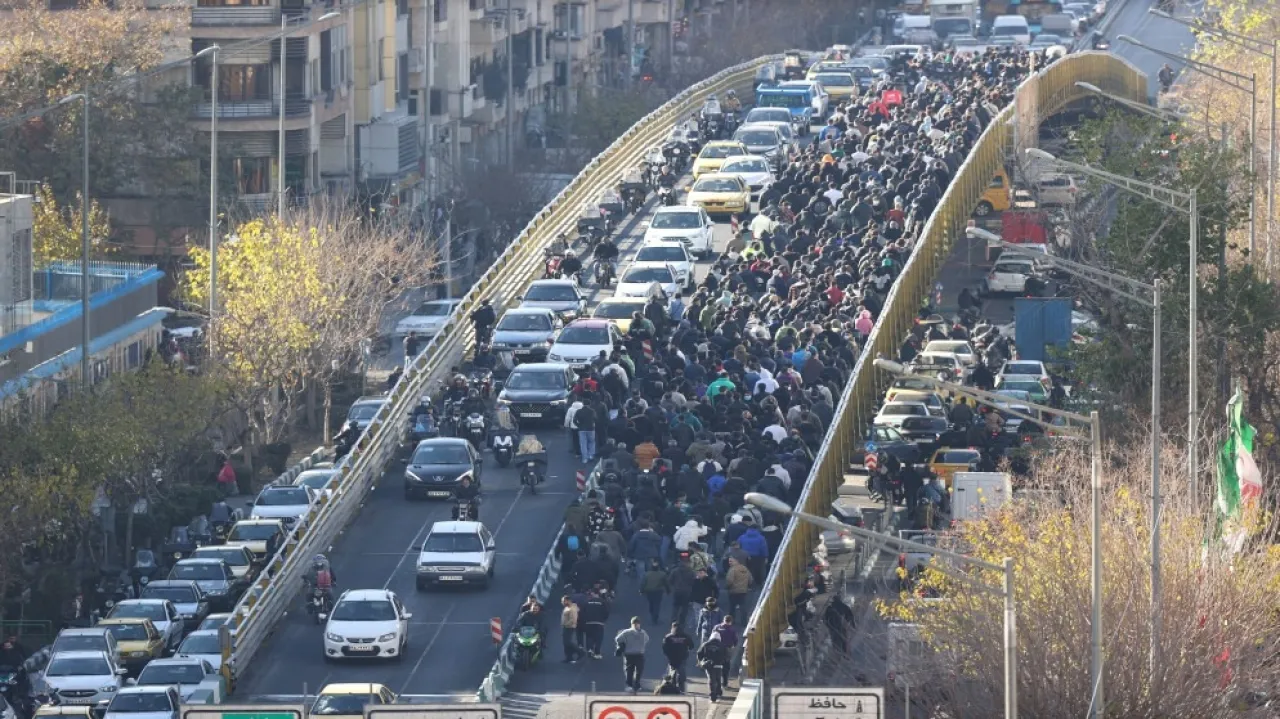
The Fars news agency reported on Saturday that marches took place in several districts of the capital Tehran, which has about 10 million inhabitants, the previous day.
But the situation appeared calm on Saturday as the streets were nearly empty amid rainy and snowy weather, according to Agence France-Presse reporters.
In the city of Darshahr (west), about 300 people threw Molotov cocktails, blocked streets, and "brandished Kalashnikov rifles" on Friday, according to Fars.
Tasnim agency quoted an official as saying that a person was killed on Friday in the city of Qom south of Tehran when a hand grenade he intended to use exploded "in his hands".
Tasnim added that a 17-year-old boy, involved in the protests in Qom, was shot and died from his injuries.
Authorities and Iranian media do not necessarily convey every incident in detail, which complicates the process of following events, as verifying the flood of videos overwhelming social media is extremely difficult.
Political demands
The movement began on Sunday in Tehran where shop owners closed their stores in protest against hyperinflation and economic stagnation. It then widened to include universities and other areas of the country.
The scope of demands by the protesters has since risen to include political demands.
In Karaj, a suburb of Tehran, the Fars agency reported that "some people burned the Iranian flag while chanting +Death to the dictator+, and +This is not the last battle, Pahlavi (the former Shah of Iran) is returning+", noting that these slogans sparked "protests".
The Islamic Revolution overthrew the rule of the Pahlavi dynasty (1925-1979), which was allied with the West and the United States.
Iran is subject to American and international sanctions based on various issues, most notably the nuclear and missile programs.
Since the onset of the latest wave of protests, the government has adopted a conciliatory tone in dealing with what it considered "legitimate demands" linked to economic difficulties, but it warned on the other hand that it will not tolerate any attempt to destabilize.
This was reflected in Khamenei's statements on Saturday.
The current protests have not reached the same scale as the demonstrations that Iran witnessed at the end of the year 2022 following the death of young woman Mahsa Amini while being detained by the morality police for not adhering to the strict dress standards of the Islamic Republic.
Several Iranian cities also witnessed protests in November 2019 following the announcement of a fuel price hike. Those protests spread to about a hundred cities, including Tehran, and resulted in dozens of deaths.