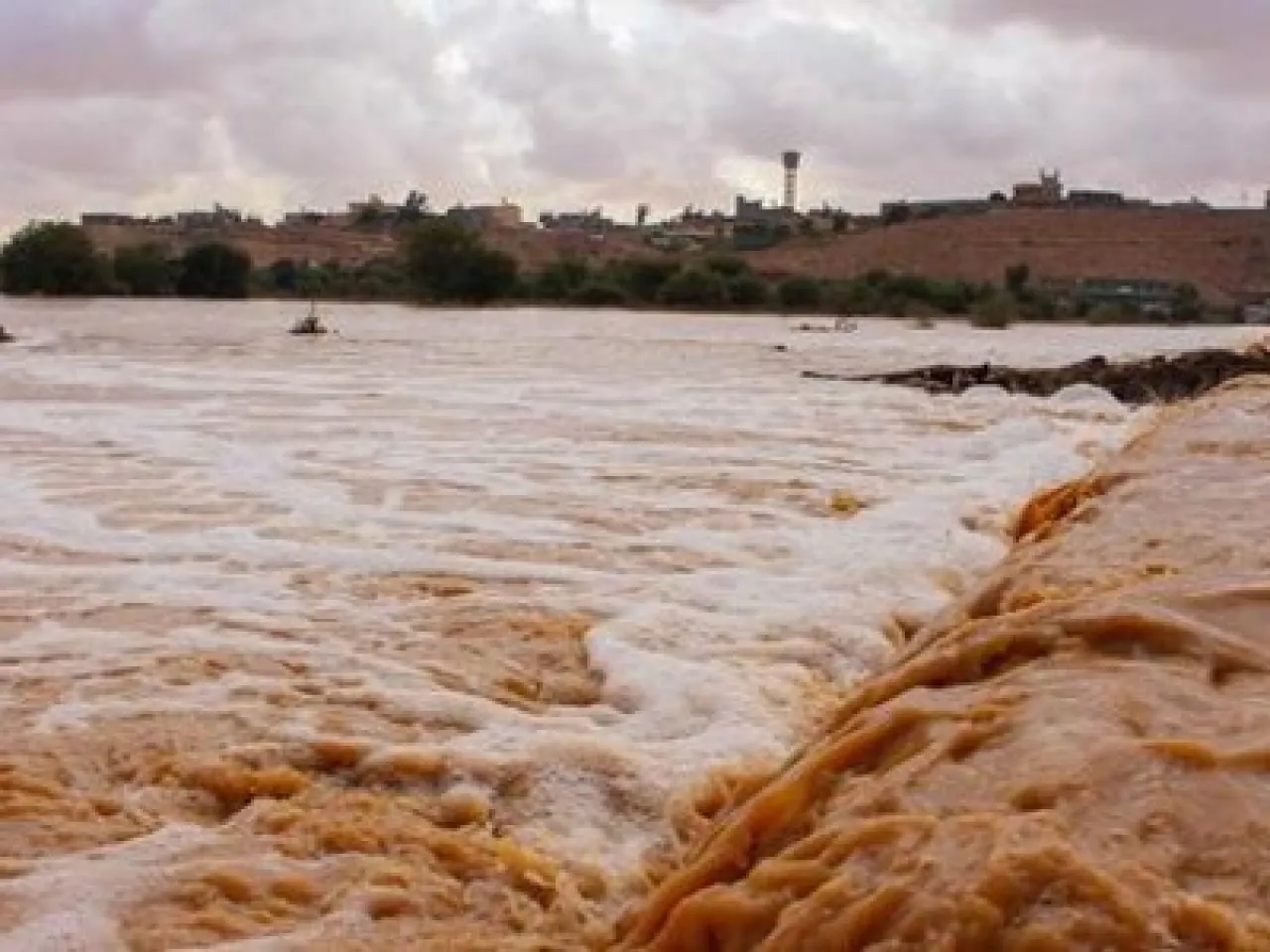
Khaberni - The head of Jordanian engineers, engineer Abdullah Asem Ghosheh, emphasized the need to make a qualitative leap in the way infrastructure is managed and maintained in Jordan, calling for the establishment of a national fund for maintenance and sustainability that would manage the financing of maintenance and rehabilitation projects of facilities and infrastructure that showed clear weakness during the recent low-pressure system and the accompanying incidents and damages in several areas.
Ghosheh confirmed that the incidents witnessed in the country's infrastructure cannot be dealt with as isolated or emergency events, but should be read within a broader context linked to changes in rainfall patterns and their frequency, and the increase in their intensity during short time periods, which imposes a comprehensive reevaluation of planning, design, and maintenance policies.
Ghosheh clarified that what we experienced during the last rainfall is not entirely an exceptional case but a repetition of previous scenarios, and that climate change and its effects are not new to Jordan and the world. Institutional work began globally since the early nineties at the Earth Summit in Rio de Janeiro, followed by a number of international agreements that have expanded in this regard, and Jordan has been affected during the past quarter-century by increasing levels of precipitation, its disturbances, and changes in intensity and duration, and intensification in the behavior of floods and rainwater courses, which put pressure on the infrastructure, like the incidents of downtown Amman flooding in 2015 and the school trip drowning in the Dead Sea in 2019, resulting in property and life losses.
The head of engineers indicated that investing in maintenance and sustainability is a direct economic investment, pointing out that global engineering studies confirm that every dinar spent on preventive maintenance saves approximately four dinars in costs of losses and treatment after accidents occur, whether they are material, social, or service losses. He noted that the proportion of budgets allocated for maintenance in Jordan did not exceed 5%, whereas global standards for that exceed 9% and increased to 15% due to addressing climate change.
These low maintenance budget ratios, according to Ghosheh, are due to debts, burdens, and recurrent deficits in the budgets of municipalities that need a national integrated effort to support the local management system and risk management within them independently of the financial problems faced by each concerned municipality, which exceeded the debts of the 104 combined municipalities at 600 million Jordanian dinars.
Ghosheh also called for the existence of a single regulatory and coordinating entity concerned with monitoring standards of dealing with the impacts of climate change and its effects on infrastructure and existing and newly established facilities and projects.
He reaffirmed that the multiplicity of references and the variation in the application of such standards weaken the efficiency of the public safety system, emphasizing the importance of unifying the technical reference, and linking urban planning to future hydrological analysis, especially in areas prone to flood risks.
He noted that protecting lives and properties is not only achieved through new projects but requires a serious revision of what is already in place, and taking corrective or preventive measures when needed, based on neutral scientific studies, and developing the philosophy of urban planning and development in urban expansion not where spaces are available but those that are less dangerous to its residents.
Ghosheh also stressed the importance of early warning systems as a fundamental element in preventing risks and similar crises, pointing out that these systems represent the first line of defense in reducing losses when they are integrated within a national risk management system, supported by clear and updated emergency plans.
He explained that dealing with infrastructure incidents must move from a reactive logic to a proactive risk management logic, which combines good planning, risk and crisis-responsive budgets, flexible engineering design, sustainable maintenance, and effective legislation.
The head of engineers confirmed that the union, as a national house of expertise, calls for dealing with what emerged from the recent low-pressure system as an opportunity to review policies and update standards, not just to address the immediate damage, emphasizing that climate change is not a justification for the weak response of infrastructure, but a factor that necessitates the development of planning and engineering tools to be more adaptable and resilient.
Ghosheh concluded by affirming that Jordan possesses the engineering capabilities and expertise capable of implementing this transformation, whenever institutional will, effective coordination, and smart investment in prevention and maintenance are available, ensuring a safe and sustainable infrastructure for future generations.