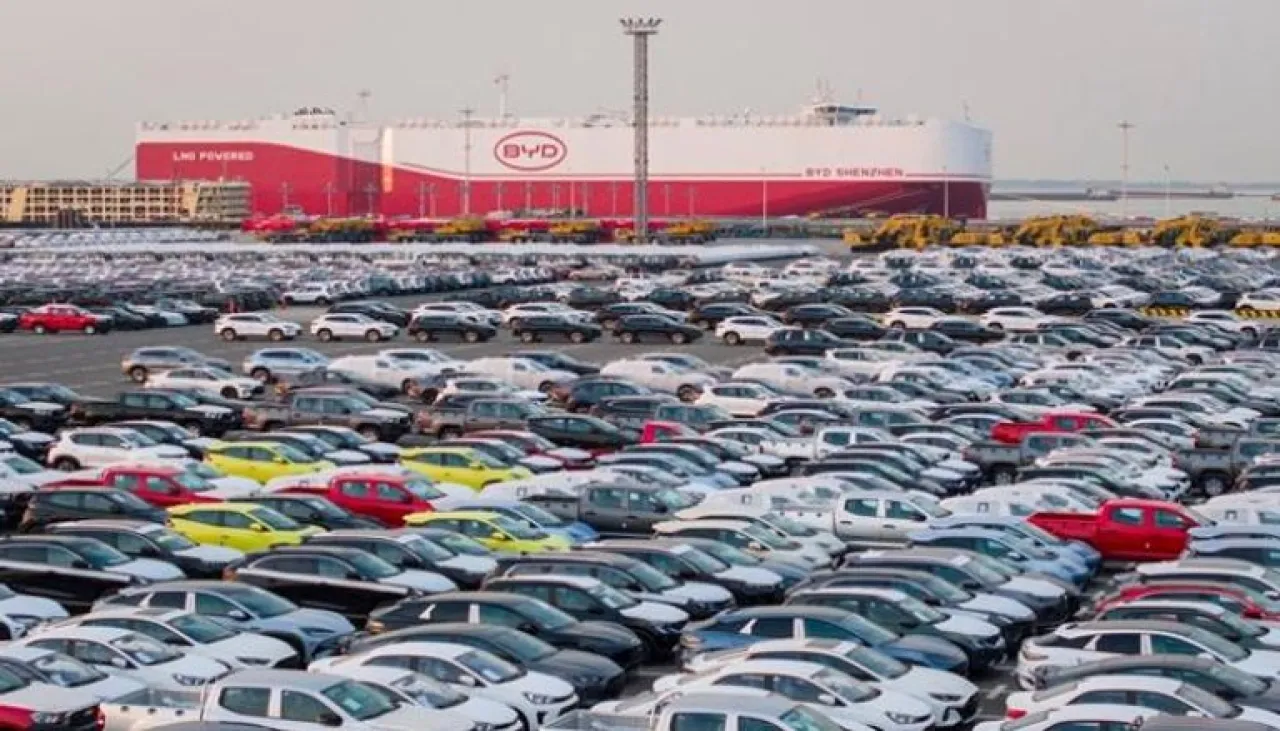
Khaberni - The car market in 2025 continued on its declining path, in a striking paradox that reflects the depth of transformations witnessed in this vital sector.
Despite the overall decrease in new car sales, electric vehicles stood out as a clear exception, confirming that they are no longer just a future option, but have become a fundamental element in the automotive industry landscape and a true driver of change.
New car sales fell by 5% in one year, reflecting the ongoing recession that has hit the market for the second consecutive year.
The French newspaper Libération attributed this decline to a combination of interconnected factors, most notably the decrease in household purchasing power, rising car and spare parts prices, tighter credit conditions, and the persistent economic uncertainty casting its shadows over European markets.
Despite attempts by some manufacturers and conservative and extremist political forces to slow down the transition towards electric vehicles, the traditional market has not been able to regain its previous momentum, while electric vehicles continued to record impressive performance.
According to data collected by AAA Data, registrations of electric vehicles increased by 12% compared to 2024, despite a challenging start to the year affected by the reduction of government subsidies and financial aid for purchasing these types of vehicles.
This growth reflects a profound shift in consumer behavior, who have become more aware of the high operational costs of traditional cars and the economic and environmental benefits provided by zero-emission vehicles.
Electric vehicles' market share reached about 20% of total new car sales, an increase of three percentage points in just one year, a strong indicator that the shift towards electricity is no longer marginal but has become a primary choice for an increasing segment of buyers, despite ongoing concerns about purchase prices and charging infrastructure.
This outcome occurs in a tense political context, with repeated attempts in December to hinder the goals of electrifying the car fleet, by some manufacturers and European political parties.
Libération newspaper indicates that these numbers reveal an increasing gap between political rhetoric and the actual market trajectory, as structural factors such as environmental legislation, technological advances, and rising fuel prices, drive consumers towards electric cars regardless of circumstantial fluctuations.
At the level of major companies, the results of 2025 showed a clear disparity in performance. Among the top 15 groups and brands, only two companies, Renault and BMW, managed to end the year with positive outcomes. These companies benefited from strategies based on diversifying electric and hybrid models, adopting more flexible pricing policies, and a strong presence in the European market.
On the other hand, Tesla recorded a sharp decline, amid intensified competition, price pressures, and slowing demand in some markets, which was a surprise in a sector where the company had long been considered unrivaled. These transformations were clearly evident during the Mondial de l'Auto in Paris, where electric models dominated the exhibition stands, symbolically indicating the direction the industry is taking, even if faced with temporary political or economic resistance.
Despite this progress, electric vehicles still face real challenges, including the higher purchase price compared to traditional cars, the disparity in charging infrastructure across regions, and the uncertainty regarding the continuation of government support. Libération noted that general indicators suggest that these hurdles are gradually decreasing, with advancements in technology, increased production, and improved consumer confidence.
The year 2025 confirms that the car market is undergoing a profound and irreversible transformation, for despite the general recession and decline in overall sales, electric vehicles continue to establish themselves as a dominant option in the future of transportation. It seems that the coming years will witness a smaller market, but more reliant on electricity and more connected to standards of sustainability and technology, making this shift one of the most prominent features of the industrial and economic landscape in the next decade.