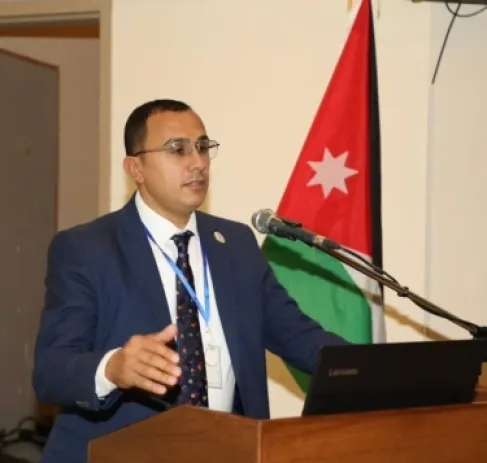
What is surprising, yet worrying, is the appearance of the Minister of Local Administration, a former engineer who worked in the ministry for years before being crowned minister, justifying the floods and readiness collapse in Al-Karak by saying “the rain was heavy and fell within a short span of time”. This justification, in itself, does not even rise to the level of a technical explanation, let alone being an excuse uglier than the sin!!
Even more perplexing is that the same minister spoke about the necessity of conducting a hydrological study by a specialized company, justifying this by his lack of knowledge in the field and the shortage of hydrology engineers in Jordan. Here arises the fundamental question:
If the minister, his technical team, the ministry, and the municipalities all realize the importance of these studies now, then how did it escape their notice before the disaster?
How is it conceivable that the infrastructure is managed, water drainage networks designed, project permits granted, and dams built without prior hydrological studies to assess risks and prepare emergency scenarios, even if not designed for the most extreme climatic conditions?
Heavy rainfall is not a supernatural phenomenon, but a known scientific probability, and one of the basics of urban planning is to prepare for the worst, not to use it as an excuse after its occurrence. So how were the dams built? On what basis were the risks of their flooding estimated? And how was the impact on the surrounding residents and areas ignored? Or is the safety of citizens not part of the planning equation at all?
What these statements reveal is not just a lack of personnel or studies, but an absence of a systematic scientific approach in urban planning, and clear confusion in understanding the role of the ministry as proactive rather than justificatory. A ministry that does not plan on a scientific basis, lacks risk scenarios, and does not commit itself or the municipalities to basic planning tools, is a ministry acting reactively, not intelligently and systematically...
With this logic, the minister becomes politically and ethically responsible for the failure, not merely an observer explaining the reasons after it is too late. And what is more astonishing is the silence of the municipalities and the engineering staff, bending behind the minister with bowed heads burdened by humiliation! Instead of being the first line of defense for professionalism and public safety.
A minister justifies the disaster instead of preventing it, and admits the absence of studies instead of being asked why they weren't conducted, is a minister who should be questioned, not listened to.
Do not apologize today; you are only recompensed for what you used to do.