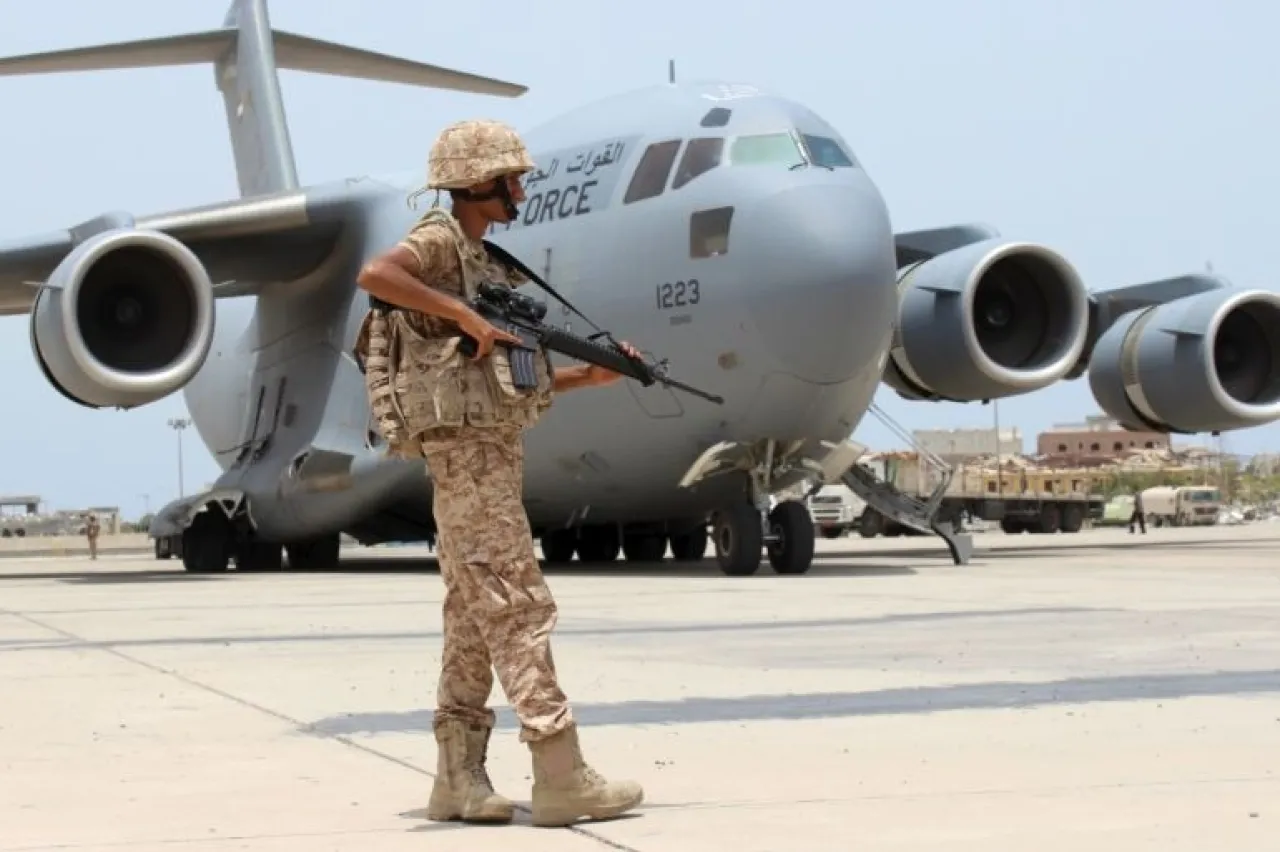
Khaberni - The UAE Defense Ministry announced the end of the remaining "counter-terrorism" teams in Yemen, confirming that the decision was made "voluntarily" and in coordination with the partners.
The announcement came hours after Rashad Al-Alimi, head of Yemen’s Presidential Leadership Council, requested the withdrawal of Emirati forces from the country within 24 hours, opening up questions: Is this a withdrawal or just a redeployment?
What exactly was terminated?
According to sources, the decision affects only specialized anti-terrorism teams, which are limited in number and function, and do not represent a broad combat presence. These limited forces are scattered in several places, most notably Shabwah province, the oil-rich, and on Mayun Island in the Red Sea, as well as being present in the Socotra Archipelago northwest of the Indian Ocean.
According to local sources in Shabwah province, the UAE has begun dismantling radars and communications equipment at the Belhaf and Marrah camps in the province as a prelude to withdrawal.
This limited direct activity follows the Emirates' announcement that it ended its regular military presence in Yemen as of 2019, and that what remains is "a narrow activity linked to specific tasks".
Did the UAE respond to the Presidential Council's request?
Linguistically and politically, Abu Dhabi is keen to deny that. The UAE Defense Ministry's statement emphasized that the decision is a sovereign Emirati one stemming from "a comprehensive assessment of the stage", and not compliance with a deadline or pressure. However, the temporal intersection gives the decision political significance as an organized exit from a file that has become costly, while maintaining a margin for maneuver.
The information indicates that the UAE responded to the request of Rashad Al-Alimi, head of Yemen’s Presidential Leadership Council, which aligns with the strong Saudi position supporting this path.
Today, Tuesday, in a statement issued by the Ministry of Foreign Affairs, Saudi Arabia emphasized the importance of the UAE's response to the request of the Yemeni Republic for the withdrawal of its military forces from Yemen within 24 hours, and stopping any military or financial support for any party inside Yemen.
What remains?
The exit does not mean leaving Yemen altogether. What remains is indirect influence such as supporting local allied forces, security/intelligence influence from outside the territory, and political presence in port and coast files. In other words: reducing direct presence not a strategic withdrawal, according to analysts familiar with the situation on the ground.
According to the analysts, the UAE's announcement of its departure from Yemen does not mean the end of its political and military influence in the country, which faces one of the worst humanitarian and economic crises in the world.
The UAE will continue to have indirect military influence over several Yemeni forces affiliated with the Southern Transitional Council such as the Security Belt Forces, the Security Support Forces, in addition to the Giants Brigades, and Shabwah Defense Forces.
Moreover, the indirect influence of the UAE, according to the same sources, will continue on the National Resistance Forces led by a member of the Presidential Leadership Council Tareq Saleh, which is based in the strategic city of Mocha near the Bab el-Mandeb Strait south of the Red Sea, known for receiving broad support from the Emirates.
There are no official statistics on the number of forces of the Southern Transitional Council, but there are estimates indicating that they could reach tens of thousands, while the National Resistance forces are about 20,000 fighters.
How does this reflect on the Yemeni scene?
The Presidential Council can market the move as a symbolic achievement in reclaiming sovereign decision-making, although it is limited in practical impact.
The decision of the head of the Presidential Leadership Council has received massive popular support, and backing from many local entities and components, most notably the House of Representatives (Parliament), the leadership of the Ministry of Defense and the Presidency of the General Staff, in addition to the Consultative Council, Hadhramaut Tribes Alliance, the Supreme Council for Popular Resistance, the Security Committee in the oil-rich Marib province and the local authority in Hadhramaut province, along with many influential political and social figures.
This widespread support has created a kind of trust between the head of the Presidential Leadership Council and these components or entities that enjoy significant popular support.
If the political and military pressures succeed in withdrawing the forces of the Southern Transitional Council from Hadhramaut and Al Mahrah provinces, this will provide the head of the Presidential Leadership Council and the supporting components with important strongholds in the provinces that will be used as a starting point for governance.
In contrast, the Southern Transitional Council will continue to control many vital areas such as Socotra Island, the temporary capital Aden, and others, according to the analysts.
If the latter withdraws from Hadhramaut and Al Mahrah under political or military pressure or both, it will be difficult for it to declare separation or what it calls "the South Arab state" since the provinces alone constitute about half the area of Yemen.
The Southern Transitional Council faces a challenge: Does the move weaken its cover, or push it to strengthen its field documents, especially in Hadhramaut?
The decisions of Al-Alimi, strongly supported by Saudi Arabia and vital Yemeni components, will enhance the military and political pressures on the Southern Transitional Council, which may eventually be forced to withdraw from Hadhramaut and Al Mahrah, leading to a loss of strategic and vital geographical areas it was aiming to strengthen its general influence over southern Yemen.
As for the coalition: it retains "options of deterrence", as shown in its movements against what it described as violations by the Transitional.
The Legitimacy Support Coalition possesses multiple deterrence options and thousands of Yemeni forces stationed near the Saudi border with Hadhramaut, including the Homeland Shield forces, formed in 2023 by Rashad Al-Alimi and supported by the Kingdom.
There are also ground forces and Saudi aerial support that will likely tip the balance towards expelling the Southern Transitional Council forces from Hadhramaut and Al Mahrah if the conflict escalates to direct confrontations.