After nearly seven years, the era of foldable smartphones has been disappointing, but the attempts by manufacturers cannot be denied.
Samsung, a Korean company, was the first major company to enter this field in 2019, and has continued to develop it since then, launching four new foldable phones in 2025 alone, the latest of which was the "Galaxy Z TriFold".
This phone, currently available in South Korea and soon to be released in the United States, features two screens and folds twice, and is priced at about $2,500, which is roughly the price of two high-end smartphones, according to a Bloomberg report reviewed by "Al Arabiya Business".
Triple-fold phones are an emerging sub-category of foldable devices, and Chinese Huawei Technologies started experimenting with it last year, combining the features of a smartphone and a wide-screen tablet, making it ideal for watching videos. Supposedly, the combination of these two features in one device should override the fact that you can buy an iPhone Pro Max and an iPad Pro for less.
The design and user experience
However, after a week of testing one of the first available units of the "Galaxy Z TriFold" in Seoul, it became clear that this experimental phone suffers from some unique design flaws that make it less polished than regular foldable phones, and perhaps less efficient than traditional foldable phones.
The price alone, in addition to the engineering complexity required, affirm the device's status as a niche product, making it almost certain that it won't resonate outside the circle of early adopters and technology enthusiasts.
The latest launch by "Samsung" is "extremely bold", especially considering its weak sales in this sector. This category, which also includes models from giant companies like Google and Huawei, still represents less than 2% of global phone sales, according to data from International Data Corporation.
Apple has remained silent so far, though it is expected to release a foldable iPhone in 2026. This makes the new year a pivotal stage for the entire sector.
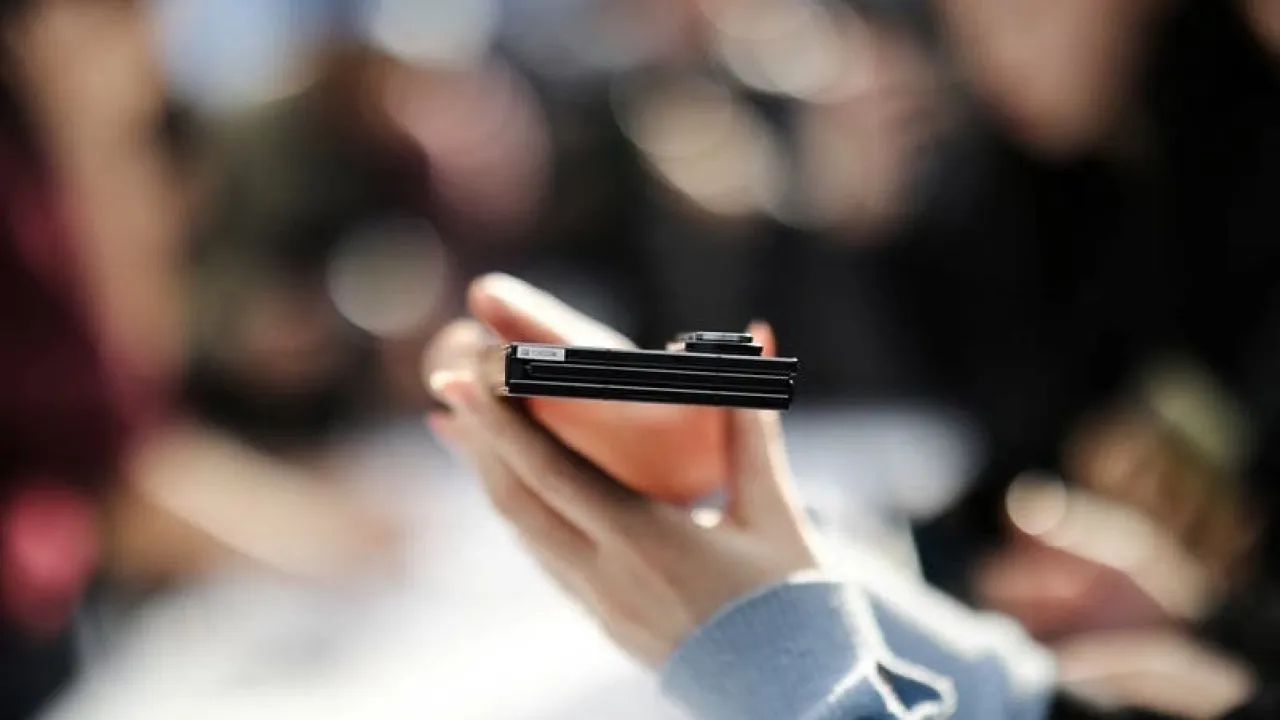
Samsung designed the "TriFold" to fold like a wallet, dividing it into three sections when used as a tablet. If the user begins to fold it incorrectly—such as closing the right side before the left—the phone quickly alerts them with on-screen notifications and vibrations.
However, the phone's durability cannot be denied, as Samsung's years in engineering foldable phones are evident in the build of the "TriFold". The device, which is the size of a 6.5-inch phone when closed, has no gaps between its three sections, providing a reassuring feeling of heaviness and solidity when held.
The hinges of the phone also demonstrate an appropriate level of resistance and emit a clicking sound when opened and closed, and Samsung has reduced nearly every panel to just the height of the necessary USB-C port.
Flaws of the phone
Although the phone is thinner in most parts than an iPhone Air and many iPads, Samsung achieved this feat by integrating all camera components into a large and heavy additional unit. The back of the "TriFold" device features a camera bump and three more prominent lenses, reducing the overall impression of slimness that the company focused on.
As a result, the device appears unbalanced whether held in hand or placed on a flat surface. The basic idea of foldable tablets like the "TriFold" is to provide the largest possible screen for the user on the go, within a small design that can fit in the pocket. However, the experience is negatively affected when the weight is unbalanced as in this case.
The uncomfortable design makes the user hesitate to carry the device for watching many videos, although the aspect ratio of the inner screen is absolutely suitable for that. There is also no built-in stand for user comfort.
The 10-inch inner screen is more prone to glare and reflections than other smartphone screens. The foldable "Oppo Find N5" phone, released earlier this year, significantly excels in this aspect, proving that better performance is possible even with flexible screens.
What worsens the situation is the poor camera performance. The images captured in low light appear grainy and dull, and lack the sharpness even achieved by mid-range Android phones like the Xiaomi 17 (priced at $630) or Google Pixel 10 (priced at $799).
Samsung has added additional selfie cameras on the large inner screen—logically for video calls—along with an external camera. However, the latter is unnecessary, as the phone can use the main camera in conjunction with the external screen.
Another problem is the semi-circular bumps at the top and bottom of each hinge, which interfere with multitasking gestures when using the screen in landscape mode. These bumps also make side scrolling in portrait mode uncomfortable.
All these stumbling blocks indicate a lack of design refinement, which is surprising given the price and also because Samsung has proven that it is capable of attention to detail.
Just this summer, the company released the "Galaxy Z Fold 7" phone priced at $2,000, whose slim design managed to appear like a regular smartphone, although the high price made it impractical for most people. Samsung said in July that early sales of this phone exceeded the previous model by 50%, indicating a better reception from consumers.