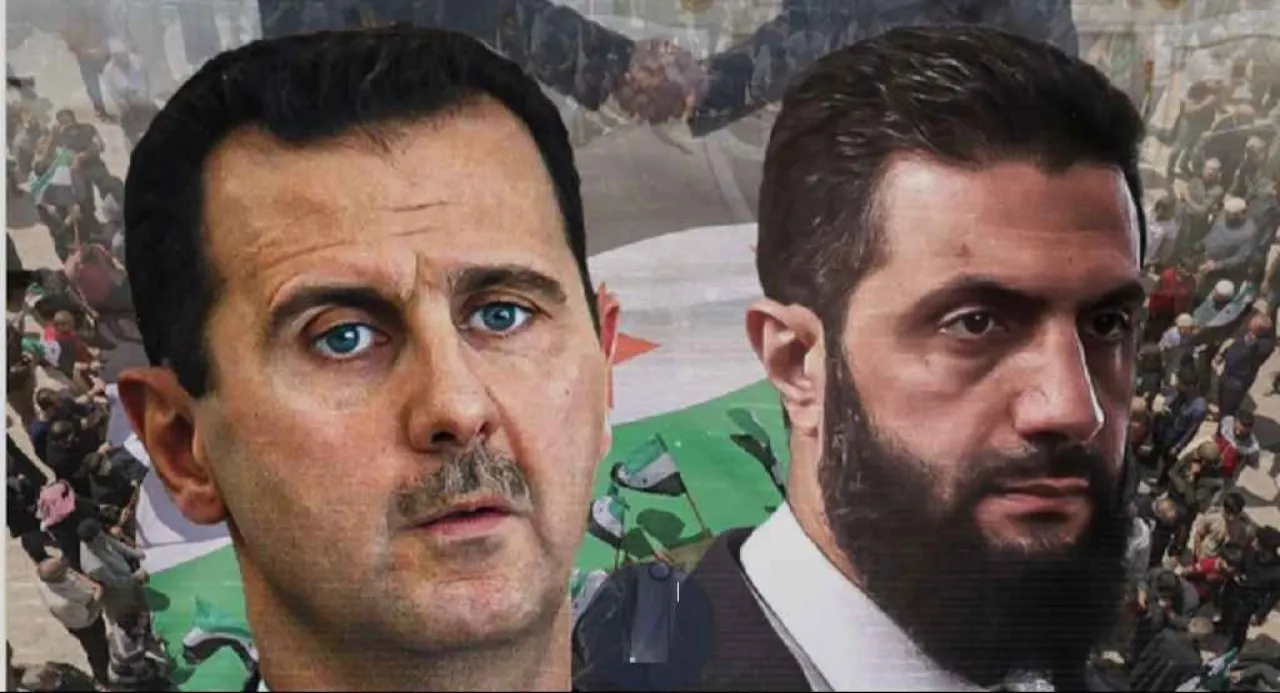
Khaberni - One year after the fall of Bashar al-Assad's regime and the flight of its leaders abroad, and while Syria is trying to find its way to stability under new leadership, former generals from their exile in Russia and Lebanon are planning an armed rebellion, according to an extensive investigative report by The New York Times.
The American newspaper revealed that the fall of the Assad regime did not eliminate the influence of a military and security elite among its leaders, but instead pushed some of them to reorganize their ranks from exile, in an attempt to destabilize the new Syrian government, and potentially carve out spheres of influence within the country.
The investigation is based on intercepted phone calls and text messages, along with interviews and in-depth analysis, explaining how military ambition intersects with money and external political pressure.
The network prominently features two former generals who are under international sanctions, Sohail al-Hassan, commander of an elite forces division under the ousted Assad regime, and Kamal Hassan, the former head of military intelligence. Despite different approaches, both are seeking to rebuild influence inside war-torn Syria after 13 years of conflict.
The newspaper says Sohail al-Hassan is known by the nickname "The Tiger" for his notorious ferocity and brutality in combat. Known to the Syrian opposition for his scorched-earth tactics, he faces accusations of ordering airstrikes on civilians.
Sohail al-Hassan, who enjoyed long-time Russian sponsorship, was among the first officials Russia sought to evacuate as the regime began to collapse, according to four former officers.
The Tiger and the Financier Evangelist
According to the investigative report, Sohail al-Hassan appears to reject retirement in his exile in Moscow, and he is the most driven towards the option of armed rebellion. Since spring of 2025, leaked messages from his phone - which the newspaper had access to - reveal a military structure beginning to form in secrecy.
The New York Times explained that "The Tiger" has accounted for and documented more than 168,000 fighters from the Alawite sect (to which Bashar al-Assad belongs) in the Syrian coastal area, 20,000 of whom have access to machine guns, 331 possess anti-aircraft guns, and 150 have anti-tank missiles, while 35 snipers still retain their weapons.
Communications reveal that Sohail al-Hassan was not operating alone, but received financial support from Rami Makhlouf, the influential businessman and cousin of Bashar al-Assad, who also seeks to play a leading role within the Alawite community from his exile in Moscow.
Makhlouf, according to the investigation, plays the role of financier and evangelist at the same time; not only does he inject hundreds of thousands of dollars as monthly salaries for the fighters (ranging between 200 and 1000 dollars), but he also promotes himself as the "savior" capable of protecting the Alawite community.
This alliance between money represented by Makhlouf and the brutal military expertise embodied by Sohail al-Hassan, forms - in the opinion of the newspaper - the solid core of what can be described as a "shadow army" waiting for a moment of weakness in the new government to strike.
Interestingly, Sohail al-Hassan now signs his correspondence with "Your servant at the rank of Mujahid", addressing someone he describes as "the general commander of our army and armed forces", with strong evidence suggesting that this person is Rami Makhlouf, as reported by the newspaper.
The investigation also reveals attempts to purchase weapons, distribute salaries to potential fighters, and even coordinate with regional militias to smuggle weapons, although this network later began to disintegrate due to disagreements and execution difficulties.
Gateway to Washington
On the other hand, Kamal Hassan, the former head of military intelligence, seems less focused on direct military action and more interested in building external political influence.
The investigation revealed that he is behind the so-called "Western Syria Development Foundation", which operates from Beirut under a humanitarian guise, but has actually sought to contract with American lobbying firms with a contract worth one million dollars, aiming to push for international protection for Alawite areas.
According to official disclosures in the United States as of August last year, the foundation contracted with the American political lobbying firm "Tiger Hill Partners", and with Joseph Schmitz, former advisor to President Donald Trump and former executive at "Blackwater".
This path, according to the newspaper, causes more diplomatic concern in Syria than the rebellion plans themselves; diplomats see that the organized political pressure in Washington could gradually pave the way for calls to establish a semi-autonomous region within Syria.
Divided Networks
However, the ambitions of the generals extend beyond mere theoretical planning; leaks have proven the involvement of Ghiath Dalla, the former commander in the Fourth Division of the Syrian Army (elite forces), in managing logistics operations from inside Lebanon.
Dalla - (54 years old) - living in modest circumstances in exile, was the main driver for attempts to smuggle weapons, including drones and anti-tank missiles, coordinated with Iraqi militias linked to Iran.
In one leaked message, Dalla told Kamal Hassan that he had distributed $300,000 in monthly salaries to potential fighters and field leaders, with amounts ranging between $200 and $1000 monthly. He also requested approval to purchase satellite communication equipment at a cost exceeding $136,000.
The documents revealed, according to the newspaper's report, that Tehran secured safe havens for former Syrian pilots accused of war crimes, such as Mohammed Hasouri, in Lebanese hotels to be ready for any possible military escalation. Hasouri (60 years old) is one of the senior leaders of the air force, accused of carrying out a chemical weapons attack on the town of Khan Sheikhoun in the north of the country in 2017.
Kamal Hassan wrote that Iranian officials had transferred Hasouri and 20 other former regime pilots to a hotel in Lebanon, and they expressed their willingness to stay and join the rebellion if their accommodation costs were covered.
In this void, former regime leaders find room to maneuver, benefiting from the fears of minorities and from military and financial networks that have not been completely dismantled.
However, the investigation also points to the limits of these attempts. The Alawite community itself does not appear unified behind these projects, and many harbor deep bitterness towards the regime that dragged them into a devastating war. Moreover, the networks that the generals attempted to build suffer from divisions, resource shortages, and regional and international scrutiny.
The New York Times concludes its investigative report quoting Bassam Barabandi, a former Syrian diplomat who defected from the regime, warning the current Syrian government that if it fails in two or three years, American leaders might look for others to deal with.