Khaberni - Israeli media reports indicate an escalation in sensitive political and security discussions in Tel Aviv about the future of the Gaza Strip, coinciding with preparations for the expected visit of the Israeli Prime Minister Benjamin Netanyahu to the United States and his meeting with President Donald Trump.
Israel's new borders and annexation of half of the Gaza Strip and according to the Israeli newspaper "Kibeh", these discussions focus on the possibility of making a substantial change in the recognized borders between Israel and the Gaza Strip, leading to a reduction in the area of the Strip by about half.
It continued that Netanyahu will propose to Trump that the yellow line should be Israel's new border in Gaza, which means the occupation annexing 54% of the area of the Strip.
Political and security circles are exploring the possibility of approaching the United States with a request to obtain American support; to transform what is known as the yellow line into a new official boundary for the State of Israel.
Such an approach, if approved, means annexing large areas of the Gaza Strip to Israel, in a step considered one of the most controversial proposals since the outbreak of the war.
Details of the Israeli plans to annex half of the Gaza Strip according to an Israeli political source involved in the consultations, the idea proposed revolves around annexing the areas up to the yellow line, coupled with continued economic pressures on Hamas, aimed at undermining their control over the Gaza Strip.
The source explained that this proposal is not seen as a temporary tactical measure, but rather a long-term strategic message, aimed at establishing a deterrence equation implying that targeting Israelis will result in loss of land.
The source added that the proposed concept includes an Israeli military presence in at least half of the area of the Strip, alongside both internal and external economic drying policies, preventing any reconstruction process in the coming phase, and focusing completely on disarming.
According to this concept, a gradual deterioration in the economic and living conditions would eventually push the population to leave the Strip.
The data indicate that the yellow line covers about 58 percent of the total area of the Gaza Strip and includes central and vital areas, among them Beit Hanoun, Beit Lahia, Khan Yunis, and large parts of Rafah city.
The supporting parties of this proposal believe that the control over these areas constitutes an advanced security depth, and redraws the deterrence equation on the borders of Gaza.
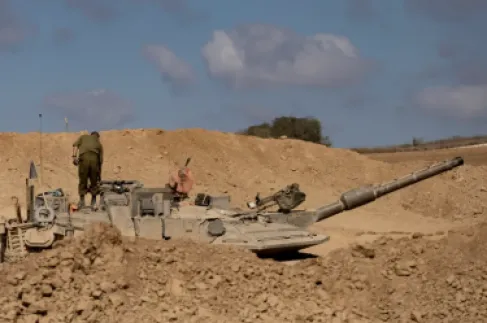
The Chief of Staff of the Israeli occupation forces, Eyal Zamir, had hinted at this approach in previous statements when he spoke in front of soldiers in the Gaza Strip weeks ago, considering that the yellow line represents a new border line and advanced defense line for the settlements, and at the same time, an attack line.
He explained that it is no longer just a theoretical demarcation on maps, but it has turned into a new security doctrine that redefines the borders between Israel and Gaza and the way the occupation army prepares for the post-war phase.
In contrast, this proposal directly conflicts with the second phase of the plan proposed by US President Donald Trump, which calls for the withdrawal of Israeli occupation forces eastward and returning to the current boundary line.
Israeli-Arab diplomatic confrontation to counter the occupation's directions Israeli sources estimate the chances of this direction obtaining official Arab cover as extremely low, if not non-existent, given the wide-ranging political and security regional implications that may arise from it.