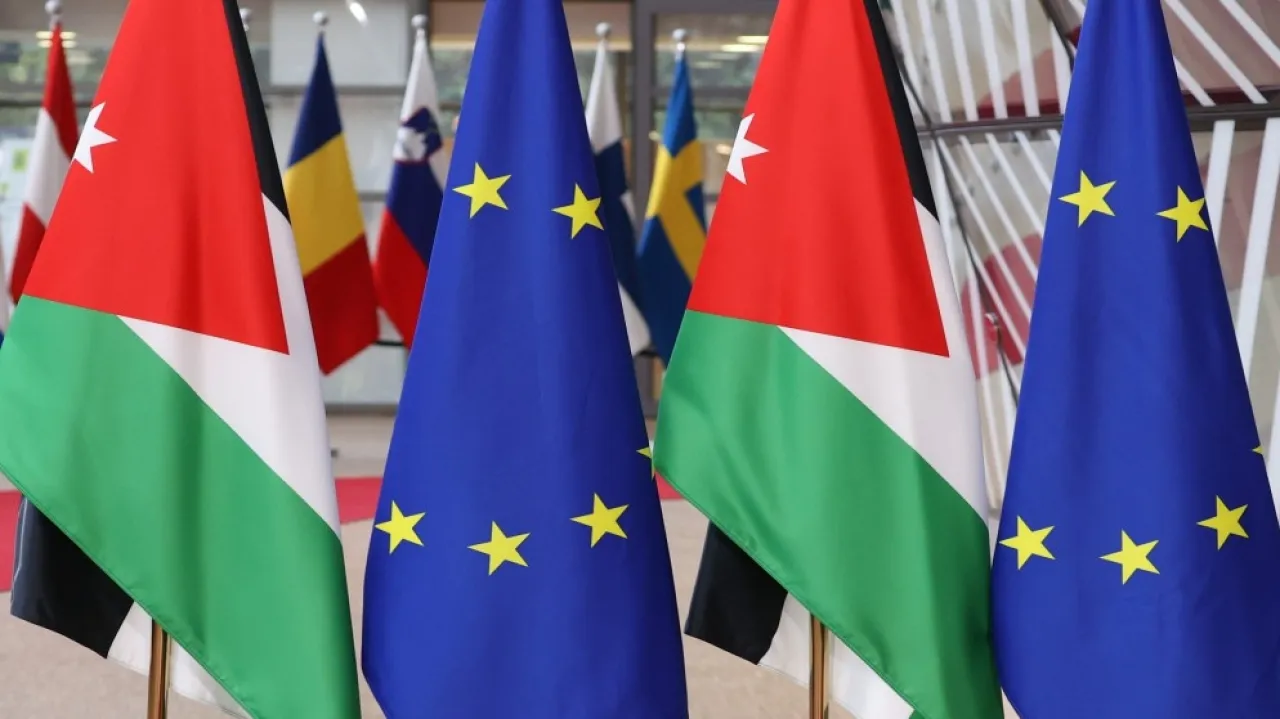
The European Parliament has approved a new total financial aid package for Jordan worth EUR 500 million, within the framework of the EU's Macro-Financial Assistance mechanism, aimed at supporting economic stability and enhancing the kingdom's ability to recover from the repercussions of regional tensions and unstable global economic conditions.
The approval was granted with an overwhelming majority, with 585 deputies voting in favor out of 664 deputies participating in the voting process within the European Parliament, with 45 deputies abstaining.
This vote constitutes the adoption of the European Parliament's position at first reading within the ordinary legislative procedure, with the draft now being referred to the Council of the European Union to adopt its stance, paving the way for completing the final legislative path and the entry into force of the aid decision officially after both parties' approval.
European Parliament President Roberta Metsola confirmed on Tuesday that enhancing support for Jordan contributes to reinforcing regional stability and enhancing Europe's shared security.
Metsola stated that the European Parliament's vote on Jordan's total financial assistance holds special significance as it supports the kingdom in advancing reforms and enhancing its economic resilience, considering it an investment in one of Europe's strategic partners.
This assistance is part of the European effort to support the Jordanian economy in covering its external financing needs amid escalating geopolitical pressures in the Middle East, according to a document observed by "Khaberni".
This package is the fifth; four previous MFA packages from the European Union have been executed since 2014, totaling EUR 1.58 billion, the latest of which was approved by the Parliament in April for the period 2025–2027.
The Commission in its proposal indicates that Jordan continued to implement the Economic Modernization Vision 2022–2033, and continued its close partnership with the International Monetary Fund through the Extended Fund Facility worth USD 1.2 billion for the period 2024–2027, which achieved positive reviews until April 2025, besides benefiting from new financing worth USD 700 million through the Resilience and Sustainability Facility.
In January 2025, the European Union and Jordan agreed to launch a comprehensive and strategic partnership, based on aspects that include politics, regional cooperation, security and defense, economic resilience, trade and investment, human capital development, migration, and refugee protection. The new aid is part of the financial package supporting this partnership.
The Jordanian government formally requested this additional assistance in January 2025, explaining that regional developments, particularly tensions between Israel and Iran and the accompanying closure of airspace and suspension of flights, contributed to deepening economic uncertainty and decline in tourism and investment, in addition to weak exports and a decline in domestic consumption and government revenues.
The proposal document, seen by "Khaberni", points out that ongoing tensions in the Middle East due to the Gaza war, the situation in Lebanon, the fall of Assad's regime in Syria, and escalation between Israel and Iran, had negative repercussions on the Jordanian economy.
It explained that these factors reflected on tourism, trade, and investor confidence, as economic growth reached about 2.5% in 2024, while inflation remained below 2% due to decreasing import prices and stringent monetary policy linked to the exchange rate pegged to the U.S. dollar.
The proposal document elucidates that Jordan "still faces deep structural challenges, including a high unemployment rate at 21.4%, with higher levels among youth and women, and low labor force participation."
Despite government measures to raise revenues and control expenditures, the budget deficit increased to 5.6% of GDP in 2024, while public debt reached 90.4% of the gross domestic product excluding social security debts, and the current account deficit widened to about 6% of the GDP due to declining exports and tourism revenues.
The new aid includes providing EUR 500 million entirely as concessional and long-term loans, to be disbursed in three installments over a period extending up to two and a half years from the date the memorandum of understanding enters into effect.
The disbursement process will depend on Jordan's commitment to implementing a robust program with the International Monetary Fund, and delivering an agreed-upon reform package covering public finance management, revenue mobilization, labor market policies, governance, energy and utilities, and improving the business environment.
The proposal document affirms that this assistance forms part of the European Union's policy to support economic stability and enhance Jordan's ability to continue reforms, within the framework of a long-term political and economic partnership between the two sides. It also contributes to supporting the Kingdom's efforts to address the repercussions of regional crises and enhance its capability to maintain its financial and economic stability during the upcoming stage.