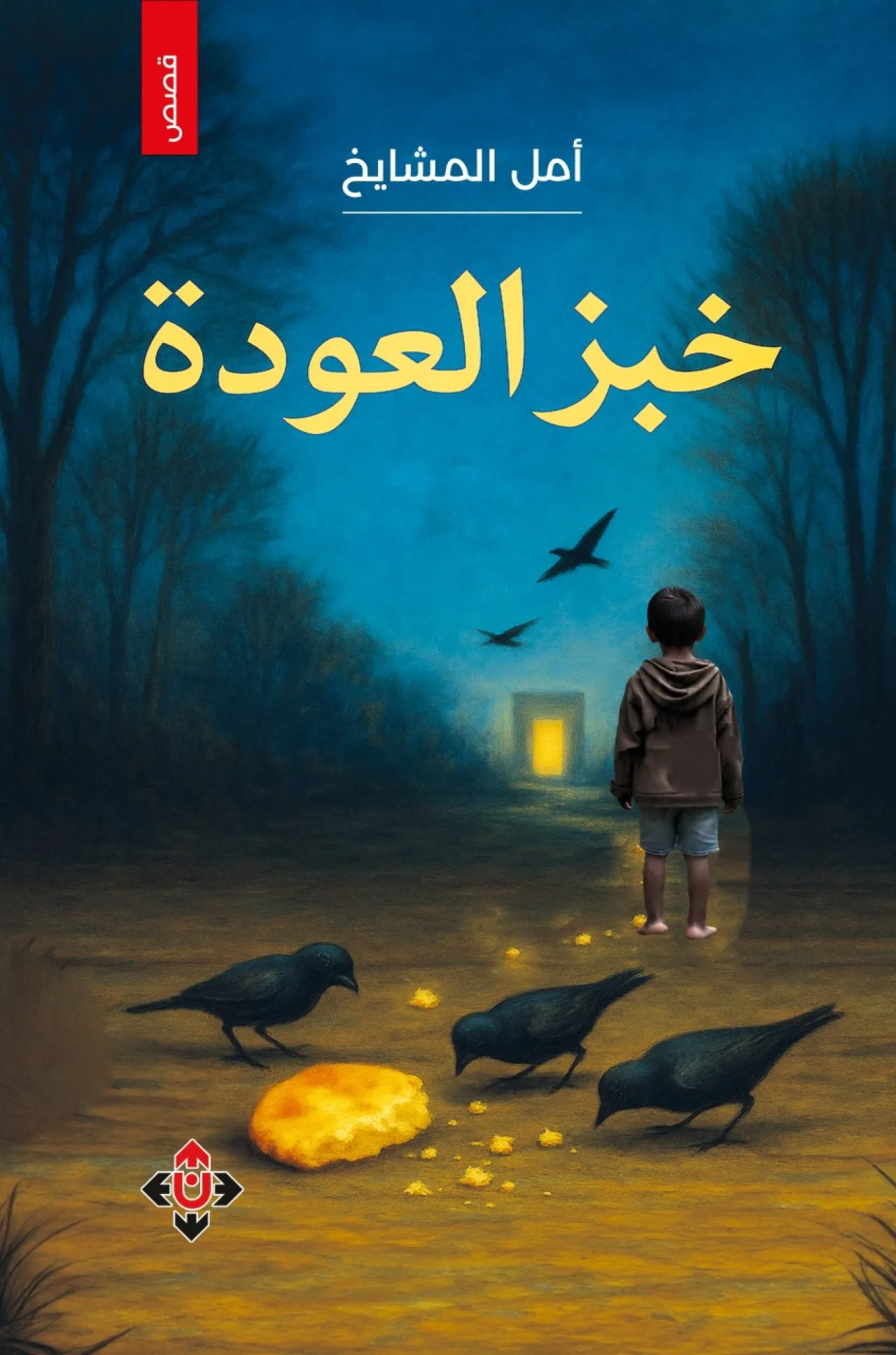
Khaberni - The stories of "Bread of Return" by the Jordanian writer Amal Al-Mashaikh blend reality and fiction, offering the reader an intense experience that speaks to the soul, leaves a mark in the memory, and talks about humans with their joys, disappointments, successes, and losses. Weaving a fine thread that brings people back to their first homes and the places where they grew up.
The recently published collection by (Now Publishers and Distributors) consists of very short texts written with poetic spirit and human depth that touches on daily life details and illuminates the darkness in the contemporary social and human scene, leaning on mythological and folk symbols; as the writer resurrects the tale of the bread that guides people back, transforming it into a major metaphor for loss, search for refuge, and the need for a thread leading one to the meaning of their first home; the homeland, memory, and the grand human embrace.
Despite the variety of story themes, they are connected by a single human thread, which is the deep desire to recover meaning, return to the self, and seek what can gather the fragments of the soul in a fast and fluctuating world. The texts are also characterized by their economical use of language, paradox, astonishment, illuminating capture, and intensification of human moments, smoothly and skillfully transitioning from one scene to another.
The texts of (Bread of Return) reveal the writer's ability to intensify scenes and endow them with suggestive energy, marked by short sentences charged with emotions, and phrases that open up a vast space for interpretation. The stories range from a realistic narrative that smartly captures irony, to another leaning towards fantasy, symbolism, and metaphor, without losing the warmth of the experience and the pulse of daily issues that the writer turns into inspiring points in the human experience in general.
In the story "Please Do Not Disturb", the writer reimagines the relationship between the living and the dead, where roles are reversed in a fantasy scene where the dead wake up to visit their relatives, carrying sweets and cakes, before the cold, yellow city returns their spirits to the silence of their graves, and here the author's ability to use imagination to expose realities' paradoxes and reveal its harshness is evident.
In the story "3D", it presents an adventure inspired by virtual reality games and experiences, but it unveils a deep human fear in confronting death and the unknown, intertwining images of nature and threats and strange creatures in an experience between dream and reality.
Family and human relationships, and transformations of values, are present in many stories: in the story "Dinner", the writer humorously shows how family members gather at one table while each resides in a separate virtual world; in the story "Consolation", the women’s conversation about the deceased shifts to topics of costliness, loans, and prices, while the bereaved mother alone listens to the holy verse being recited for her son’s soul; here, the writer reveals the fragility of the relationship between what we show socially and what we truly experience.
In the story "Hunger", two contrasting images of children in distant worlds coexist: one asking about the 'prize' after having dinner twice in a neat neighborhood, and the other in a refugee camp is asked to leave some food for his baby brother. Through this contrast, the author confronts the reader with the truth of the widening social gap, using simple and shocking language.
Many stories in the collection are based on existential and philosophical symbols, delving into questions of the human psyche and the meaning of the road, choice, and human anxiety, while other texts touch the aesthetics of nature, reinterpreting it as a mirror of human emotion.