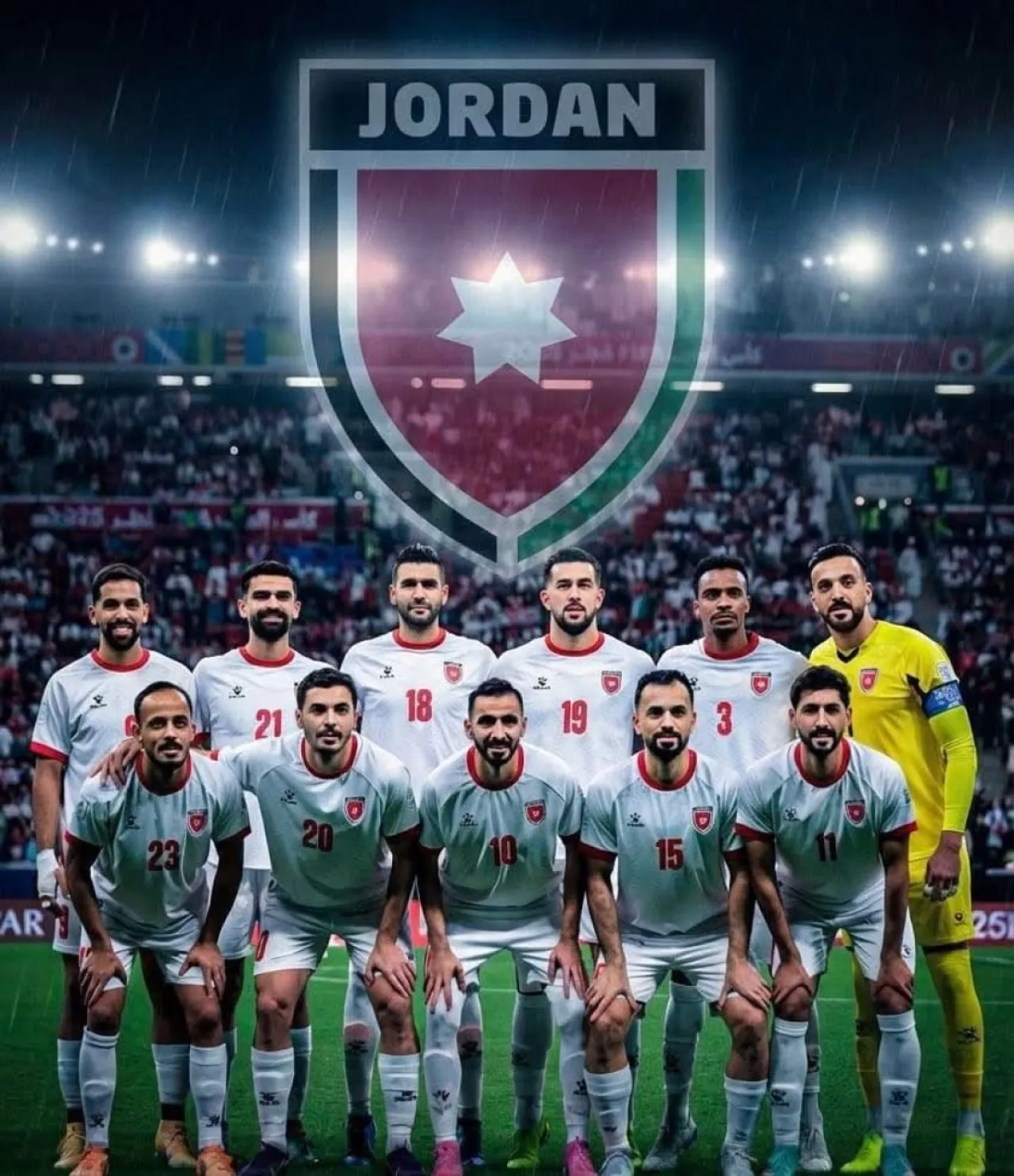
Economic experts have confirmed that the presence of the Nashama team in the World Cup finals represents a real engine and an opportunity for economic growth, job creation, and attracting quality investments.
They told the Jordan News Agency (Petra) that international experiences have shown that countries that have succeeded in turning the sports momentum into economic returns did not rely solely on the event itself, but attracted global attention and transformed it into tourist and investment demand.
Dr. Hamza Al-Akkalik, an expert in digital transformation governance and data privacy, said that the moment the Nashama stand face-to-face with football giants like Argentina, the world will see not just 11 players on the field, but the Jordanian national identity being processed through millions of algorithms across continents.
He pointed out that this event is a digital hurricane and a major economic platform that requires us to shift from a fan mindset to a digital investor mindset, noting that we are facing a historic opportunity to turn Jordan into a live lab for exporting expertise and content, supported by the fact that we have more than 10,000 graduates annually in technology and artificial intelligence fields, representing the new oil waiting to contribute to the national income.
He added: in the 21st-century economy, attention is the most expensive commodity, and Jordan's presence in a group that includes Argentina means that the name of the kingdom will resonate in billions of search operations. Here lays the role of data governance; the goal is not just to spread traditional tourist pictures but to build a national system that serves as a data refinery to analyze global fan behavior. Using sentiment analysis technologies and artificial intelligence, we can understand what piques the curiosity of Latin or European fans towards Jordan, and then direct social media algorithms to provide highly customized content that turns this curiosity into cash flows through digital tourism or e-commerce.
To convert this momentum into sustainable national income, Al-Akkalik explained that we must immediately move according to an executive action plan based on establishing the ‘Immersive Content Excellence Center’, by assembling artificial intelligence and augmented reality graduates to produce digital experiences that allow the global fan to tour Petra, Jerash, and Umm Qais from their room. These experiences are not just videos; they are interactive platforms that allow purchasing digital rights to heritage pieces or booking smart tourism trips, generating direct and sustainable revenues.
Al-Akkalik called for the development of a cross-border cultural trade platform, by linking the national identity with a digital supply chain, where a fan impressed by the Jordanian culture during the World Cup can acquire Jordanian handmade or technological products at the click of a button, supported with smart logistics and advanced digital payment solutions.
In turn, Abdurrahman Al-Husami, CEO of ‘Makana 360’, said that Jordan's presence in the World Cup could be transformed into national economic income when treated as a national economic opportunity, not just a fleeting sports event. The World Cup puts Jordan on a global platform that generates ‘demand’: demand for visiting Jordan, following its sports story, and dealing with it as a stable environment conducive to business and investment.
He referred to the company's latest report, which showed clear indicators of this demand over a short period; Jordan's digital and media presence from December 1–10 of this year recorded 588.3 thousand conversations, an increase of 66 percent over the previous period, and the engagement with content involving Jordan reached 27.8 million interactions, an increase of 89 percent. The number of media articles about Jordan reached 76.5 thousand, up by 64 percent, with media reach increasing by 73 percent compared to the previous reference period.
Regarding translating our presence in the World Cup into national income, Al-Husami detailed that in terms of tourism, the global interest can be translated into direct revenues through targeted marketing campaigns during peaks of interest, linking them with specific travel offers and easy booking paths, and presenting Jordan as a nearby, safe, and rich in experiences destination.
He indicated that knowledge interest indicators show the existence of actual international curiosity that can be converted into visits; the Jordan page on Wikipedia garnered 40118 visits during December 1–10, which is about 20 percent higher than the usual weekly average, noting that the success of this approach would increase visitor numbers, hotel occupancy, and activate restaurants, transportation, and services sectors, which are employment-rich sectors and accommodate broad job opportunities for youth.
He highlighted that football became the prominent driver of Jordan's digital image during the week of the draw; 76 percent of the interaction involving Jordan was related to football, with football-related interest rising by more than 530 percent during the same period.
Visual platform monitoring indicators recorded a significant increase, as searches on YouTube for content about the Jordanian team’s victories in the Arab Cup increased by more than fifty times, showing that this system generates direct income and jobs in sports marketing, content production, event management, e-commerce, and associated supply chains.
The attention to Jordan is no longer confined to the Arab region; conversations in Spanish and Portuguese accounted for approximately 15.7 percent, with a 5400 percent jump within one week, French conversations increased by 990 percent, while English conversations accounted for about 14.7 percent, up by 87 percent. This shows entry into new markets and audiences that can be economically engaged in appropriate languages and suitable content.
Meanwhile, manager of the National Academy for Tourism and Aviation, and expert in tourism sustainability and honorary professor at the University of Malaga, Dr. Mahmoud Al-Duwairi, said that Jordan's presence in the World Cup represents a rare national economic asset if well invested within a clear institutional framework, consistent with the Economic Modernization Vision 2023–2033, which places increasing national income, job creation, and attracting investments at the top of its priorities.
Dr. Al-Duwairi said: For Jordan, with tourism revenues nearing 6 billion dinars annually, investing in the World Cup presence as part of a smart national campaign could realistically achieve an increase ranging between 2 to 5 percent annually, which equates to 105 to 263 million additional dinars in GDP, without needing huge capital investments, but through improving conversion from viewing to visiting and booking.
He noted that this growth directly reflects on employment in the tourism sector, since the sector currently employs about 55,856 direct workers inside tourism establishments, and more than 290 thousand supported jobs along the value chain. Therefore, a 5 percent increase in revenues can generate about 4 thousand new direct job opportunities and more than 12 thousand indirect job opportunities in logistics services, effectively contributing to reducing unemployment rates, especially among youth.
On his part, Ibrahim Al-Hawarin, Professor of Economic Development and Labor Markets at the Department of Economics in Al-Hussein Bin Talal Business School, mentioned that Jordan, being a first-time participant in the World Cup, is expected to garner special attention, as it is in a group that includes the reigning world champion, the Argentine team led by football legend Lionel Messi. He noted that attention has already begun to manifest clearly through search engines like Google, which have seen a significant increase in searches for information related to Jordan.
Regarding how to employ this global event's growing interest for creating sustainable economic impact that drives economic growth and employment in the kingdom, he mentioned that one of the economic growth engines in the Economic Modernization Vision is transforming it into a distinguished global destination, through tourism or tv and film production.
From this standpoint, the private sector working in tourism can greatly contribute to enhancing the national economy by employing its skills in tourism marketing during this event, which will attract more tourists and increase tourism demand, positively reflecting on tourism revenues and total expenditure in the kingdom, thereby providing direct job opportunities in this sector and indirectly affecting employment positively in other sectors.
Al-Hawarin added: Promotion should not only include archaeological sites such as Petra, but also medical, religious, and conference tourism.
He explained that the World Cup also presents an important opportunity to promote Jordan as a significant location in the film industry, especially in cooperation with producers in the U.S. film industry. Jordan possesses diverse tourist locations and outstanding artistic facilities, along with qualified human resources capable of offering competitive priced film production services.
He added that public and private sectors could collaborate with film producers to establish long-term agreements that enhance Jordan's position as a main site for cinema production, in addition to stimulating the sports sector in Jordan and increasing its returns.