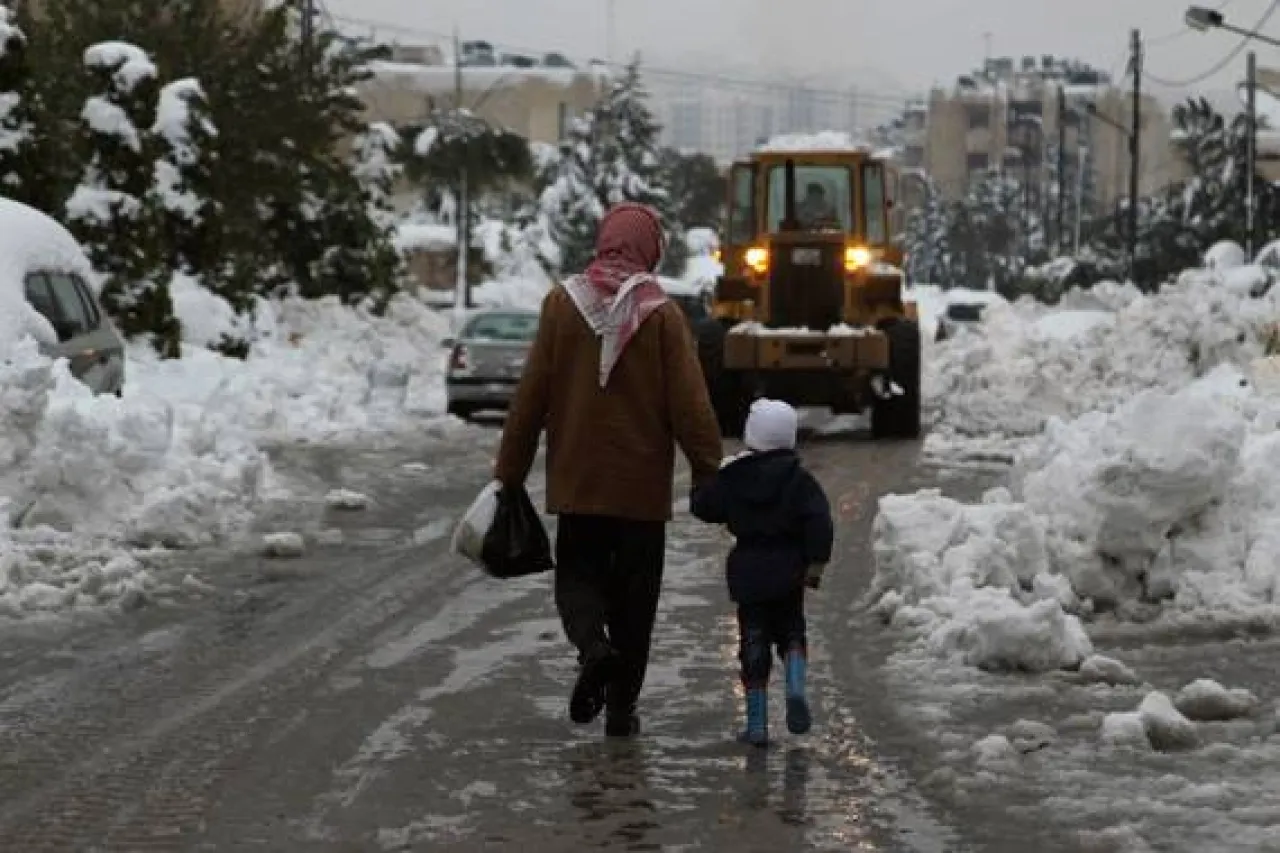
The astronomical winter season begins in the northern half of the globe tomorrow, Sunday, with the occurrence of the winter solstice around six in the evening by the kingdom's time.
This day is characterized by the shortest day and the longest night of the year, where the length of the day in Amman and its suburbs is only about 10 hours and 3 minutes.
Jordanian astronomical sources mentioned that the astronomical winter lasts for about 89 days, ending with the vernal equinox on March 20, 2026, while the forty days of winter start from the day of the solstice, followed by the fifty days of winter lasting 50 days and divided into 4 "astronomical seasons."
Specialists attributed the succession of seasons to the tilt of the Earth's rotational axis by 23.5 degrees, which leads to a difference in the angle of incidence of the sun's rays on the Earth's regions during its apparent annual journey on the ecliptic.
The president of the Jordanian Astronomical Society, Dr. Ammar Al-Sakaji said: The moment of the winter solstice for the northern half of the globe this year will occur around six in the evening tomorrow, Sunday, by Jordan's time.
He added, "At this moment, the sun is perpendicular to the Tropic of Capricorn, reaching its lowest elevation in the sky during the year, which results in recording the longest shadow for objects at noon, and this event marks the beginning of the astronomical winter, where the hours of the night are the longest and the daytime hours are the shortest throughout the year."
The astronomical winter lasts 88 days, 23 hours, and 42 minutes, ending with the vernal equinox which will be at 5:45 PM on March 20, 2026 (by Jordan's time), while the southern half of the globe experiences the summer solstice during the same period.
He said that for Amman and its suburbs, the length of the day on the winter solstice will be about 10 hours and 3 minutes, and the astronomical midnight occurs at about 12:34 after midnight Sunday to Monday (21/22-12), which is the darkest time astronomically for the day of the winter solstice, after which the length of the day gradually increases until the vernal equinox, when night and day are roughly equal.
He pointed out that from a weather perspective, the forty days of winter begin with the day of the winter solstice and last about 40 days, followed by the fifty days of winter that extend 50 days, and are divided into 4 parts known as the "seasons": Saad Al-Dhahab, Saad Baladh, Saad Alsaud, and Saad Al-Khabia, where the duration of each is about 12.5 days.
He confirmed that determining the timing of these seasons depends on the "stellar calendar," for example, Saad Al-Dhahab starts on the first Saturday of next February, with the appearance of the star Beta Capricorn known as "Dabhah", and it is about 8 degrees high at the moment of sunrise, indicating that the Jordanian Astronomical Society observed and photographed the star of Saad Al-Dhahab and the rest of the Saad stars during the past year.
To illustrate the effect of the winter and summer solstices, a simple experiment can be conducted by observing the length of the shadow at noon; on the day of the winter solstice, the shadow is the longest of the year, while the shadow is the shortest on the day of the summer solstice at noon.
The Sakaji said, meteorologists use a different definition of the seasons, with winter beginning on December 1 and ending at the end of February, for climate and statistical purposes.
For his part, the director of scientific affairs and training at the regional center for teaching space science and technology for Western Asia, Dr. Hanna Sabat, explained that the reason for the four seasons is due to the difference in the inclination of the sun's rays falling on the Earth, depending on its position in its orbit, which in turn is due to the tilt of the Earth's rotational axis by about 23.5 degrees away from the perpendicular to its orbital plane.
He added that if this rotational axis were completely perpendicular to the orbital plane, the sun's rays would fall perpendicular to the Earth's equator throughout the year, and at the same time, the inclination of its rays would increase by moving north or south of the equator, i.e., we would obtain fixed climatic regions throughout the year with no seasonal changes.
He added that the vernal equinox starts in the northern half of the globe around March 21 each year, where the sun is perpendicular to the equator, and the summer solstice occurs around June 22, where the sun's rays are perpendicular to the Tropic of Cancer (latitude 23.5 north).
He stated that the autumnal equinox starts around September 23, where the sun's rays are perpendicular to the equator again, and finally, the winter solstice occurs around December 21, where the sun's rays are perpendicular to the Tropic of Capricorn (latitude 23.5 south), noting that the exact opposite occurs in the southern half of the globe.
He continued that as a result of the Earth's orbital movement, the sun apparently moves on the celestial dome – relative to an Earth observer – at a rate of about one degree per day towards the west, and this apparent path of the sun is called the "ecliptic" or "zodiac" – and the star groups lying on the ecliptic are called the zodiac, where the sun apparently completes a full cycle on the ecliptic during a complete year (called the tropical year, which is about 365.242 days), and the ecliptic is inclined to the celestial equator by about 23.5 degrees as a result of the tilt of the Earth's rotational axis, and the two circles intersect at two points, which are the equinox points.
Sabat pointed out that the sun is at its lowest point below the celestial equator on the day of the winter solstice, and as a result, the inclination of the sun's rays falling on the northern half of the globe is significant, which reduces its heating; at the same time, the sun's path in the sky during the day is short in the northern part of the Earth, meaning that the length of the day is also short.
For his part, a member of the Jordanian Astronomical Society and interested in meteorology and astronomical heritage, Ibrahim Al-Dajah said that the stellar calendar (anwa) is one of the oldest astronomical knowledge among Arabs, as they relied on it in understanding the succession of seasons, forecasting weather conditions and determining the seasons of agriculture, grazing, and travel.
Among its most prominent stars in the winter season (the fifty days of winter: the four seasons) are stars whose rising is associated with clear and consecutive climatic changes; for Saad Al-Dhahab indicates the intensity of the cold and its severity, followed by Saad Baladh indicating the beginning of beneficial rains that the earth absorbs, then Saad Alsaud heralding the breaking of the cold and the beginning of moderation and plant growth, while Saad Al-Khabiya carries signs of gradually rising temperatures and the approaching features of spring.
He added: Nowadays, anwa is not viewed as scientifically accurate forecasting in the modern sense, but as cultural and cognitive heritage formed through long observations that lasted for centuries, reflecting the deep connection of the Arab man with the sky and nature, and this heritage is still present in popular proverbs and environmental memory, witnessing the wisdom of ancestors in reading the stars and deriving their indications in their daily lives.
He continued: Based on this interest, we will this year observe and photograph these stars as we have been following and documenting them every year, contributing to preserving this heritage and enhancing it with modern knowledge and observation.