Many reasons granted Morocco the supremacy over Jordan in a thrilling, competitive, and tactical final of the Arab Cup 2025, which concluded yesterday, Thursday, in Qatar.
The final was perfect for football fans, whether Moroccan or Jordanian, and was enjoyed by the neutral fans, acting as an open culinary feast of football that included everything without the audience having to ask for it:
More than 84,000 in the Lusail Stadium.
Competition in the stands between the fans of the two teams in a magical cold atmosphere.
A tactical showdown between the coaches from the sidelines.
A physical and football battle with fierceness and a desire to win on the green field.
A global finale for a tournament that now rivals the most important sports competitions in the world.
Reasons for Morocco's win over Jordan in the Arab Cup final
The match was supposed to have a closed nature, with an extensive feeling-out period between two teams coached by Moroccan coaches from the same footballing school, but the global goal scored by Oussama Tannane from beyond the midfield in the fourth minute of the game changed the equations, shocking the Moroccan Jamal Sellami, coach of Jordan, and the shock continued throughout the first half.
In this half, Tarik Sektioui dominated both performance and result, controlling the midfield thanks to Tannane and Amin Zouhou and Mohamed Hririmate (best player of the tournament) with offensive support from Karim Barkaoui and Walid Azarou.
Sektioui controlled the first half as he wished, with Sellami surrendering amidst the absence of the spirit and tactical discipline typically associated with "Al-Nashama" until the half ended with a 1-0 lead for "The Atlas Lions".
In the second half, as if the Jordan team had changed and another team took its place, Sellami began recovering his tactical health by involving Oday Al-Fakhouri and Adham Al-Quraishi, bringing back the spirit, strength, and desire to win to Jordan. They started attacking the Moroccan team fiercely, resulting in two goals scored by Ali Alwan (top scorer of the Arab Cup): the first three minutes into the second half, and the second from a penalty kick in the 68th minute, all while Sektioui was stunned by the technical and tactical transformations presented by his fellow countryman and brother friend Sellami, who swept the second half in performance, result, and tactics.
Since the coaches know each other well, and giving up is not in the dictionary of "the friends", Sektioui responded by involving his striking force from the bench, represented in the veteran and dangerous scorer Abderrazak Hamdallah after his team conceded the second goal.
In addition to Hamdallah, Sektioui deployed all his weaponry represented in Saber Bougrine and Munir El Haddadi, to provide the added value and to affirm the Moroccan coach's consistent ability to change the course of the game with his substitutions and their timing.
As usual, Hamdallah did not disappoint Sektioui's trust in him; while celebrations and "Dabkeh" were resounding in the stands of "Al-Nashama", Hamdallah sneaked behind the lines of the Jordanian team to capitalize on a rebounded ball from the Jordanian goalkeeper, scoring the tying goal just 3 minutes before the end of the match, amid shock from the coach, players, technical staff, and the Jordanian fans, and despite attempts by both sides—including a dangerous ball and a one-on-one situation that Ali Alwan faced, brilliantly saved by the Moroccan goalkeeper Benabid—the Swedish referee Glenn Nyberg was quicker than all to announce the end of regular time.
Overtime smiled at Morocco
Three minutes into the first half of overtime, Mohannad Abu Taher scored a sensational goal that would have competed with the Moroccan Tannane's goal, but the referee disallowed it for a handball on Abu Taher, turning this cancellation into a turning point, with control shifting to Morocco whose players maintained their focus and played with their experience, outmatching their Jordanian counterparts.
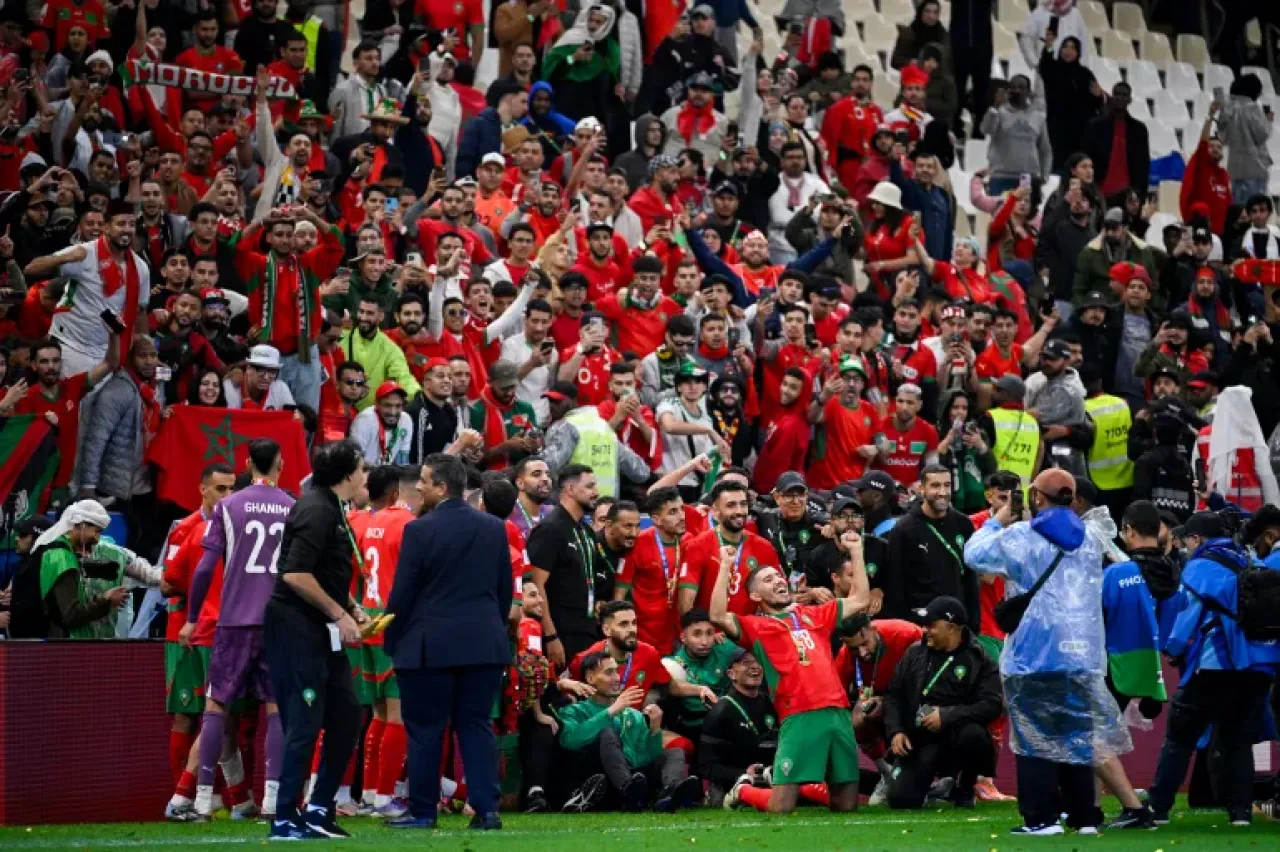
In the 100th minute, from a set piece—which also yielded the second goal for Morocco—veteran Hamdallah capitalized on poor organization by the Jordan defense and scored the third goal, exploding the stands of Lusail Stadium with phenomenal Moroccan joy.
The remaining five minutes of the first extra half, and the second extra half, witnessed no dangerous attacks due to the hastiness of the Jordanian players against the concentration and calm of the Moroccan players, who succeeded in maintaining the score and securing their second title in the history of the Arab Cup.
Controversial refereeing instances
The Swedish referee Nyberg managed the game well, but his problem was poor positioning and excessive reliance on the "VAR" technology, even in decisions that were clear and close to him, he was not decisive, instead always waiting for assistance from the "VAR", according to arbitration experts who counted 5 notable refereeing instances considered controversial:
The penalty that led to Jordan's lead after a handball call on Achraf Mahdoui (correct decision by the referee)
The second goal by Hamdallah which the referee initially disallowed for offside, then confirmed by VAR (correct decision)
A penalty called for Morocco after a foul on Hamdallah which was not awarded by the referee because it was preceded by an offside (correct decision by the referee)
A goal disallowed by "VAR" for Jordan scored by Mohannad Abu Taher due to a handball before scoring the goal (the decision is correct, as the handball rule—after revision—counts any hand touch followed by a scored goal as a mistake)
A foul not given to Jordanian defender Abdullah Naseeb after a reckless play by one of the Moroccan attackers, but the referee did not only fail to call the foul, but also forced Naseeb—according to new instructions—to stay off the pitch for two minutes during which the third goal for Morocco occurred.