Khaberni - Omar Souleyman is one of the most prominent Syrian artists who have managed to transfer folk music from its local environment to the international arena, and despite that, his name is not sufficiently notable in the Arab world.
Let's get to know the Syrian singer Omar Souleyman, who started his career as a simple worker, before launching into global fame.
The humble beginnings in the heart of Al-Hasakah
Omar Souleyman began his artistic journey at the age of seven when he sang traditional dabke songs in his town "Ras al-Ain" in Al-Hasakah province.
The Syrian artist worked in construction to support himself while music was a side passion he practiced in his spare time, not realizing that this passion would later transform him into a global music icon.
The real turning point came in 1994 when he performed his first official wedding concert, after which he found himself overwhelmed with consecutive invitations.
Souleyman remembers that period, stating in his circulated statements, that after the first five concerts he realized that his schedule was completely full, and he no longer had any free time during the week, month, or even the year, as each concert led to new invitations, thus spreading his fame like wildfire across villages and cities of Syria.
The magic of mixed music and frenetic rhythm
Souleyman's musical style is distinguished by being an exceptional mix that reflects the cultural diversity of his region, where Arab, Kurdish, Turkish, and Assyrian communities coexist.
The artist narrates that he used to sing for all these communities in their distinct musical styles, mimicking their traditional singing and blending it with his personal style, adding flavors from Iraqi Choubi and Kurdish music to the authentic Syrian dabke.
The radical transformation occurred when he swapped traditional instruments with a Yamaha electronic keyboard and digital percussion, freeing his music from the physical constraints of traditional playing, and it began to accelerate year after year until it reached the frenetic rhythm that characterizes it today.
Souleyman describes this fast music as "a kind of sport that makes you move," resembling any sport requiring jumping and running, and the audience dances more enthusiastically to the fast music.
More than 500 albums
Omar Souleyman recorded over 500 cassette tapes of his live performances at wedding parties, presenting each recording as a gift to the bride and groom, akin to "a sound photo album of their happy day."
However, these tapes were not confined to the homes of the married couples, but were copied in large numbers and distributed in music shops across the region, turning Souleyman into a folk star without any official media support or major production companies.
Some of his songs extend over 30 minutes in their full versions, and sometimes reach a full hour of continuous performance, where complex electronic melodies intertwine with romantic, sad lyrics, while Souleyman collaborates with talented poets who write verses for him in seconds during live performances, providing Souleyman with new, immediate lyrics throughout the show.
The Western discovery: From Damascus to Brooklyn
The dramatic shift occurred in 2006 when American musician Mark Gerges visited Damascus and heard a tape of Souleyman emanating from a stall in the market.
He was amazed by what he heard, bought large quantities of the Syrian artist's tapes, and began compiling his best songs on behalf of the company "Sublime Frequencies" in Seattle, which describes itself as "a group of explorers dedicated to acquiring and displaying the mysterious sights and sounds from modern and traditional urban and rural frontiers."
The company released four compilation albums of his work with local titles such as "Nights of the Island" and "The Road to Al-Hasakah," introducing the Western audience to this strange sound from northeast Syria.
Omar Souleyman started his Western career by performing small venues in London, then progressed to major festivals where he performed at legendary festivals like Glastonbury and the Pitchfork Festival in Paris, and the CMJ show in New York.
International collaborations: From Björk to Gorillaz
Souleyman collaborated with Icelandic singer Björk on a remix for her Biophilia project in 2011, but it wasn't as many would imagine - the two artists never met, and the music was mixed in the studio without Souleyman having much say in the production process or even in determining the profits he would earn from album sales.
British musician Kieran Hebden, known as Four Tet, produced Souleyman's first studio album titled "Wenu Wenu" in 2013, which was released by "Domino Record," the same company that contracts with bands like Arctic Monkeys.
The album maintained the authentic sound that Souleyman had spent years refining, with only an improvement in production quality.
His second album "Bahdeni Nami" was released in 2015, featuring collaborations with German duo Modeselektor, BBC broadcaster Gilles Peterson and a remix by Cole Alexander of Black Lips.
Most recently, he collaborated with British band Gorillaz and American singer Yasiin Bey on the song "Damascus" recorded between London, Mumbai, New York, and Damascus, and it will be part of the band's ninth album The Mountain scheduled for release in February 2026, while the song garnered nearly a million views within 72 hours of its release.
The Arab neglect and cultural elitism
Despite his dazzling Western success, the major Arab media have almost completely ignored Souleyman until 2013.
The artist expressed his bitterness about this neglect, saying that he is happy with Western coverage but the Arab and Syrian media have failed to offer anything for him.
According to media reports, the urban elite in Damascus and Aleppo regard Souleyman's music as the opposite of "modernity" and high culture, associating it in their minds with the remote Jazeera region and communities of migrant workers.
When the rare Syrian newspapers published about him, the headlines were like "The Syrian Jazeera singer Omar Souleyman garners significant interest in many European countries," noting that "many in Syria have not heard of him," puis just translate what European blogs have written about him.
Souleyman also previously referred to the absence of copyright laws that make it difficult for folk and traditional music artists to claim ownership of their music and receive the recognition they deserve.
The Syrian War: Pain and Exile
The Syrian civil war forced Souleyman to leave his town of Ras al-Ain, which became uninhabitable after battles between Kurdish separatists, the Syrian army, and opposition forces.
He faced a terrifying displacement journey from Beirut to Turkey through Syria, where he had to dodge bandits and taxis loaded with bodies, while bombs exploded around him and bursts of machine gun fire filled the air as he rushed to catch a flight for a concert in America.
The artist settled in the city of Şanlıurfa in southeastern Turkey with about 3.6 million other Syrian refugees, and there he opened a free bakery serving needy Syrian and Turkish families.
During this period, Souleyman sadly said: "All I want is for the war to stop and for everyone to return to their normal lives. When I see hungry people or dead, it saddens me, sometimes I no longer feel like singing."
Sadly, during his stay there, Turkish authorities arrested the artist in November 2021 on charges related to alleged membership in the banned Kurdistan Workers Party, as officers raided his house in Şanlıurfa and took him for interrogation, before releasing him just two days later.
Western misunderstanding and problematic descriptions
Throughout his career, Souleyman in the West faced problematic descriptions of his music, where some critics described it as "Jihad Techno," a description that completely shocked him when he learned of it.
The artist affirmed that all his songs are about love, and he does not sing anything political, let alone jihad, as his lyrics carry romantic poetic images such as "You are like a tall hill, the more I climb it, the more I count my steps" and "My little heart struggles because of your love."
After the outbreak of the Syrian war, critics and journalists associated his music with the Syrian tragedy in forced ways, becoming "a wedding singer from drought-stricken and war-torn Syria," and his religious and ethnic identity as a "Sunni Arab" became worthy of mention in music reviews.
When Souleyman insisted that his new songs were about love and not about war, one critic interpreted his denial as evidence that "the topic of war makes Souleyman a little tense."
Personality coldness and music warmth
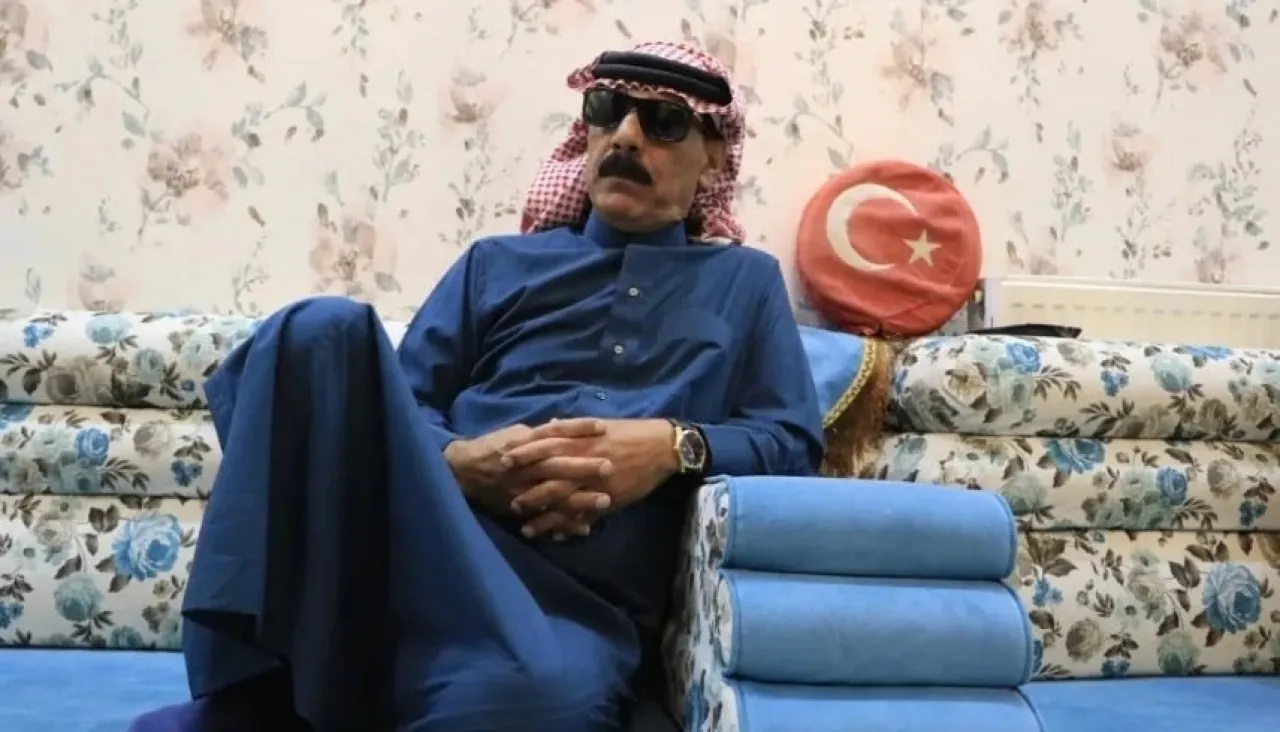
Omar Souleyman often appeared in his interviews wearing his dark sunglasses, his red checkered keffiyeh, and white robe, smoking one cigarette after another with complete calm.
When asked about his collaboration with artists like Four Tet and Björk, he simply answered: "You know, it's work" and about his favorite artist to collaborate with? He answers: "My keyboard player."
His coldness and easy demeanor, embodied by sitting on a white Swedish sofa in an apartment in the most sophisticated neighborhood of Williamsburg, New York, formed a perfect contrast with the wild undulations of his music.
He continued to behave and perform as if he were still in a wedding hall in the deserts of northern Syria, even when he was on stage in front of a crowd of young people.
When asked about the type of Western music he likes, in an interview in 2013 he answered for the first time in English instead of Arabic with one word: "slow," then added: "I like anything slow." It's an answer that sums up the personality of a man standing in the heart of a musical hurricane of his own making, yet retaining his inner calm and personal clarity.